Im vorherigen Teil des Artikels haben wir eine Implementierung des einfachsten neuronalen Netzwerks in Form einer JS-Klasse geschrieben. Versuchen wir nun, ihr eine echte Aufgabe zu geben. Das Szenario sieht wie folgt aus: Der Benutzer zeichnet einen Smiley in einen bestimmten Block der Webseite, und unser neuronales Netzwerk versucht festzustellen, ob er traurig oder lustig ist. Lass uns anfangen.
Da wir unsere kleine Anwendung als Webseite implementieren und Layout und Stil den Rahmen unseres Themas sprengen, werden wir diese Punkte überspringen und uns eingehender mit der Programmierung befassen. Zuerst erstellen wir eine Seitenvorlage, platzieren Elemente darauf und verbinden ein Skript mit einer neuronalen Netzwerkklasse.
<!doctype html>
<html lang="en">
<head>
<meta charset="UTF-8">
<meta name="viewport"
content="width=device-width, user-scalable=no, initial-scale=1.0, maximum-scale=1.0, minimum-scale=1.0">
<meta http-equiv="X-UA-Compatible" content="ie=edge">
<script src="NeuralNetwork.js"></script>
<title>Sad Or Happy?</title>
</head>
<body>
<div id="wrapper">
<canvas width="400" height="400" id="paintField"></canvas>
<div id="controls">
<button class="control" id="happy"></button>
<button class="control" id="sad"></button>
<button class="control" id="clear">
Clear
</button>
<button class="control" id="train">
Train
</button>
<button class="control" disabled id="predict">
Predict
</button>
</div>
</div>
</body>
<style>
#wrapper {
width: 400px;
margin: 0 auto;
}
#paintField {
height: 400px;
width: 100%;
border: 1px solid black;
}
#controls {
display: grid;
grid-gap: 10px;
grid-template-columns: 1fr 1fr;
margin-top: 30px;
}
#clear, #train, #predict {
grid-column: 1 / -1;
}
.control {
font-size: 20px;
padding: 4px;
cursor: pointer;
}
</style>
<script>
</script>
</html>
Werfen wir einen kurzen Blick auf die Steuerelemente.
Die Leinwand mit der ID paintField ist eine 10 x 10-Leinwand mit jeweils 40 Pixel. Darauf zeichnet der Benutzer mit der Maus einen Smiley, um das Netzwerk zu trainieren oder Vorhersagen daraus zu treffen.
Schaltflächen mit der ID glücklich und traurig füllen den Datensatz für das Training des neuronalen Netzwerks. Der Benutzer zeichnete einen Smiley, drückte den entsprechenden Knopf, das Netzwerk erinnerte sich daran und wurde etwas schlauer.
Clear . , .
Train .
, , Predict . .
<script> .
const canvas = document.querySelector('#paintField');
const clearBtn = document.querySelector('#clear');
const sadBtn = document.querySelector('#sad');
const happyBtn = document.querySelector('#happy');
const trainBtn = document.querySelector('#train');
const predictBtn = document.querySelector('#predict');
const ctx = canvas.getContext('2d');
const paintField = new Array(100);
const trainData = [];
const NN = new Network(100, 2);
let mouseDown = false;
let happyCount = 0;
let sadCount = 0;
NN.learningRate = 0.8;
:
paintField - . 100 , .
trainData - .
NN - . 100 - paintField 2 . , , - .
, , learningRate .
.
function drawGrid() {
ctx.strokeStyle = '#CCC'
for (let i = 1; i < 10; i++) {
ctx.moveTo(0, i * 40);
ctx.lineTo(400, i * 40);
ctx.moveTo(i * 40, 0);
ctx.lineTo(i * 40, 400);
}
ctx.stroke();
}
function clearCanvas() {
ctx.fillStyle = '#FFF';
ctx.fillRect(0, 0, 400, 400);
drawGrid();
}
function drawSquare(row, column, color) {
ctx.fillStyle = color;
ctx.fillRect(column * 40 + 1, row * 40 + 1, 38, 38);
}
function draw(event) {
const rowIndex = Math.floor(event.offsetY / 40);
const columnIndex = Math.floor(event.offsetX / 40);
const arrayIndex = rowIndex * 10 + columnIndex;
paintField[arrayIndex] = 1;
const color = paintField[arrayIndex] ? 'green' : 'white';
drawSquare(rowIndex, columnIndex, color);
}
function clearField() {
paintField.fill(false);
clearCanvas(ctx)
}
function updateInterface() {
happyBtn.innerText = `=) ${happyCount}`;
sadBtn.innerText = `=( ${sadCount}`;
}
function storeResult(value) {
trainData.push([[...paintField], value]);
updateInterface()
}
drawGrid - .
clearCanvas - .
drawSquare - .
draw - , . , , .
clearField - .
updateInterface - , , .
storeResult - .
, , .
document.addEventListener('mousedown', (e) => {
mouseDown = true;
});
document.addEventListener('mouseup', (e) => {
mouseDown = false;
});
canvas.addEventListener('mousemove', (e) => {
if (!mouseDown) {
return;
}
draw(e);
});
clearBtn.addEventListener('click', () => {
clearField();
});
happyBtn.addEventListener('click', () => {
happyCount += 1;
storeResult([1, 0]);
clearField();
});
sadBtn.addEventListener('click', () => {
sadCount += 1;
storeResult([0, 1]);
clearField();
});
predictBtn.addEventListener('click', () => {
NN.input = [...paintField];
const [happiness, sadness] = NN.prediction;
alert(`I think it's a ${happiness > sadness ? 'happy' : 'sad'} face!\n
Happiness: ${Math.round(happiness * 100)}% Sadness: ${Math.round(sadness * 100)}%`);
});
trainBtn.addEventListener('click', () => {
NN.train(trainData, 1000).then(() => {
predictBtn.disabled = false;
alert('Trained!');
})
});
clearField();
updateInterface();
. . , , .
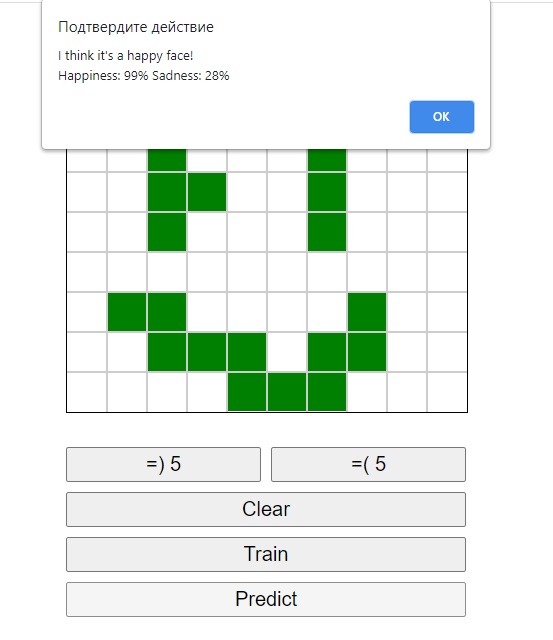
, - , - . , Train . ? ! Predict.
That’s all, Folks!
. , , . . .
.