Die Aufgabe bestand darin, die Niederlassungen mit dem Hauptsitz des Unternehmens zu vereinen, in dem sich der Serverraum befand. Fortigate 60E organisierte den Internetzugang und fungierte als Firewall in der Zentrale. In Zweigstellen fungierte es als Mikrotik für den Internetzugang verschiedener Modelle. Es war auch erforderlich, dynamisches OSPF-Routing zu konfigurieren und IPSec-VPN-Tunnel mit GRE einzurichten. Nachdem ich im Internet gestöbert hatte, fand ich einige verstreute Artikel über die Verbindung von Fortigate mit Microtic über IPsec VPN und GRE-Tunnel. Ich habe beschlossen, diese Informationen in einem meiner Artikel zu kombinieren, um sie in Zukunft selbst als Spickzettel zu verwenden. Ich werde im nächsten Artikel über das dynamische OSPF-Routing schreiben.
Also die Eingabedaten:
1. Hauptsitz von HQ FortiOS 6.4.5:
Öffentliche IP XXXX (Netzwerkschnittstelle Port1)
Internes Netzwerk 192.168.111.0/24 (Netzwerkschnittstelle Port2)
2. Zweigstelle des Unternehmens Zweigstelle Mikrotik RouterOS 6.48.1:
Öffentliche IP YYYY ether1 Netzwerkschnittstelle
Internes Netzwerk 192.168.112.0/24 (ether2-Netzwerkschnittstelle)
In Abb. zeigt schematisch die Verbindung von Hauptgeschäftsstelle und Filiale.

Fortigate mikrotik, , IPsec GRE. mikrotik . GRE, Winbox mikrotik Interfaces->GRE Tunnel->+( , ), : - Local Address Y.Y.Y.Y - Remote Address X.X.X.X "keepalive", . , , , . 10 10 . . ., 100 . , . GRE IPsec "Allow Fast Path", "Local Address:" IPsec. “IPsec Secret”, IPsec. , “IPsec Secret”.

IP GRE-. IP->Addresses->+

:
/interface gre
add name=gre-tunnel1 keepalive=10s,10 local-address=Y.Y.Y.Y remote-address=X.X.X.X allow-fast-path=no
/ip address
add address=10.10.10.2/30 interface= gre-tunnel1
IPsec . phase-1, , IP , IP->IPsec->Profiles.

Peer phase-1, IP->IPsec->Peers. name Branch-HQ, FortiGate HQ, profile1, phase-1.

IPsec phase-1.

phase-2, IPsec, IPsec (AH ESP), IPsec SA. IP->IPsec->Proposals

IPsec , IP->IPsec->Policies->General. Peer Branch-HQ, . Src. Address – mikrotik Y.Y.Y.Y, Dst. Address – FortiGate HQ X.X.X.X, GRE Protocol - 47.

Action Proposal – porposal1, .
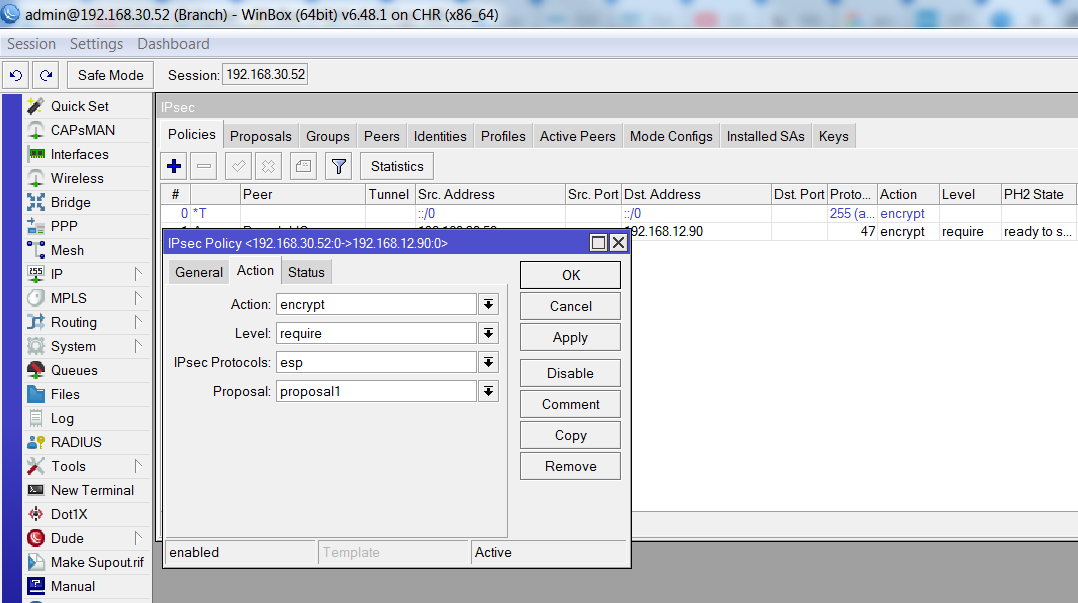
:
/ip ipsec profile
add dh-group=modp1536,modp2048 enc-algorithm=aes-256 hash-algorithm=sha256 lifetime=24h name=profile1
/ip ipsec peer
add address=X.X.X.X local-address=Y.Y.Y.Y name=Branch-HQ profile=profile1
/ip ipsec proposal
add auth-algorithms=sha256 enc-algorithms= aes-256-cbc lifetime=30m name=proposal1
pfs-group=modp1536
/ip ipsec policy
add peer=Branch-HQ src-address= Y.Y.Y.Y dst-address= X.X.X.X protocol=47 proposal=proposal1
/ip ipsec identity
add peer=Branch-HQ secret=#!@BRaNCH@!#
IP->Firewall->Filter Rules:
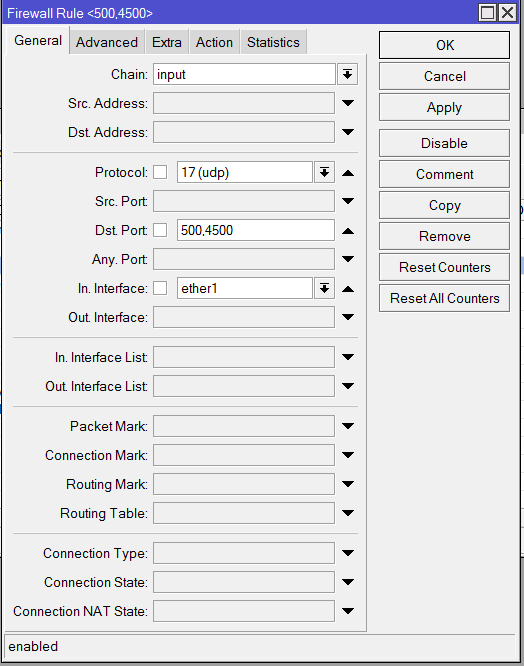

:
/ip firewall filter
add chain=input protocol=17 dst-port=500,4500 in-interface=ether1 action=accept
, :
/ip route
add dst-address=192.168.111.0/24 gateway=10.10.10.1
mikrotik , FortiGate.
FortiGate IPsec phase-1 :
config vpn ipsec phase1-interface
edit HQA-Branch
set peertype any
set proposal aes256-sha256
set dpd on-idle
set dhgrp 5 14
set auto-discovery-sender enable
set remote-gw Y.Y.Y.Y
set psksecret #!@BRaNCH@!#
set dpd-retryinterval 5
next
end
Phase-2 , “protocol 47” transport-mode ( ) GRE:
config vpn ipsec phase2-interface
edit "HQA-Branch"
set phase1name "HQA-Branch"
set proposal aes256-sha256
set dhgrp 5 14
set auto-negotiate enable
set encapsulation transport-mode
set protocol 47
next
end
GRE tunnel:
config system gre-tunnel
edit "HQ-Branch"
set interface "HQA-Branch"
set remote-gw Y.Y.Y.Y
set local-gw X.X.X.X
next
end
IP IP :
config system interface
edit "HQ-Branch"
set ip 10.10.10.1 255.255.255.255
set remote-ip 10.10.10.2 255.255.255.252
set interface "HQA-Branch"
next
end
GRE, IPsec, , . , , GRE IPsec. FortiOS IPsec . «» IPsec (, IPsec ).
config firewall policy
edit 2
set name "Enable IPsec"
set srcintf "HQA-Branch"
set dstintf "HQA-Branch"
set srcaddr "all"
set dstaddr "all"
set action accept
set schedule "always"
set service "ALL"
next
port2 GRE :
config firewall policy
edit 3
set name "GRE HQ->Branch"
set srcintf "port2"
set dstintf "HQ-Branch"
set srcaddr "all"
set dstaddr "all"
set action accept
set schedule "always"
set service "ALL"
next
edit 4
set name "GRE Branch->HQ"
set srcintf "HQ-Branch"
set dstintf "port2"
set srcaddr "all"
set dstaddr "all"
set action accept
set schedule "always"
set service "ALL"
next
end
GRE, GRE IPsec. , remote-gw gre-tunnel IPsec. :
config router static
edit 1
set dst Y.Y.Y.Y/30
set device "HQA-Branch"
next
edit 2
set dst 192.168.112.0 255.255.255.0
set device "HQ-Branch"
next
end
Und jetzt sind IPSec und GRE gestiegen, der Verkehr vom lokalen Netzwerk der Zentrale gelangt in das lokale Netzwerk der Zweigstelle und umgekehrt.
Verwendete die folgenden Artikel:
1. Fortinet
Dies ist meine zweite Arbeit, bitte treten Sie nicht zu viel.