Im Folgenden finden Sie kein Tutorial, sondern nur einen Spickzettel für Entwickler, die bereits mit den Grundlagen von C # .Net vertraut sind.
Der Spickzettel enthält nur "Basis" -Fragen. Fragen wie "Wie würden Sie entwerfen ...", "Welche Anwendungsebenen ..." sind nicht im Spickzettel enthalten. Wie in den Kommentaren erwähnt, sind die Fragen für Jun wahrscheinlicher, sie werden jedoch bei mittleren Interviews gestellt.
Code-Formatierung
In den Beispielen steht der Kürze halber die öffnende Klammer {nicht in einer neuen Zeile. Der Interviewer kann verwirrt sein, weil In C # ist es üblich, {in eine neue Zeile zu setzen. Daher ist es besser, während des Interviews die gängige Formatierung zu verwenden.
Stapel und Heap, Werttyp und Referenztyp
Der Referenztyp (Beispielklasse, Schnittstelle) wird in einem großen Heap gespeichert
Der Werttyp (Beispiel int, struct, Verweise auf Instanzen des Referenztyps) werden im schnellen Stapel gespeichert
Beim Zuweisen (Übergeben an eine Methode) von Werttypen werden Referenztypen als Referenz übergeben (siehe Abschnitt Struktur unten).
struct
Werttyp => Wenn zugewiesen (an die Methode übergeben), werden alle Felder und Eigenschaften kopiert und dürfen nicht null sein
keine Vererbung
unterstützt Schnittstellen
Wenn es einen Konstruktor gibt, müssen alle Felder und Eigenschaften darin festgelegt werden
interface IMyInterface {
int Property { get; set; }
}
struct MyStruc : IMyInterface {
public int Field;
public int Property { get; set; }
}
class Program {
static void Main(string[] args) {
var ms = new MyStruc {
Field = 1,
Property = 2
};
// value type ,
//
TryChange(ms);
Console.WriteLine(ms.Property);
// ==> ms.Property = 2;
// boxing ( )
IMyInterface msInterface = new MyStruc {
Field = 1,
Property = 2
};
// object (reference type)
// , msInterface
TryChange(msInterface);
Console.WriteLine(msInterface.Property);
// ==> ms.Property = 3;
}
static void TryChange(IMyInterface myStruc) {
myStruc.Property = 3;
}
}
DateTime ist eine Struktur, daher ist es sinnlos, Felder vom Typ DateTime auf null zu überprüfen:
class MyClass {
public DateTime Date { get; set; }
}
var mc = new MyClass();
// false,
// .. DateTime struct (value type) null
var isDate = mc.Date == null;
Boxen / Unboxen
// boxing (value type, stack -> object, heap)
int i = 123;
object o = i;
// unboxing (object, heap -> value type, stack)
object o = 123;
var i = (int)o;
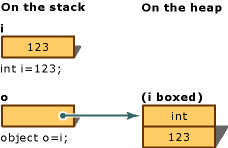
// boxing
int i = 123;
object o = i;
i = 456;
// ==> .. i, o
// i = 456
// o = 123
// boxing
IMyInterface myInterface = new MyStruct(2);
// boxing i
int i = 2;
string s = "str" + i;
// .. String.Concat(object? arg0, object? arg1)
// unboxing, .. Session Dictionary<string, object>
int i = (int)Session["key"];
string
heap reference type
( ) value type
string a = "hello";
string b = "hello";
// string value type
// ( == )
Console.WriteLine(a == b);
// ==> true
var mc1 = new MyClass { Property = 1 };
var mc2 = new MyClass { Property = 2 };
// reference type
// heap
Console.WriteLine(mc1 == mc2);
// ==> false
const vs readonly
const - =>
readonly -
class MyClass {
public const string Const = "some1";
public readonly string Field = "some2";
}
var cl = new MyClass();
Console.WriteLine(MyClass.Const);
Console.WriteLine(cl.Field);
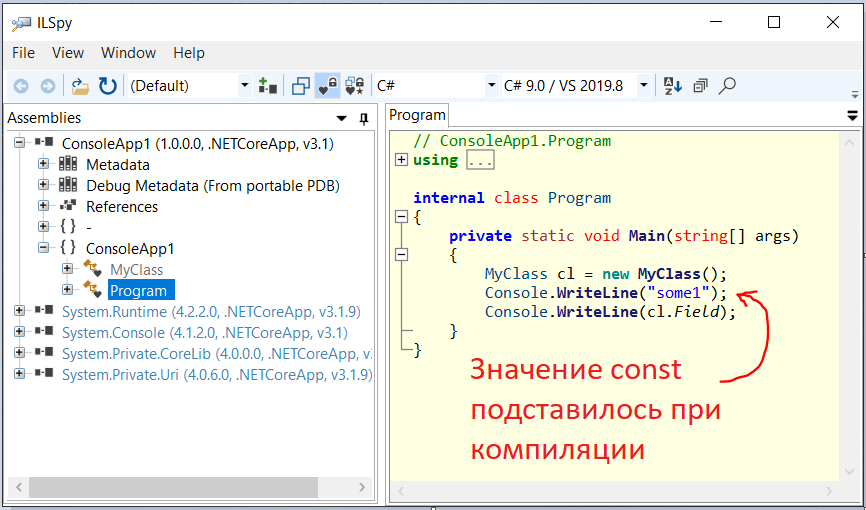
- dll , :
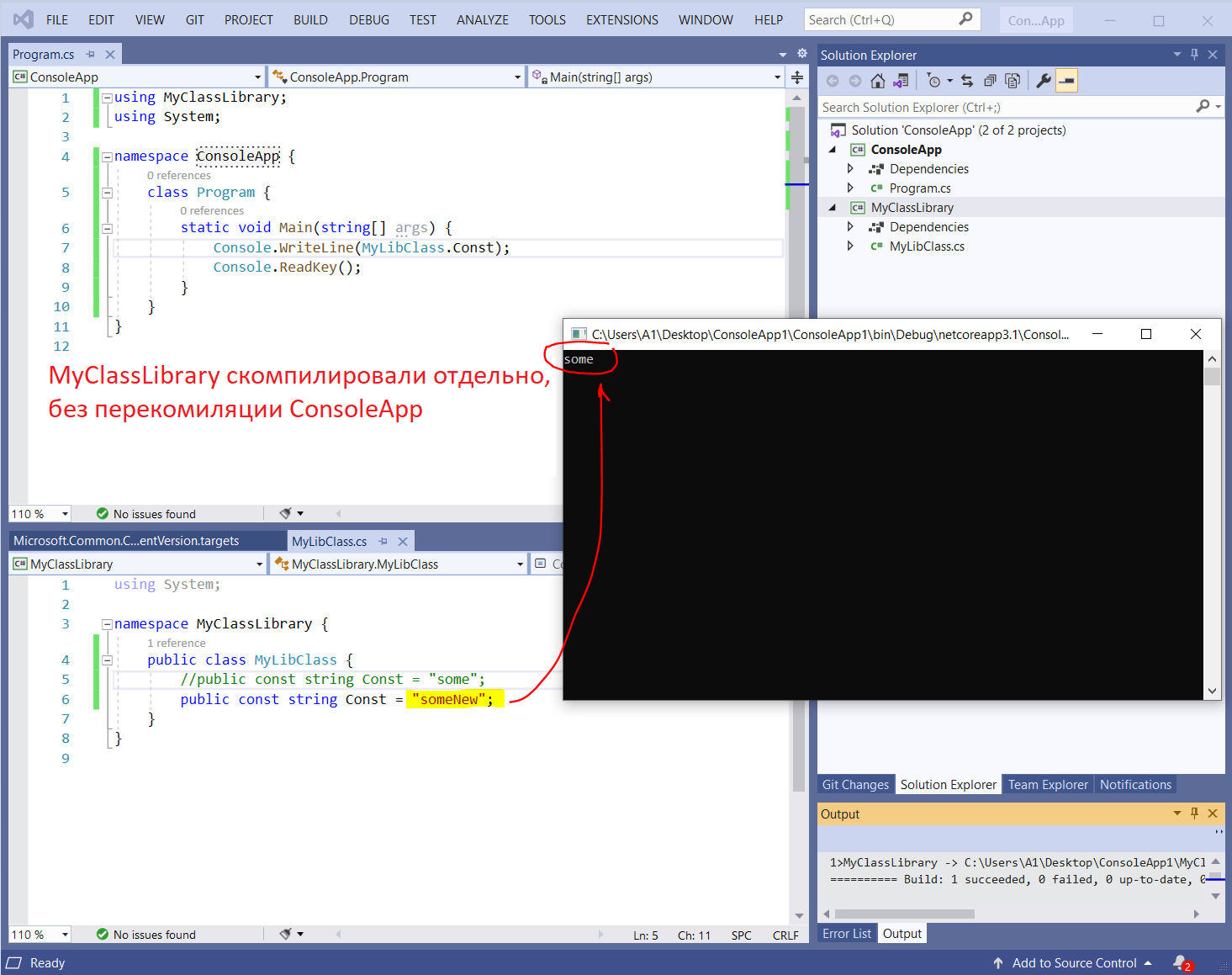
ref out
ref out new class struct
out ref, ,
struct MyStruc {
public int Field;
}
class Program {
static void Main(string[] args) {
var ms = new MyStruc { Field = 1 };
createNew(ms);
Console.WriteLine(ms.Field);
// ==> ms.Field = 1
var ms2 = new MyStruc { Field = 1 };
createNew2(ref ms2);
Console.WriteLine(ms2.Field);
// ==> ms2.Field = 2
}
static void createNew(MyStruc myStruc) {
myStruc = new MyStruc { Field = 2 };
}
static void createNew2(ref MyStruc myStruc) {
myStruc = new MyStruc { Field = 2 };
}
static void createNew3(out MyStruc myStruc) {
// ,
// myStruc = new
}
}
generic-.
interface IAnimal { }
class Cat : IAnimal {
public void Meow() { }
}
class Dog : IAnimal {
public void Woof() { }
}
// , List -
// , List Add,
// ( . )
List<IAnimal> animals = new List<Cat>();
// , IEnumerable -
// IEnumerable
IEnumerable<IAnimal> lst = new List<Cat>();
Add List:
//
List<Cat> cats = new List<Cat>();
cats.Add(new Cat());
List<Cat> animals = cats;
animals.Add(new Cat());
foreach (var cat in cats) {
cat.Meow(); // cats 2
}
//
List<Cat> cats = new List<Cat>();
cats.Add(new Cat());
List<IAnimal> animals = cats;
animals.Add(new Dog()); // , :
//
foreach (var cat in cats) {
cat.Meow(); // cats 1 1 , Meow()
}
Object
ToString
GetType
Equals
GetHashCode
ToString GetType .
Equals GetHashCode , linq, . , .. .Net. hash .
GetHashCode .
,
class MyClass {
public event Action<string> Evt;
public void FireEvt() {
if (Evt != null)
Evt("hello");
// Evt("hello") -
//
//foreach (var ev in Evt.GetInvocationList())
// ev.DynamicInvoke("hello");
}
public void ClearEvt() {
// MyClass
Evt = null;
}
}
var cl = new MyClass();
//
cl.Evt += (msg) => Console.WriteLine($"1 {msg}");
cl.Evt += (msg) => Console.WriteLine($"2 {msg}");
//
Action<string> handler = (msg) => Console.WriteLine($"3 {msg}");
cl.Evt += handler;
cl.Evt -= handler;
cl.FireEvt();
// ==>
// 1 hello
// 2 hello
//
// "+=" "-="
// MyClass
cl.Evt = null;
Finalizer (destructor) ~
garbage collector
.Net,
struct
finalizer: IDisposable. Dispose finalizer, Dispose. finalizer .
throw vs "throw ex"
try {
...
} catch (Exception ex) {
// , .. CallStack
throw;
// CallStack
throw ex;
}
Garbage collector
. heap , , . Garbage collector. :
( ) -
heap
(Generation 0) - , . Generation 0.
- Generation 1.
Generation 0 , . - Generation 1.
, 2 - Generation 2.
Derived.Static.Fields
Derived.Static.Constructor
Derived.Instance.Fields
Base.Static.Fields
Base.Static.Constructor
Base.Instance.Fields
Base.Instance.Constructor
Derived.Instance.Constructor
class Parent {
public Parent() {
// virtual
//
//
DoSomething();
}
protected virtual void DoSomething() {
}
}
class Child : Parent {
private string foo;
public Child() {
foo = "HELLO";
}
protected override void DoSomething() {
Console.WriteLine(foo.ToLower()); //NullReferenceException
}
}
( , ), . (, , ) - . vs vs .
-
-
- , , )
-
SOLID
Single responsibility - , , God-object
Open closed principle -
Liskov substitution -
Interface segregation principle -
Dependency inversion principle - , ,
3
(: )
(: )
(: )
IDisposable, try, catch, finally
singleton ( lock)
(mutex, semaphore ..)
/ . : . , . . ? ( )?
SQL , HAVING
Stack and heap – .NET data structures
Boxing and Unboxing (C# Programming Guide)
Eingebaute Referenztypen (C # -Referenz)
Kovarianz und Kontravarianz bei Generika
C # -Varianzproblem: Zuweisen einer Liste als Liste
Finalizer (C # -Programmierhandbuch)
Destruktoren in realen Anwendungen?
Virtueller Mitgliedsaufruf in einem Konstruktor
Vererbung gegen Zusammensetzung gegen Aggregation