- Wie ich an IOCCC-'19 teilgenommen habe (und verloren habe). Teil 1: "Tic-Tac-Toe"
- Wie ich an IOCCC-'19 teilgenommen habe (und verloren habe). Teil 2: "NOR Simulator"
Ich hoffe, dieser Artikel hilft Ihnen beim Parsen des Codes oder Codes eines anderen nach einem Dekompiler oder Verschleierer.
Wenn Sie immer noch nicht wissen, was IOCCC ist, oder sich mit einer einfacheren Version des verschleierten Codes vertraut machen möchten, empfehle ich, sich dem ersten Teil zuzuwenden.
Allen anderen wünsche ich eine angenehme Lektüre.
Alle Quellen werden auf Github abgelegt , von wo Sie sie herunterladen und versuchen können, sie zu kompilieren.
Ausgangsdaten
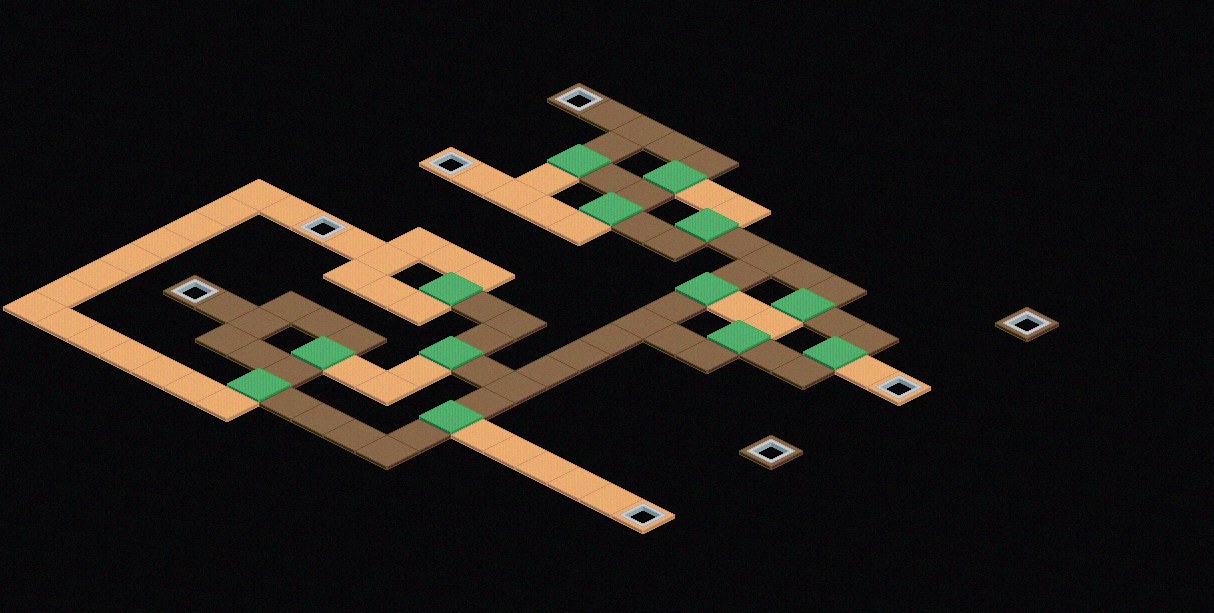
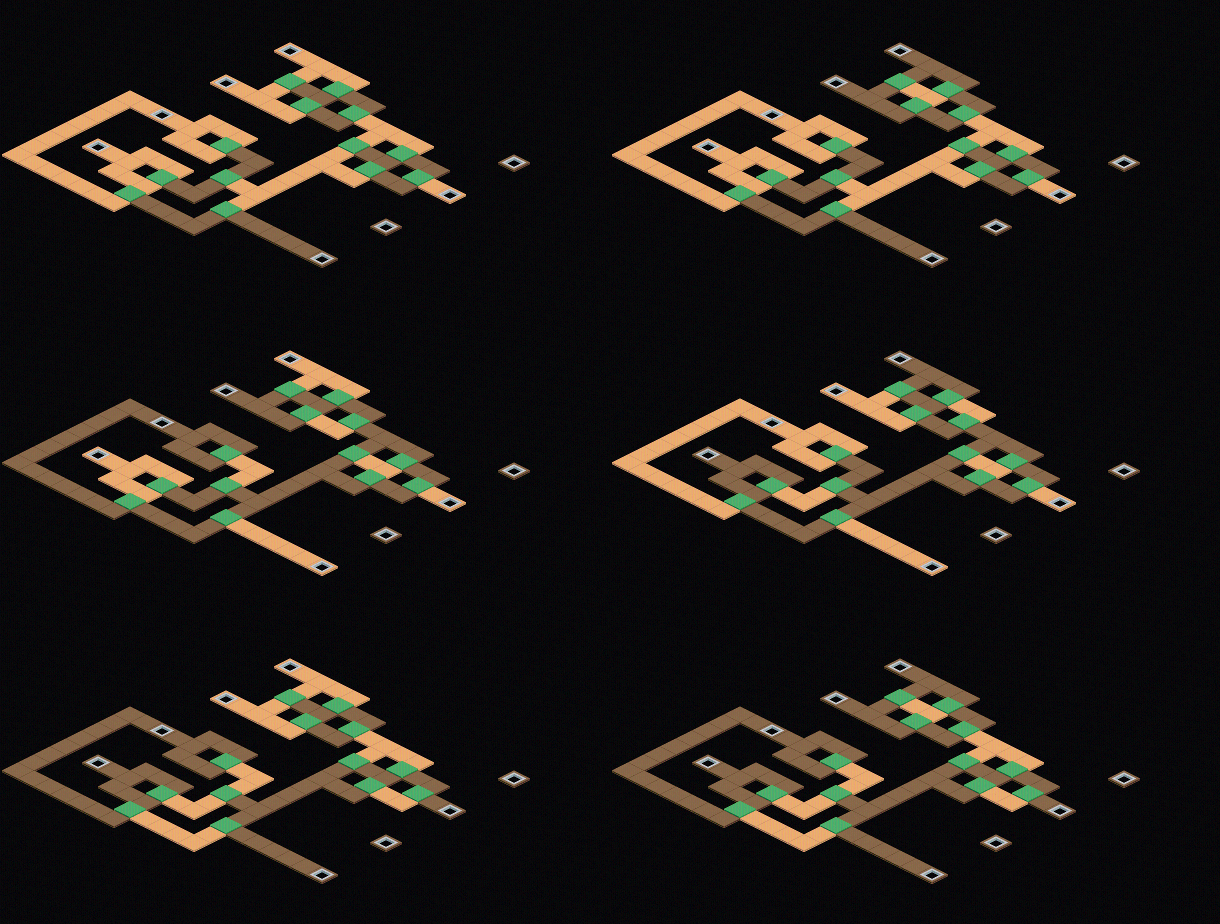
Da der Quellcode in Textform unter dem Link zu finden ist, werde ich zeigen, wie der Code grafisch aussieht:
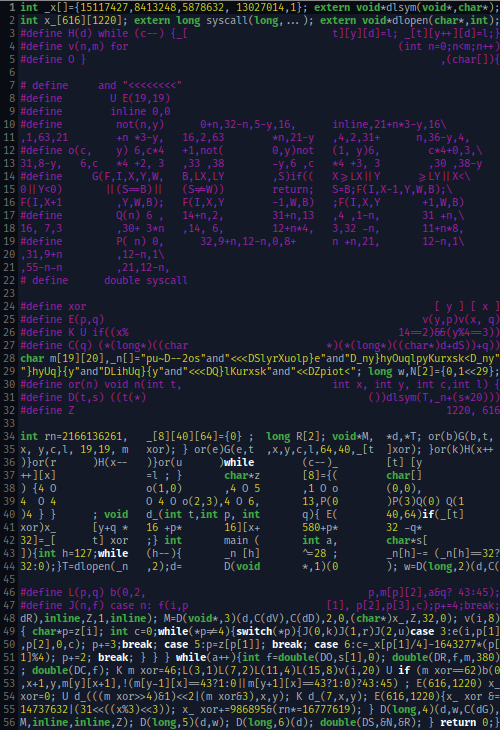
Traditionell werden "zusätzliche Punkte" vergeben, wenn der Code nicht standardisiert formatiert ist oder wie ein Bild aussieht. Nehmen wir an, dass hier alles in Ordnung ist.
Aber was macht das Programm?
Es initialisiert den X-Server-Grafikstapel, scannt die bereitgestellte Konfigurationsdatei, zeichnet ein elektrisches Diagramm gemäß der Datei und startet die Simulation, wobei abwechselnd die Polarität an den 4 Eingangspins geändert wird, wobei nur NOR-Elemente (Not-OR) verwendet werden. Das Rendern erfolgt mit dem alten LCD-Bildschirm-Shader.
Das Programm enthält mehrere Konfigurationsdateien, nämlich:
DIP8-4packnot.txt - ein ungefähres Analogon des CMOS 4041 / Vierkanal-Wechselrichters
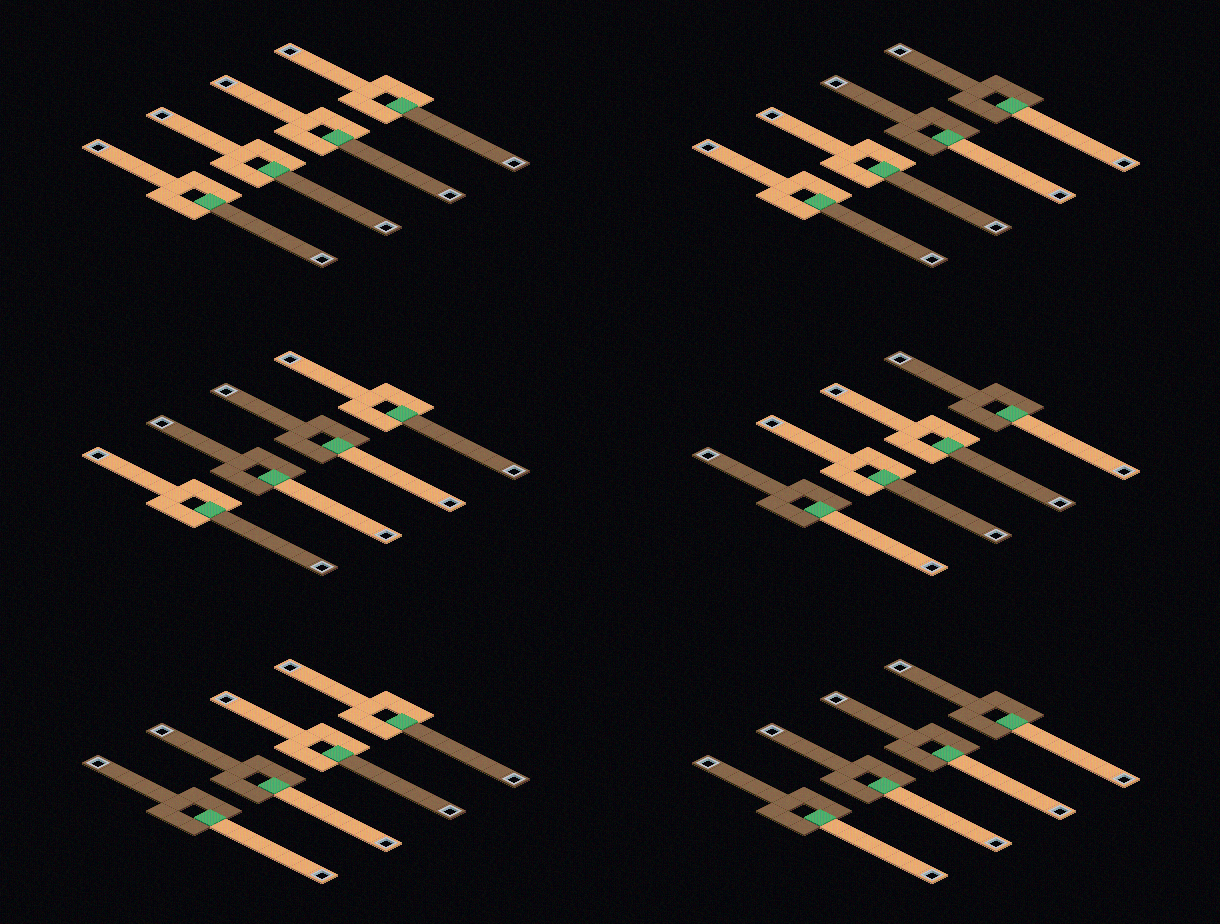
(Das Bild wird zweimal komprimiert, um die Grenzen des Anstands zu erreichen. Es ist eigentlich lustig, dass das Programm mit einem Gewicht von 3,5 KB eine Reihe von Bildern generiert, die bei maximaler Komprimierung 10,5 + MB aufnehmen.)
DIP8-triplexor.txt - ein ungefähres Analogon von CMOS 4030 mit kombinierten Eingängen und drei Kanälen / Dreikanal-XOR-Gatter mit kombinierten Eingängen
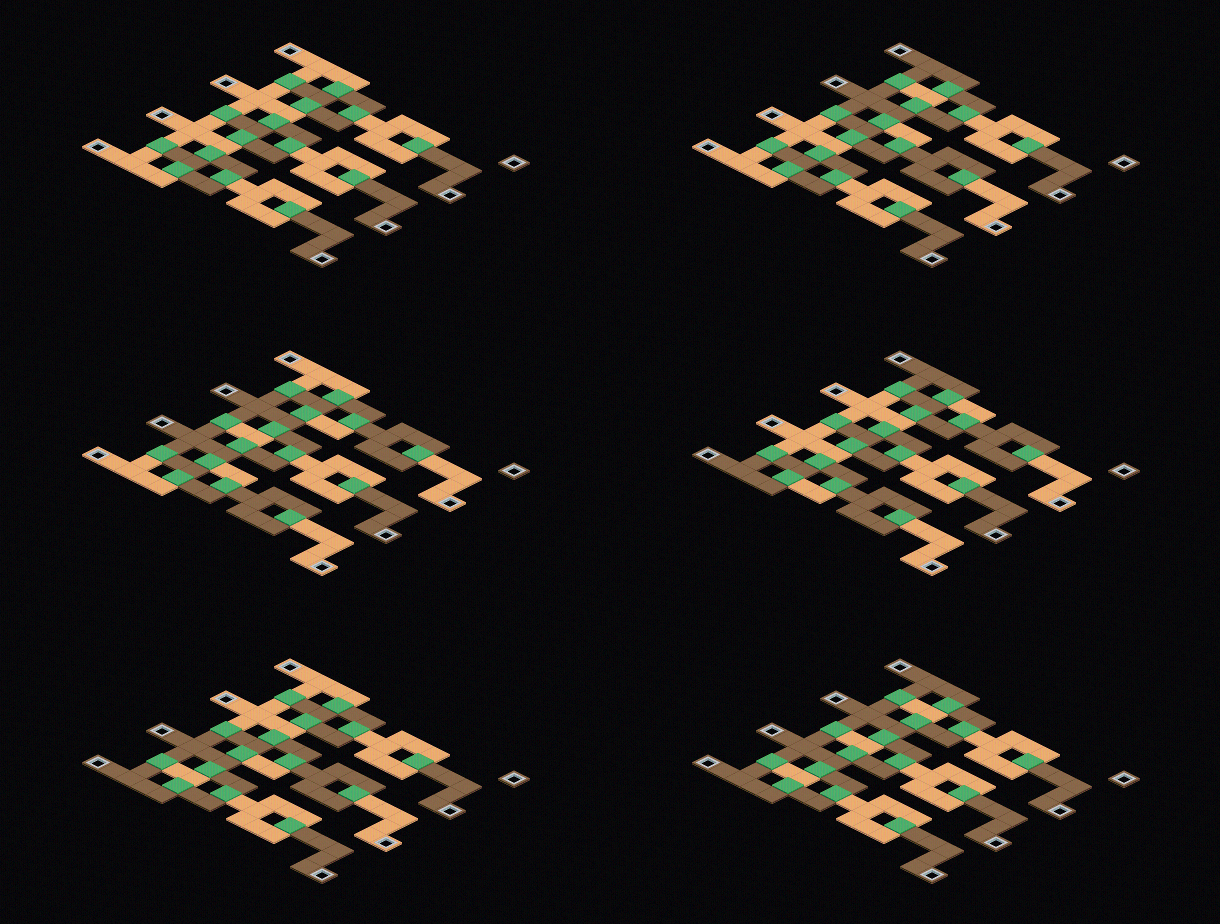
DIP8-fulladder.txt - ein ungefähres Analogon von CMOS 4008, jedoch für zwei Bits / Addierer für 2 Bits mit einem Übertragsbitausgang
Code analysieren
Die schwierigste Aufgabe bestand diesmal darin, in die Größenbeschränkung der eingereichten Arbeiten zu passen. Nicht nur die Dateigröße ist begrenzt, sondern auch die Anzahl der bedingten "Token" - Operationssymbole, Sprachschlüsselwörter und Klammerpaare. Um diese Funktion des Größenparser-Checkers im Programm "auszunutzen", wird eine große Anzahl von Definitionen deklariert, die Codeblöcke auf ein einziges C-Schlüsselwort reduzieren.
Schauen wir uns zunächst das Makefile an, um zu verstehen, wie der Code zusammengesetzt wird:
#!/usr/bin/env make
PROJECT=prog
CC= gcc
SRC=prog.c
CWARN=-Wall -Wextra -Wno-char-subscripts

CSTD= -std=c99
# Syscalls table
# DS - syscall nanosleep
# DO - syscall open
# DR - syscall read
# DC - syscall close

# X11 structures offsets
# dS - offset of screens in Display
# dR - offset of root in Screen
# dD - offset of root_depth in Screen
# dV - offset of root_visual in Screen
# dG - offset of default_gc in Screen

BITS := $(shell uname -p)

ifeq ($(BITS), x86_64)
    ARCH= -m64
    CDEFINE= -DDS=35 -DDO=2 -DDR=0 -DDC=3 -DdS=232 -DdR=16 -DdD=56 -DdV=64 -DdG=72
else
    ARCH= -m32
    CDEFINE= -DDS=162 -DDO=5 -DDR=3 -DDC=6 -DdS=140 -DdR=8 -DdD=36 -DdV=40 -DdG=44
endif


OPT= -g

CFLAGS= ${CWARN} ${CSTD} ${ARCH} ${CDEFINE} ${OPT}
LDFLAGS= -ldl

RM= rm

all:  ${PROJECT}

${PROJECT}:
	${CC} ${CFLAGS} ${SRC} -o $@ ${LDFLAGS}
clean:
	${RM} -f ${PROJECT}
Wie Sie sehen können, verwendet diese Arbeit, genau wie die vorherige, aktiv Systemaufrufe, um hässliche "#include" zu vermeiden, die das Bildmuster brechen. Erinnern wir uns an diese Tatsache und bereiten eine Zeile für den Präprozessor und den Linter vor:
Nach dem Präprozessor
gcc -DDS=35 -DDO=2 -DDR=0 -DDC=3 -DdS=232 -DdR=16 -DdD=56 -DdV=64 -DdG=72 prog.c -ldl -E | indent -kr -brf > /tmp/fmt.cint _x[] = { 15117427, 8413248, 5878632, 13027014, 1 };
extern void *dlsym(void *, char *);
int x_[616][1220];
extern long syscall(long, ...);
extern void *dlopen(char *, int);
char m[19][20], _n[] =
"pu~D--2os" "<<<<<<<<" "<<<DSlyrXuolp}e" "<<<<<<<<"
"D_ny}hyOuqlpyKurxsk<D_ny" "}hyUq}{y" "<<<<<<<<" "DLihUq}{y" "<<<<<<<<"
"<<<DQ}lKurxsk" "<<<<<<<<" "<<DZpiot<";
long w, N[2] = { 0, 1 << 29 };
int rn = 2166136261, _[8][40][64] = { 0 };
long R[2];
void *M, *d, *T;
void b(int t, int x, int y, int c, int l) {
if ((x >= 19 || y >= 19 || x < 0 || y < 0) || (m[y][x] == l)
|| (m[y][x] != c))
return;
m[y][x] = l;
b(t, x - 1, y, c, l);
b(t, x + 1, y, c, l);
b(t, x, y - 1, c, l);
b(t, x, y + 1, c, l);
}
void e(int t, int x, int y, int c, int l) {
if ((x >= 64 || y >= 40 || x < 0 || y < 0) || (_[t][y][x] == l)
|| (_[t][y][x] != c))
return;
_[t][y][x] = l;
e(t, x - 1, y, c, l);
e(t, x + 1, y, c, l);
e(t, x, y - 1, c, l);
e(t, x, y + 1, c, l);
}
void k(int t, int x, int y, int c, int l) {
while (c--) {
_[t][y][x++] = l;
_[t][y++][x++] = l;
}
}
void r(int t, int x, int y, int c, int l) {
while (c--) {
_[t][y][x--] = l;
_[t][y++][x--] = l;
}
}
void u(int t, int x, int y, int c, int l) {
while (c--)
_[t][y++][x] = l;
}
char *z[8] = {
(char[]) {4},
(char[]) {6, 1 * 4 + 1, 0 + 0, 32 - 0, 5 - 0, 16, 0, 0,
21 + 0 * 3 - 0, 16, 1, 63, 21 + 0 * 3 - 0, 16, 2,
63 * 0, 21 - 0, 4, 2, 31 + 0, 36 - 0, 4, 0 + 1,
32 - 1, 5 - 0, 16, 0, 0, 21 + 1 * 3 - 0, 16, 1, 63,
21 + 1 * 3 - 0, 16, 2, 63 * 1, 21 - 0, 4, 2, 31 + 1,
36 - 0, 4, 6, 1 * 4 + 0, 3, 31, 8 - 0, 6, 1 * 4 + 2,
3, 33, 38 - 0, 6, 1 * 4 + 3, 3, 30, 38 - 0, 4},
(char[]) {5, 1},
(char[]) {6, 0 * 4 + 1, 0 + 0, 32 - 0, 5 - 0, 16,
0, 0, 21 + 0 * 3 - 0, 16, 1, 63,
21 + 0 * 3 - 0, 16, 2, 63 * 0, 21 - 0,
4, 2, 31 + 0, 36 - 0, 4, 0 + 1, 32 - 1,
5 - 0, 16, 0, 0, 21 + 1 * 3 - 0, 16, 1,
63, 21 + 1 * 3 - 0, 16, 2, 63 * 1,
21 - 0, 4, 2, 31 + 1, 36 - 0, 4, 6,
0 * 4 + 0, 3, 31, 8 - 0, 6, 0 * 4 + 2,
3, 33, 38 - 0, 6, 0 * 4 + 3, 3, 30,
38 - 0,
4},
(char[]) {4}, (char[]) {4},
(char[]) {6, 2 * 4 + 1, 0 + 0, 32 - 0, 5 - 3, 16, 0, 0,
21 + 0 * 3 - 3, 16, 1, 63, 21 + 0 * 3 - 3, 16, 2, 63 * 0,
21 - 3, 4, 2, 31 + 0, 36 - 3, 4, 0 + 1, 32 - 1, 5 - 3,
16, 0, 0, 21 + 1 * 3 - 3, 16, 1, 63, 21 + 1 * 3 - 3, 16,
2, 63 * 1, 21 - 3, 4, 2, 31 + 1, 36 - 3, 4, 6, 2 * 4 + 0,
3, 31, 8 - 3, 6, 2 * 4 + 2, 3, 33, 38 - 3, 6, 2 * 4 + 3,
3, 30, 38 - 3, 4},
(char[]) {6, 13, 0, 32, 9 + 0, 12 - 0,
0, 8 + 0 + 0, 21, 12 - 0, 1,
31, 9 + 0, 12 - 0, 1,
55 - 0 - 0, 21, 12 - 0, 0,
32, 9 + 3, 12 - 3, 0,
8 + 3 + 3, 21, 12 - 3, 1,
31, 9 + 3, 12 - 3, 1,
55 - 3 - 3, 21, 12 - 3, 6,
14 + 0, 2, 31 + 0, 13, 4,
1 - 0, 31 + 0, 16, 7, 3,
30 + 3 * 0, 14, 6,
12 + 0 * 4, 3, 32 - 0,
11 + 0 * 8, 6, 14 + 1, 2,
31 + 1, 13, 4, 1 - 1,
31 + 1, 16, 7, 3,
30 + 3 * 1, 14, 6,
12 + 1 * 4, 3, 32 - 1,
11 + 1 * 8,
4}
};
void d_(int t, int p, int q) {
for (int y = 0; y < 40; y++)
for (int x = 0; x < 64; x++)
if (_[t]
[y][x])
x_[y + q * 16 + p * 16][x + 580 + p * 32 - q *
32] = _[t][y][x];
}
int main(int a, char *s[]) {
int h = 127;
while (h--) {
_n[h] ^= 28;
_n[h] -= (_n[h] == 32 ? 32 : 0);
}
T = dlopen(_n, 2);
d = ((void *(*)()) dlsym(T, _n + (1 * 20))) (0);
w = ((long (*)()) dlsym(T, _n + (2 * 20))) (d,
(*(long *)
((char
*) (*(long *) ((char *)
d +
232)) +
16))
, 0, 0, 1220, 616, 1, 0,
0);
M = ((void *(*)()) dlsym(T, _n + (3 * 20))) (d,
(*(long *)
((char
*) (*(long *) ((char *)
d +
232)) +
64)),
(*(long *)
((char
*) (*(long *) ((char *)
d +
232)) +
56)), 2, 0, (char *) x_,
1220, 616, 32, 0);
for (int i = 0; i < 8; i++) {
char *p = z[i];
int c = 0;
while (*p != 4) {
switch (*p) {
case 0:
k(i, p[1], p[2], p[3], c);
p += 4;
break;
case 1:
r(i, p[1], p[2], p[3], c);
p += 4;
break;
case 2:
u(i, p[1], p[2], p[3], c);
p += 4;
break;
case 3:
e(i, p[1]
, p[2], 0, c);
p += 3;
break;
case 5:
p = z[p[1]];
break;
case 6:
c = _x[p[1] / 4] - 1643277 * (p[1] % 4);
p += 2;
break;
}
}
}
while (a++) {
int f = syscall(2, s[1], 0);
syscall(0, f, m, 380);
syscall(3, f);
for (int y = 0; y < 19; y++)
for (int x = 0; x < 19; x++)
if ((x % 14 == 2) && (y % 4 == 3))
m[y][x] = 46;
b(0, 2, 3, m[3][2], a & 1 ? 43 : 45);
b(0, 2, 7, m[7][2], a & 2 ? 43 : 45);
b(0, 2, 11, m[11][2], a & 4 ? 43 : 45);
b(0, 2, 15, m[15][2], a & 8 ? 43 : 45);
for (int i = 0; i < 20; i++)
for (int y = 0; y < 19; y++)
for (int x = 0; x < 19; x++)
if (m[y][x] == 62)
b(0, x + 1, y, m[y][x + 1],
!(m[y - 1][x] == 43 ? 1 : 0
|| m[y + 1][x] == 43 ? 1 : 0) ? 43 : 45);
for (int y = 0; y < 616; y++)
for (int x = 0; x < 1220; x++)
x_[y][x] = 0;
for (int y = 0; y < 19; y++)
for (int x = 0; x < 19; x++)
d_(((m[y][x] >> 4) & 1) << 2 | (m[y][x] & 3), x, y);
for (int y = 0; y < 19; y++)
for (int x = 0; x < 19; x++)
if ((x % 14 == 2) && (y % 4 == 3))
d_(7, x, y);
for (int y = 0; y < 616; y++)
for (int x = 0; x < 1220; x++) {
x_[y][x] &= 14737632 | (31 << ((x % 3) << 3));
x_[y][x] += 986895 & (rn *= 16777619);
} ((long (*)()) dlsym(T, _n + (4 * 20))) (d, w,
(*(long *)
((char
*) (*(long
*) ((char *)
d +
232)) +
72)), M, 0, 0, 0,
0, 1220, 616);
((long (*)()) dlsym(T, _n + (5 * 20))) (d, w);
((long (*)()) dlsym(T, _n + (6 * 20))) (d);
syscall(35, &N, &R);
} return 0;
}
Nun, wir haben mindestens eine der Wettbewerbsbedingungen erfüllt, der Code nach dem Präprozessor wurde nicht klarer.
Beginnen wir mit dem, was Sie auf einen Blick erfassen können, und versuchen Sie, die Ereigniskette zu rekonstruieren.
dlsym \ dlopen
Um die Funktionen des X-Servers nutzen und ein Fenster erstellen und dann etwas darin zeichnen zu können, muss sich der Code natürlich an die XLib-Bibliothek wenden. Der Code enthält dlopen / dlsym-Funktionen, mit denen Sie die Bibliothek dynamisch laden können, aber an der Eingabe wird ihnen eine Art kniffliges Durcheinander zugeführt:
char _n[] =
    "pu~D--2os" "<<<<<<<<" "<<<DSlyrXuolp}e" "<<<<<<<<"
    "D_ny}hyOuqlpyKurxsk<D_ny" "}hyUq}{y" "<<<<<<<<" "DLihUq}{y" "<<<<<<<<"
    "<<<DQ}lKurxsk" "<<<<<<<<" "<<DZpiot<";
...
T = dlopen(_n, 2);
Machen wir einen Schritt zurück und überprüfen den folgenden Code:
int h = 127;
    while (h--) {
	_n[h] ^= 28;
	_n[h] -= (_n[h] == 32 ? 32 : 0);
    }
Anscheinend transformiert es das ursprüngliche Array auf irgendeine Weise, so dass wir lesbare Zeilen erhalten können. Lassen Sie es uns separat ausführen:
https://onlinegdb.com/SJNM9Og7v :
libX11.so
XOpenDisplay
XCreateSimpleWindow
XCreateImage
XPutImage
XMapWindow
XFlush
Um Funktionen aufzurufen, deren Format in einer Zeile so unterschiedlich ist, nutzt der Code die Tatsache aus, dass im C-Sprachstandard (void) keine Parameter und () eine beliebige Anzahl von Parametern bedeutet. Es bleibt nur, die resultierende Leere * in den entsprechenden ((long (*) ()) Typ und voila umzuwandeln:
w = ((long (*)()) dlsym(T, _n + (2 * 20))) (d, (*(long *)((char *) (*(long *)((char *) d + 232)) + 16))Da wir wissen, was diese Konvertierungen bedeuten, können wir diese ungewöhnliche Verwendung von dlsym jetzt zuerst durch Zeichenfolgen ersetzen:
Nach dem Ersetzen der Zeilen:
int _x[] = { 15117427, 8413248, 5878632, 13027014, 1 };

extern void *dlsym(void *, char *);
int x_[616][1220];
extern long syscall(long, ...);
extern void *dlopen(char *, int);
char m[19][20];
long w, N[2] = { 0, 1 << 29 };
int rn = 2166136261, _[8][40][64] = { 0 };
long R[2];
void *M, *d, *T;

void b(int t, int x, int y, int c, int l) {
    if ((x >= 19 || y >= 19 || x < 0 || y < 0) || (m[y][x] == l)
	|| (m[y][x] != c))
	return;
    m[y][x] = l;
    b(t, x - 1, y, c, l);
    b(t, x + 1, y, c, l);
    b(t, x, y - 1, c, l);
    b(t, x, y + 1, c, l);
}

void e(int t, int x, int y, int c, int l) {
    if ((x >= 64 || y >= 40 || x < 0 || y < 0) || (_[t][y][x] == l)
	|| (_[t][y][x] != c))
	return;
    _[t][y][x] = l;
    e(t, x - 1, y, c, l);
    e(t, x + 1, y, c, l);
    e(t, x, y - 1, c, l);
    e(t, x, y + 1, c, l);
}

void k(int t, int x, int y, int c, int l) {
    while (c--) {
	_[t][y][x++] = l;
	_[t][y++][x++] = l;
    }
}

void r(int t, int x, int y, int c, int l) {
    while (c--) {
	_[t][y][x--] = l;
	_[t][y++][x--] = l;
    }
}

void u(int t, int x, int y, int c, int l) {
    while (c--)
	_[t][y++][x] = l;
}

char *z[8] = {
    (char[]) {4},
    (char[]) {6, 1 * 4 + 1, 0 + 0, 32 - 0, 5 - 0, 16, 0, 0,
		     21 + 0 * 3 - 0, 16, 1, 63, 21 + 0 * 3 - 0, 16, 2,
		     63 * 0, 21 - 0, 4, 2, 31 + 0, 36 - 0, 4, 0 + 1,
		     32 - 1, 5 - 0, 16, 0, 0, 21 + 1 * 3 - 0, 16, 1, 63,
		     21 + 1 * 3 - 0, 16, 2, 63 * 1, 21 - 0, 4, 2, 31 + 1,
		     36 - 0, 4, 6, 1 * 4 + 0, 3, 31, 8 - 0, 6, 1 * 4 + 2,
		     3, 33, 38 - 0, 6, 1 * 4 + 3, 3, 30, 38 - 0, 4},
	(char[]) {5, 1},
	(char[]) {6, 0 * 4 + 1, 0 + 0, 32 - 0, 5 - 0, 16,
				   0, 0, 21 + 0 * 3 - 0, 16, 1, 63,
				   21 + 0 * 3 - 0, 16, 2, 63 * 0, 21 - 0,
				   4, 2, 31 + 0, 36 - 0, 4, 0 + 1, 32 - 1,
				   5 - 0, 16, 0, 0, 21 + 1 * 3 - 0, 16, 1,
				   63, 21 + 1 * 3 - 0, 16, 2, 63 * 1,
				   21 - 0, 4, 2, 31 + 1, 36 - 0, 4, 6,
				   0 * 4 + 0, 3, 31, 8 - 0, 6, 0 * 4 + 2,
				   3, 33, 38 - 0, 6, 0 * 4 + 3, 3, 30,
				   38 - 0,
				   4},
	(char[]) {4}, (char[]) {4},
	(char[]) {6, 2 * 4 + 1, 0 + 0, 32 - 0, 5 - 3, 16, 0, 0,
		  21 + 0 * 3 - 3, 16, 1, 63, 21 + 0 * 3 - 3, 16, 2, 63 * 0,
		  21 - 3, 4, 2, 31 + 0, 36 - 3, 4, 0 + 1, 32 - 1, 5 - 3,
		  16, 0, 0, 21 + 1 * 3 - 3, 16, 1, 63, 21 + 1 * 3 - 3, 16,
		  2, 63 * 1, 21 - 3, 4, 2, 31 + 1, 36 - 3, 4, 6, 2 * 4 + 0,
		  3, 31, 8 - 3, 6, 2 * 4 + 2, 3, 33, 38 - 3, 6, 2 * 4 + 3,
		  3, 30, 38 - 3, 4},
    (char[]) {6, 13, 0, 32, 9 + 0, 12 - 0,
					       0, 8 + 0 + 0, 21, 12 - 0, 1,
					       31, 9 + 0, 12 - 0, 1,
					       55 - 0 - 0, 21, 12 - 0, 0,
					       32, 9 + 3, 12 - 3, 0,
					       8 + 3 + 3, 21, 12 - 3, 1,
					       31, 9 + 3, 12 - 3, 1,
					       55 - 3 - 3, 21, 12 - 3, 6,
					       14 + 0, 2, 31 + 0, 13, 4,
					       1 - 0, 31 + 0, 16, 7, 3,
					       30 + 3 * 0, 14, 6,
					       12 + 0 * 4, 3, 32 - 0,
					       11 + 0 * 8, 6, 14 + 1, 2,
					       31 + 1, 13, 4, 1 - 1,
					       31 + 1, 16, 7, 3,
					       30 + 3 * 1, 14, 6,
					       12 + 1 * 4, 3, 32 - 1,
					       11 + 1 * 8,
					       4}
};

void d_(int t, int p, int q) {
    for (int y = 0; y < 40; y++)
	for (int x = 0; x < 64; x++)
	    if (_[t]
		[y][x])
		x_[y + q * 16 + p * 16][x + 580 + p * 32 - q *
					32] = _[t][y][x];
}

int main(int a, char *s[]) {
    T = dlopen("libX11.so", 2);
    d = ((void *(*)()) dlsym(T, "XOpenDisplay") (0);
    w = ((long (*)()) dlsym(T, "XCreateSimpleWindow")) (d,
						(*(long *)
						 ((char
						   *) (*(long *) ((char *)
								  d +
								  232)) +
						  16))


						, 0, 0, 1220, 616, 1, 0,
						0);
    M = ((void *(*)()) dlsym(T, "XCreateImage")) (d,
						 (*(long *)
						  ((char
						    *) (*(long *) ((char *)
								   d +
								   232)) +
						   64)),
						 (*(long *)
						  ((char
						    *) (*(long *) ((char *)
								   d +
								   232)) +
						   56)), 2, 0, (char *) x_,
						 1220, 616, 32, 0);
    for (int i = 0; i < 8; i++) {
	char *p = z[i];
	int c = 0;
	while (*p != 4) {
	    switch (*p) {
	    case 0:
		k(i, p[1], p[2], p[3], c);
		p += 4;
		break;
	    case 1:
		r(i, p[1], p[2], p[3], c);
		p += 4;
		break;
	    case 2:
		u(i, p[1], p[2], p[3], c);
		p += 4;
		break;
	    case 3:
		e(i, p[1]
		  , p[2], 0, c);
		p += 3;
		break;
	    case 5:
		p = z[p[1]];
		break;
	    case 6:
		c = _x[p[1] / 4] - 1643277 * (p[1] % 4);
		p += 2;
		break;
	    }
	}
    }
    while (a++) {
	int f = syscall(2, s[1], 0);
	syscall(0, f, m, 380);
	syscall(3, f);
	for (int y = 0; y < 19; y++)
	    for (int x = 0; x < 19; x++)
		if ((x % 14 == 2) && (y % 4 == 3))
		    m[y][x] = 46;
	b(0, 2, 3, m[3][2], a & 1 ? 43 : 45);
	b(0, 2, 7, m[7][2], a & 2 ? 43 : 45);
	b(0, 2, 11, m[11][2], a & 4 ? 43 : 45);
	b(0, 2, 15, m[15][2], a & 8 ? 43 : 45);
	for (int i = 0; i < 20; i++)
	    for (int y = 0; y < 19; y++)
		for (int x = 0; x < 19; x++)
		    if (m[y][x] == 62)
			b(0, x + 1, y, m[y][x + 1],
			  !(m[y - 1][x] == 43 ? 1 : 0
			    || m[y + 1][x] == 43 ? 1 : 0) ? 43 : 45);
	for (int y = 0; y < 616; y++)
	    for (int x = 0; x < 1220; x++)
		x_[y][x] = 0;
	for (int y = 0; y < 19; y++)
	    for (int x = 0; x < 19; x++)
		d_(((m[y][x] >> 4) & 1) << 2 | (m[y][x] & 3), x, y);
	for (int y = 0; y < 19; y++)
	    for (int x = 0; x < 19; x++)
		if ((x % 14 == 2) && (y % 4 == 3))
		    d_(7, x, y);
	for (int y = 0; y < 616; y++)
	    for (int x = 0; x < 1220; x++) {
		x_[y][x] &= 14737632 | (31 << ((x % 3) << 3));
		x_[y][x] += 986895 & (rn *= 16777619);
	    } ((long (*)()) dlsym(T, "XPutImage")) (d, w,
						      (*(long *)
						       ((char
							 *) (*(long
							       *) ((char *)
								   d +
								   232)) +
							72)), M, 0, 0, 0,
						      0, 1220, 616);
	((long (*)()) dlsym(T, "XMapWindow")) (d, w);
	((long (*)()) dlsym(T, "XFlush")) (d);
	syscall(35, &N, &R);
    } return 0;
}
Und dann zu den nativen Funktionen:
Nach dem Ersetzen durch "native" Funktionen:
#include <X11/Xlib.h>

int _x[] = { 15117427, 8413248, 5878632, 13027014, 1 };

int x_[616][1220];
extern long syscall(long, ...);
char m[19][20];
long w, N[2] = { 0, 1 << 29 };
int rn = 2166136261, _[8][40][64] = { 0 };
long R[2];
void *M, *d, *T;

void b(int t, int x, int y, int c, int l) {
    if ((x >= 19 || y >= 19 || x < 0 || y < 0) || (m[y][x] == l)
	|| (m[y][x] != c))
	return;
    m[y][x] = l;
    b(t, x - 1, y, c, l);
    b(t, x + 1, y, c, l);
    b(t, x, y - 1, c, l);
    b(t, x, y + 1, c, l);
}

void e(int t, int x, int y, int c, int l) {
    if ((x >= 64 || y >= 40 || x < 0 || y < 0) || (_[t][y][x] == l)
	|| (_[t][y][x] != c))
	return;
    _[t][y][x] = l;
    e(t, x - 1, y, c, l);
    e(t, x + 1, y, c, l);
    e(t, x, y - 1, c, l);
    e(t, x, y + 1, c, l);
}

void k(int t, int x, int y, int c, int l) {
    while (c--) {
	_[t][y][x++] = l;
	_[t][y++][x++] = l;
    }
}

void r(int t, int x, int y, int c, int l) {
    while (c--) {
	_[t][y][x--] = l;
	_[t][y++][x--] = l;
    }
}

void u(int t, int x, int y, int c, int l) {
    while (c--)
	_[t][y++][x] = l;
}

char *z[8] = {
    (char[]) {4},
    (char[]) {6, 1 * 4 + 1, 0 + 0, 32 - 0, 5 - 0, 16, 0, 0,
		     21 + 0 * 3 - 0, 16, 1, 63, 21 + 0 * 3 - 0, 16, 2,
		     63 * 0, 21 - 0, 4, 2, 31 + 0, 36 - 0, 4, 0 + 1,
		     32 - 1, 5 - 0, 16, 0, 0, 21 + 1 * 3 - 0, 16, 1, 63,
		     21 + 1 * 3 - 0, 16, 2, 63 * 1, 21 - 0, 4, 2, 31 + 1,
		     36 - 0, 4, 6, 1 * 4 + 0, 3, 31, 8 - 0, 6, 1 * 4 + 2,
		     3, 33, 38 - 0, 6, 1 * 4 + 3, 3, 30, 38 - 0, 4},
	(char[]) {5, 1},
	(char[]) {6, 0 * 4 + 1, 0 + 0, 32 - 0, 5 - 0, 16,
				   0, 0, 21 + 0 * 3 - 0, 16, 1, 63,
				   21 + 0 * 3 - 0, 16, 2, 63 * 0, 21 - 0,
				   4, 2, 31 + 0, 36 - 0, 4, 0 + 1, 32 - 1,
				   5 - 0, 16, 0, 0, 21 + 1 * 3 - 0, 16, 1,
				   63, 21 + 1 * 3 - 0, 16, 2, 63 * 1,
				   21 - 0, 4, 2, 31 + 1, 36 - 0, 4, 6,
				   0 * 4 + 0, 3, 31, 8 - 0, 6, 0 * 4 + 2,
				   3, 33, 38 - 0, 6, 0 * 4 + 3, 3, 30,
				   38 - 0,
				   4},
	(char[]) {4}, (char[]) {4},
	(char[]) {6, 2 * 4 + 1, 0 + 0, 32 - 0, 5 - 3, 16, 0, 0,
		  21 + 0 * 3 - 3, 16, 1, 63, 21 + 0 * 3 - 3, 16, 2, 63 * 0,
		  21 - 3, 4, 2, 31 + 0, 36 - 3, 4, 0 + 1, 32 - 1, 5 - 3,
		  16, 0, 0, 21 + 1 * 3 - 3, 16, 1, 63, 21 + 1 * 3 - 3, 16,
		  2, 63 * 1, 21 - 3, 4, 2, 31 + 1, 36 - 3, 4, 6, 2 * 4 + 0,
		  3, 31, 8 - 3, 6, 2 * 4 + 2, 3, 33, 38 - 3, 6, 2 * 4 + 3,
		  3, 30, 38 - 3, 4},
    (char[]) {6, 13, 0, 32, 9 + 0, 12 - 0,
					       0, 8 + 0 + 0, 21, 12 - 0, 1,
					       31, 9 + 0, 12 - 0, 1,
					       55 - 0 - 0, 21, 12 - 0, 0,
					       32, 9 + 3, 12 - 3, 0,
					       8 + 3 + 3, 21, 12 - 3, 1,
					       31, 9 + 3, 12 - 3, 1,
					       55 - 3 - 3, 21, 12 - 3, 6,
					       14 + 0, 2, 31 + 0, 13, 4,
					       1 - 0, 31 + 0, 16, 7, 3,
					       30 + 3 * 0, 14, 6,
					       12 + 0 * 4, 3, 32 - 0,
					       11 + 0 * 8, 6, 14 + 1, 2,
					       31 + 1, 13, 4, 1 - 1,
					       31 + 1, 16, 7, 3,
					       30 + 3 * 1, 14, 6,
					       12 + 1 * 4, 3, 32 - 1,
					       11 + 1 * 8,
					       4}
};

void d_(int t, int p, int q) {
    for (int y = 0; y < 40; y++)
	for (int x = 0; x < 64; x++)
	    if (_[t]
		[y][x])
		x_[y + q * 16 + p * 16][x + 580 + p * 32 - q *
					32] = _[t][y][x];
}

int main(int a, char *s[]) {
    d = XOpenDisplay(0);
    w = XCreateSimpleWindow(d, (*(long *) ((char *) (*(long *) ((char *)d + 232)) + 16)), 0, 0, 1220, 616, 1, 0, 0);
    M = XCreateImage(d, (*(long *)((char *) (*(long *) ((char *)d + 232)) + 64)), (*(long *)((char *) (*(long *) ((char *)d + 232)) + 56)), 2, 0, (char *) x_, 1220, 616, 32, 0);
    for (int i = 0; i < 8; i++) {
	    char *p = z[i];
	    int c = 0;
	    while (*p != 4) {
	        switch (*p) {
	        case 0:
	    	    k(i, p[1], p[2], p[3], c);
	    	    p += 4;
	    	    break;
	        case 1:
	    	    r(i, p[1], p[2], p[3], c);
	    	    p += 4;
	    	    break;
	        case 2:
	    	    u(i, p[1], p[2], p[3], c);
	    	    p += 4;
	    	    break;
	        case 3:
	    	    e(i, p[1]
	    	      , p[2], 0, c);
	    	    p += 3;
	    	    break;
	        case 5:
	    	    p = z[p[1]];
	    	    break;
	        case 6:
	    	    c = _x[p[1] / 4] - 1643277 * (p[1] % 4);
	    	    p += 2;
	    	    break;
	        }
	    }
    }
    while (a++) {
	    int f = syscall(2, s[1], 0);
	    syscall(0, f, m, 380);
	    syscall(3, f);
	    for (int y = 0; y < 19; y++)
	        for (int x = 0; x < 19; x++)
		    if ((x % 14 == 2) && (y % 4 == 3))
		        m[y][x] = 46;
	    b(0, 2, 3, m[3][2], a & 1 ? 43 : 45);
	    b(0, 2, 7, m[7][2], a & 2 ? 43 : 45);
	    b(0, 2, 11, m[11][2], a & 4 ? 43 : 45);
	    b(0, 2, 15, m[15][2], a & 8 ? 43 : 45);
	    for (int i = 0; i < 20; i++)
	        for (int y = 0; y < 19; y++)
		    for (int x = 0; x < 19; x++)
		        if (m[y][x] == 62)
			    b(0, x + 1, y, m[y][x + 1],
			    !(m[y - 1][x] == 43 ? 1 : 0
			        || m[y + 1][x] == 43 ? 1 : 0) ? 43 : 45);
	    for (int y = 0; y < 616; y++)
	        for (int x = 0; x < 1220; x++)
		    x_[y][x] = 0;
	    for (int y = 0; y < 19; y++)
	        for (int x = 0; x < 19; x++)
		    d_(((m[y][x] >> 4) & 1) << 2 | (m[y][x] & 3), x, y);
	    for (int y = 0; y < 19; y++)
	        for (int x = 0; x < 19; x++)
    		if ((x % 14 == 2) && (y % 4 == 3))
	    	    d_(7, x, y);
    	for (int y = 0; y < 616; y++)
	        for (int x = 0; x < 1220; x++) {
	    	    x_[y][x] &= 14737632 | (31 << ((x % 3) << 3));
	    	    x_[y][x] += 986895 & (rn *= 16777619);
	        }
	    XPutImage(d, w, (*(long *)((char *) (*(long *) ((char *)d + 232)) +	72)), M, 0, 0, 0, 0, 1220, 616);
	    XMapWindow(d, w);
	    XFlush(d);
	    syscall(35, &N, &R);
    }
    return 0;
}
Syscalls
Ersetzen wir die Systemaufrufe auf die gleiche Weise wie im ersten Teil:
Code ohne Systemaufrufe:
#include <X11/Xlib.h>
#include <sys/types.h>
#include <sys/stat.h>
#include <fcntl.h>
#include <unistd.h>

int _x[] = { 15117427, 8413248, 5878632, 13027014, 1 };

int x_[616][1220];
char m[19][20];
long w;
int rn = 2166136261, _[8][40][64] = { 0 };

void *M, *d, *T;

void b(int t, int x, int y, int c, int l) {
    if ((x >= 19 || y >= 19 || x < 0 || y < 0) || (m[y][x] == l)
	|| (m[y][x] != c))
	return;
    m[y][x] = l;
    b(t, x - 1, y, c, l);
    b(t, x + 1, y, c, l);
    b(t, x, y - 1, c, l);
    b(t, x, y + 1, c, l);
}

void e(int t, int x, int y, int c, int l) {
    if ((x >= 64 || y >= 40 || x < 0 || y < 0) || (_[t][y][x] == l)
	|| (_[t][y][x] != c))
	return;
    _[t][y][x] = l;
    e(t, x - 1, y, c, l);
    e(t, x + 1, y, c, l);
    e(t, x, y - 1, c, l);
    e(t, x, y + 1, c, l);
}

void k(int t, int x, int y, int c, int l) {
    while (c--) {
	_[t][y][x++] = l;
	_[t][y++][x++] = l;
    }
}

void r(int t, int x, int y, int c, int l) {
    while (c--) {
	_[t][y][x--] = l;
	_[t][y++][x--] = l;
    }
}

void u(int t, int x, int y, int c, int l) {
    while (c--)
	_[t][y++][x] = l;
}

char *z[8] = {
    (char[]) {4},
    (char[]) {6, 1 * 4 + 1, 0 + 0, 32 - 0, 5 - 0, 16, 0, 0,
		     21 + 0 * 3 - 0, 16, 1, 63, 21 + 0 * 3 - 0, 16, 2,
		     63 * 0, 21 - 0, 4, 2, 31 + 0, 36 - 0, 4, 0 + 1,
		     32 - 1, 5 - 0, 16, 0, 0, 21 + 1 * 3 - 0, 16, 1, 63,
		     21 + 1 * 3 - 0, 16, 2, 63 * 1, 21 - 0, 4, 2, 31 + 1,
		     36 - 0, 4, 6, 1 * 4 + 0, 3, 31, 8 - 0, 6, 1 * 4 + 2,
		     3, 33, 38 - 0, 6, 1 * 4 + 3, 3, 30, 38 - 0, 4},
	(char[]) {5, 1},
	(char[]) {6, 0 * 4 + 1, 0 + 0, 32 - 0, 5 - 0, 16,
				   0, 0, 21 + 0 * 3 - 0, 16, 1, 63,
				   21 + 0 * 3 - 0, 16, 2, 63 * 0, 21 - 0,
				   4, 2, 31 + 0, 36 - 0, 4, 0 + 1, 32 - 1,
				   5 - 0, 16, 0, 0, 21 + 1 * 3 - 0, 16, 1,
				   63, 21 + 1 * 3 - 0, 16, 2, 63 * 1,
				   21 - 0, 4, 2, 31 + 1, 36 - 0, 4, 6,
				   0 * 4 + 0, 3, 31, 8 - 0, 6, 0 * 4 + 2,
				   3, 33, 38 - 0, 6, 0 * 4 + 3, 3, 30,
				   38 - 0,
				   4},
	(char[]) {4}, (char[]) {4},
	(char[]) {6, 2 * 4 + 1, 0 + 0, 32 - 0, 5 - 3, 16, 0, 0,
		  21 + 0 * 3 - 3, 16, 1, 63, 21 + 0 * 3 - 3, 16, 2, 63 * 0,
		  21 - 3, 4, 2, 31 + 0, 36 - 3, 4, 0 + 1, 32 - 1, 5 - 3,
		  16, 0, 0, 21 + 1 * 3 - 3, 16, 1, 63, 21 + 1 * 3 - 3, 16,
		  2, 63 * 1, 21 - 3, 4, 2, 31 + 1, 36 - 3, 4, 6, 2 * 4 + 0,
		  3, 31, 8 - 3, 6, 2 * 4 + 2, 3, 33, 38 - 3, 6, 2 * 4 + 3,
		  3, 30, 38 - 3, 4},
    (char[]) {6, 13, 0, 32, 9 + 0, 12 - 0,
					       0, 8 + 0 + 0, 21, 12 - 0, 1,
					       31, 9 + 0, 12 - 0, 1,
					       55 - 0 - 0, 21, 12 - 0, 0,
					       32, 9 + 3, 12 - 3, 0,
					       8 + 3 + 3, 21, 12 - 3, 1,
					       31, 9 + 3, 12 - 3, 1,
					       55 - 3 - 3, 21, 12 - 3, 6,
					       14 + 0, 2, 31 + 0, 13, 4,
					       1 - 0, 31 + 0, 16, 7, 3,
					       30 + 3 * 0, 14, 6,
					       12 + 0 * 4, 3, 32 - 0,
					       11 + 0 * 8, 6, 14 + 1, 2,
					       31 + 1, 13, 4, 1 - 1,
					       31 + 1, 16, 7, 3,
					       30 + 3 * 1, 14, 6,
					       12 + 1 * 4, 3, 32 - 1,
					       11 + 1 * 8,
					       4}
};

void d_(int t, int p, int q) {
    for (int y = 0; y < 40; y++)
	for (int x = 0; x < 64; x++)
	    if (_[t]
		[y][x])
		x_[y + q * 16 + p * 16][x + 580 + p * 32 - q *
					32] = _[t][y][x];
}

int main(int a, char *s[]) {
    d = XOpenDisplay(0);
    w = XCreateSimpleWindow(d, (*(long *) ((char *) (*(long *) ((char *)d + 232)) + 16)), 0, 0, 1220, 616, 1, 0, 0);
    M = XCreateImage(d, (*(long *)((char *) (*(long *) ((char *)d + 232)) + 64)), (*(long *)((char *) (*(long *) ((char *)d + 232)) + 56)), 2, 0, (char *) x_, 1220, 616, 32, 0);
    for (int i = 0; i < 8; i++) {
	    char *p = z[i];
	    int c = 0;
	    while (*p != 4) {
	        switch (*p) {
	        case 0:
	    	    k(i, p[1], p[2], p[3], c);
	    	    p += 4;
	    	    break;
	        case 1:
	    	    r(i, p[1], p[2], p[3], c);
	    	    p += 4;
	    	    break;
	        case 2:
	    	    u(i, p[1], p[2], p[3], c);
	    	    p += 4;
	    	    break;
	        case 3:
	    	    e(i, p[1]
	    	      , p[2], 0, c);
	    	    p += 3;
	    	    break;
	        case 5:
	    	    p = z[p[1]];
	    	    break;
	        case 6:
	    	    c = _x[p[1] / 4] - 1643277 * (p[1] % 4);
	    	    p += 2;
	    	    break;
	        }
	    }
    }
    while (a++) {
	    int f = open(s[1], 0);
	    read(f, m, 380);
	    close(f);


	    for (int y = 0; y < 19; y++)
	        for (int x = 0; x < 19; x++)
		    if ((x % 14 == 2) && (y % 4 == 3))
		        m[y][x] = 46;
	    b(0, 2, 3, m[3][2], a & 1 ? 43 : 45);
	    b(0, 2, 7, m[7][2], a & 2 ? 43 : 45);
	    b(0, 2, 11, m[11][2], a & 4 ? 43 : 45);
	    b(0, 2, 15, m[15][2], a & 8 ? 43 : 45);
	    for (int i = 0; i < 20; i++)
	        for (int y = 0; y < 19; y++)
		    for (int x = 0; x < 19; x++)
		        if (m[y][x] == 62)
			    b(0, x + 1, y, m[y][x + 1],
			    !(m[y - 1][x] == 43 ? 1 : 0
			        || m[y + 1][x] == 43 ? 1 : 0) ? 43 : 45);
	    for (int y = 0; y < 616; y++)
	        for (int x = 0; x < 1220; x++)
		    x_[y][x] = 0;
	    for (int y = 0; y < 19; y++)
	        for (int x = 0; x < 19; x++)
		    d_(((m[y][x] >> 4) & 1) << 2 | (m[y][x] & 3), x, y);
	    for (int y = 0; y < 19; y++)
	        for (int x = 0; x < 19; x++)
    		if ((x % 14 == 2) && (y % 4 == 3))
	    	    d_(7, x, y);
    	for (int y = 0; y < 616; y++)
	        for (int x = 0; x < 1220; x++) {
	    	    x_[y][x] &= 14737632 | (31 << ((x % 3) << 3));
	    	    x_[y][x] += 986895 & (rn *= 16777619);
	        }
	    XPutImage(d, w, (*(long *)((char *) (*(long *) ((char *)d + 232)) +	72)), M, 0, 0, 0, 0, 1220, 616);
	    XMapWindow(d, w);
	    XFlush(d);

	    sleep(1);
    }
    return 0;
}
XCreateSimpleWindow und Offsets
Versuchen wir, die folgende Konstruktion zu zerlegen:
w = XCreateSimpleWindow(d, (*(long *) ((char *) (*(long *) ((char *)d + 232)) + 16)), 0, 0, 1220, 616, 1, 0, 0);Eine Reihe von Typkonvertierungen, die auf den ersten Blick nur erforderlich sind, um den Leser zu verwirren, aber jede Konvertierung hat hier ihren eigenen Zweck, nämlich:
d ist ein Zeiger auf eine Anzeigestruktur im Xlib-Kontext. Es hat ein Array-Feld namens screen. Um einen Zeiger auf das erste Element dieses Arrays zu erhalten, müssen wir eine bestimmte Anzahl von Bytes (x64 - 232) ab dem Anzeigezeiger vorwärts zählen. Da Display nicht char * ist, hätten wir beim direkten Lesen die Größe von (langen *) Bytes berechnet. Also setzen wir d in char * und verschieben 232 Bytes:
((char *)d + 232)Wir haben die Position des ersten Screens-Elements im Speicher. Lassen Sie es uns in einen vollwertigen Zeiger konvertieren und dereferenzieren:
(*(long *) ((char *)d + 232))Jetzt müssen wir innerhalb der Screens-Struktur einen Zeiger auf das Root-Fenster Root erhalten. Um dies zu tun, entfernen wir uns um 16 Bytes von Screens und dereferenzieren die Konstruktion:
(*(long *) ((char *) (*(long *) ((char *)d + 232)) + 16))Dieses Konstrukt wird tatsächlich jeden Tag von Xlib-Programmierern verwendet, da es häufig verwendet wird
RootWindow(Display, DefaultScreen(Display))In ähnlicher Weise werden wir die entsprechenden Offsets an anderen Stellen ersetzen, um vertrautere Makros zu erhalten (gleichzeitig werden wir die Einrückungspfosten korrigieren):
Code nach dem Ersetzen von Offsets:
#include <X11/Xlib.h>
#include <sys/types.h>
#include <sys/stat.h>
#include <fcntl.h>
#include <unistd.h>

int _x[] = { 15117427, 8413248, 5878632, 13027014, 1 };

int x_[616][1220];
char m[19][20];
int rn = 2166136261, _[8][40][64] = { 0 };

void *T;

Display * display;
Window window;
XImage * image;

void b(int t, int x, int y, int c, int l) {
    if ((x >= 19 || y >= 19 || x < 0 || y < 0) || (m[y][x] == l)
    || (m[y][x] != c))
    return;
    m[y][x] = l;
    b(t, x - 1, y, c, l);
    b(t, x + 1, y, c, l);
    b(t, x, y - 1, c, l);
    b(t, x, y + 1, c, l);
}

void e(int t, int x, int y, int c, int l) {
    if ((x >= 64 || y >= 40 || x < 0 || y < 0) || (_[t][y][x] == l)
        || (_[t][y][x] != c))
        return;
    _[t][y][x] = l;
    e(t, x - 1, y, c, l);
    e(t, x + 1, y, c, l);
    e(t, x, y - 1, c, l);
    e(t, x, y + 1, c, l);
}

void k(int t, int x, int y, int c, int l) {
    while (c--) {
        _[t][y][x++] = l;
        _[t][y++][x++] = l;
    }
}

void r(int t, int x, int y, int c, int l) {
    while (c--) {
        _[t][y][x--] = l;
        _[t][y++][x--] = l;
    }
}

void u(int t, int x, int y, int c, int l) {
    while (c--)
        _[t][y++][x] = l;
}

char *z[8] = {
    (char[]) {4},
    (char[]) {6, 1 * 4 + 1, 0 + 0, 32 - 0, 5 - 0, 16, 0, 0,
              21 + 0 * 3 - 0, 16, 1, 63, 21 + 0 * 3 - 0, 16, 2,
              63 * 0, 21 - 0, 4, 2, 31 + 0, 36 - 0, 4, 0 + 1,
              32 - 1, 5 - 0, 16, 0, 0, 21 + 1 * 3 - 0, 16, 1, 63,
              21 + 1 * 3 - 0, 16, 2, 63 * 1, 21 - 0, 4, 2, 31 + 1,
              36 - 0, 4, 6, 1 * 4 + 0, 3, 31, 8 - 0, 6, 1 * 4 + 2,
              3, 33, 38 - 0, 6, 1 * 4 + 3, 3, 30, 38 - 0, 4},
    (char[]) {5, 1},
    (char[]) {6, 0 * 4 + 1, 0 + 0, 32 - 0, 5 - 0, 16,
              0, 0, 21 + 0 * 3 - 0, 16, 1, 63,
              21 + 0 * 3 - 0, 16, 2, 63 * 0, 21 - 0,
              4, 2, 31 + 0, 36 - 0, 4, 0 + 1, 32 - 1,
              5 - 0, 16, 0, 0, 21 + 1 * 3 - 0, 16, 1,
              63, 21 + 1 * 3 - 0, 16, 2, 63 * 1,
              21 - 0, 4, 2, 31 + 1, 36 - 0, 4, 6,
              0 * 4 + 0, 3, 31, 8 - 0, 6, 0 * 4 + 2,
              3, 33, 38 - 0, 6, 0 * 4 + 3, 3, 30,
              38 - 0,
              4},
    (char[]) {4},
    (char[]) {4},
    (char[]) {6, 2 * 4 + 1, 0 + 0, 32 - 0, 5 - 3, 16, 0, 0,
              21 + 0 * 3 - 3, 16, 1, 63, 21 + 0 * 3 - 3, 16, 2, 63 * 0,
              21 - 3, 4, 2, 31 + 0, 36 - 3, 4, 0 + 1, 32 - 1, 5 - 3,
              16, 0, 0, 21 + 1 * 3 - 3, 16, 1, 63, 21 + 1 * 3 - 3, 16,
              2, 63 * 1, 21 - 3, 4, 2, 31 + 1, 36 - 3, 4, 6, 2 * 4 + 0,
              3, 31, 8 - 3, 6, 2 * 4 + 2, 3, 33, 38 - 3, 6, 2 * 4 + 3,
              3, 30, 38 - 3, 4},
    (char[]) {6, 13, 0, 32, 9 + 0, 12 - 0,
              0, 8 + 0 + 0, 21, 12 - 0, 1,
              31, 9 + 0, 12 - 0, 1,
              55 - 0 - 0, 21, 12 - 0, 0,
              32, 9 + 3, 12 - 3, 0,
              8 + 3 + 3, 21, 12 - 3, 1,
              31, 9 + 3, 12 - 3, 1,
              55 - 3 - 3, 21, 12 - 3, 6,
              14 + 0, 2, 31 + 0, 13, 4,
              1 - 0, 31 + 0, 16, 7, 3,
              30 + 3 * 0, 14, 6,
              12 + 0 * 4, 3, 32 - 0,
              11 + 0 * 8, 6, 14 + 1, 2,
              31 + 1, 13, 4, 1 - 1,
              31 + 1, 16, 7, 3,
              30 + 3 * 1, 14, 6,
              12 + 1 * 4, 3, 32 - 1,
              11 + 1 * 8,
              4}
};

void d_(int t, int p, int q) {
    for (int y = 0; y < 40; y++)
    for (int x = 0; x < 64; x++)
        if (_[t][y][x])
            x_[y + q * 16 + p * 16][x + 580 + p * 32 - q * 32] = _[t][y][x];
}

int main(int a, char *s[]) {
    display = XOpenDisplay(0);
    window = XCreateSimpleWindow(display,
                                 RootWindow(display, DefaultScreen(display)),
                                 0, 0, 1220, 616, 1, 0, 0);
    image = XCreateImage(display,
                     DefaultVisual(display, DefaultScreen(display)),
                     DefaultDepth(display, DefaultScreen(display)),
                     2, 0, (char *) x_, 1220, 616, 32, 0);
    for (int i = 0; i < 8; i++) {
        char *p = z[i];
        int c = 0;
        while (*p != 4) {
            switch (*p) {
            case 0:
                k(i, p[1], p[2], p[3], c);
                p += 4;
                break;
            case 1:
                r(i, p[1], p[2], p[3], c);
                p += 4;
                break;
            case 2:
                u(i, p[1], p[2], p[3], c);
                p += 4;
                break;
            case 3:
                e(i, p[1]
                  , p[2], 0, c);
                p += 3;
                break;
            case 5:
                p = z[p[1]];
                break;
            case 6:
                c = _x[p[1] / 4] - 1643277 * (p[1] % 4);
                p += 2;
                break;
            }
        }
    }
    while (a++) {
        int f = open(s[1], 0);
        read(f, m, 380);
        close(f);


        for (int y = 0; y < 19; y++)
            for (int x = 0; x < 19; x++)
                if ((x % 14 == 2) && (y % 4 == 3))
                    m[y][x] = 46;
        b(0, 2, 3, m[3][2], a & 1 ? 43 : 45);
        b(0, 2, 7, m[7][2], a & 2 ? 43 : 45);
        b(0, 2, 11, m[11][2], a & 4 ? 43 : 45);
        b(0, 2, 15, m[15][2], a & 8 ? 43 : 45);
        for (int i = 0; i < 20; i++)
            for (int y = 0; y < 19; y++)
                for (int x = 0; x < 19; x++)
                    if (m[y][x] == 62)
                        b(0, x + 1, y, m[y][x + 1],
                            !(m[y - 1][x] == 43 ? 1 : 0
                            || m[y + 1][x] == 43 ? 1 : 0) ? 43 : 45);
        for (int y = 0; y < 616; y++)
            for (int x = 0; x < 1220; x++)
                x_[y][x] = 0;
        for (int y = 0; y < 19; y++)
            for (int x = 0; x < 19; x++)
                d_(((m[y][x] >> 4) & 1) << 2 | (m[y][x] & 3), x, y);
        for (int y = 0; y < 19; y++)
            for (int x = 0; x < 19; x++)
                if ((x % 14 == 2) && (y % 4 == 3))
                    d_(7, x, y);
        for (int y = 0; y < 616; y++)
            for (int x = 0; x < 1220; x++) {
                x_[y][x] &= 14737632 | (31 << ((x % 3) << 3));
                x_[y][x] += 986895 & (rn *= 16777619);
            }
        XPutImage(display, window,
                  DefaultGC(display, DefaultScreen(display)),
                  image, 0, 0, 0, 0, 1220, 616);
        XMapWindow(display, window);
        XFlush(display);

        sleep(1);
    }
    return 0;
}
Bilddaten
Beachten Sie, dass XCreateImage einen Zeiger auf den Speicherbereich benötigt, in dem die Pixeldaten gespeichert werden. Für unseren Funktionsaufruf ist dies die Variable "x_". Benennen Sie es in pixdata um und suchen Sie alle Orte, an denen es verwendet wird:
void d_(int t, int p, int q) {
    for (int y = 0; y < 40; y++)
    for (int x = 0; x < 64; x++)
        if (_[t][y][x])
            pixdata[y + q * 16 + p * 16][x + 580 + p * 32 - q * 32] = _[t][y][x]; // ,      -
}
image = XCreateImage(display,
DefaultVisual(display, DefaultScreen(display)),
DefaultDepth(display, DefaultScreen(display)),
2, 0, (char *) pixdata, 1220, 616, 32, 0); // for (int y = 0; y < 616; y++)
for (int x = 0; x < 1220; x++)
pixdata[y][x] = 0; // "" , for (int y = 0; y < 616; y++)
for (int x = 0; x < 1220; x++) { // - , .
pixdata[y][x] &= 14737632 | (31 << ((x % 3) << 3));
pixdata[y][x] += 986895 & (rn *= 16777619);
}Isolieren wir den Block pixdata [..] = 0 in eine separate Funktion und versuchen herauszufinden, was das erste Auftreten bewirkt:
    for (int y = 0; y < 40; y++)
    for (int x = 0; x < 64; x++)
        if (_[t][y][x])
            pixdata[y + q * 16 + p * 16][x + 580 + p * 32 - q * 32] = _[t][y][x];
Wenn Sie sich das während des Programmiervorgangs erzeugte endgültige Bild genau ansehen, werden Sie leicht feststellen, dass 40 und 64 die Größe eines separaten „Blocks“ haben, aus dem die Schaltung aufgebaut ist.
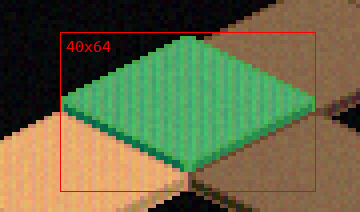
Daher zeichnet diese Funktion eine separate "Kachel" auf die Leinwand des Hauptbilds, und nach der Indizierung des Arrays "_" ist die Variable "t" für den Bildindex und p und q - für die x- und y-Koordinaten verantwortlich. Benennen Sie auch "_" in Texturen um:
Der Code im Moment:
#include <X11/Xlib.h>
#include <sys/types.h>
#include <sys/stat.h>
#include <fcntl.h>
#include <unistd.h>

/*    */

/*! \brief     */
#define IMAGE_WIDTH *1220)
/*! \brief     */
#define IMAGE_HEIGHT (616)

/*! \brief   */
#define TEXTURE_COUNT (8)
/*! \brief     */
#define TEXTURE_WIDTH (64)
/*! \brief     */
#define TEXTURE_HEIGHT (40)

/*! \brief    .
 *   int      */
int pixdata[IMAGE_HEIGHT][IMAGE_WIDTH];
int textures[TEXTURE_COUNT][TEXTURE_HEIGHT][TEXTURE_WIDTH] = { 0 };

/*! \brief   Xlib */
Display * display;
/*! \brief    Xlib */
Window window;
/*! \brief      */
XImage * image;

/* \brief  ,     */
static void _image_reset(void) {
    for (int y = 0; y < IMAGE_HEIGHT; y++)
        for (int x = 0; x < IMAGE_WIDTH; x++)
            pixdata[y][x] = 0;
}

/*! \brief
 * \param[in] t
 * \param[in] x X
 * \param[in] y Y   */
void _texture_draw(int t, int x, int y) {
    for (int ty = 0; ty < TEXTURE_HEIGHT; ty++)
        for (int tx = 0; tx < TEXTURE_WIDTH; tx++)
            if (textures[t][ty][tx])
                pixdata[ty + y * 16 + x * 16]
                       [tx + 580 + x * 32 - y * 32] = textures[t][ty][tx];
}

/*    */

int _x[] = { 15117427, 8413248, 5878632, 13027014, 1 };

char m[19][20];
int rn = 2166136261;

void *T;

void b(int t, int x, int y, int c, int l) {
    if ((x >= 19 || y >= 19 || x < 0 || y < 0) || (m[y][x] == l)
    || (m[y][x] != c))
    return;
    m[y][x] = l;
    b(t, x - 1, y, c, l);
    b(t, x + 1, y, c, l);
    b(t, x, y - 1, c, l);
    b(t, x, y + 1, c, l);
}

void e(int t, int x, int y, int c, int l) {
    if ((x >= TEXTURE_WIDTH || y >= TEXTURE_HEIGHT ||
         x < 0 || y < 0) ||
         (textures[t][y][x] == l) ||
         (textures[t][y][x] != c))
        return;
    textures[t][y][x] = l;
    e(t, x - 1, y, c, l);
    e(t, x + 1, y, c, l);
    e(t, x, y - 1, c, l);
    e(t, x, y + 1, c, l);
}

void k(int t, int x, int y, int c, int l) {
    while (c--) {
        textures[t][y][x++] = l;
        textures[t][y++][x++] = l;
    }
}

void r(int t, int x, int y, int c, int l) {
    while (c--) {
        textures[t][y][x--] = l;
        textures[t][y++][x--] = l;
    }
}

void u(int t, int x, int y, int c, int l) {
    while (c--)
        textures[t][y++][x] = l;
}

char *z[8] = {
    (char[]) {4},
    (char[]) {6, 1 * 4 + 1, 0 + 0, 32 - 0, 5 - 0, 16, 0, 0,
              21 + 0 * 3 - 0, 16, 1, 63, 21 + 0 * 3 - 0, 16, 2,
              63 * 0, 21 - 0, 4, 2, 31 + 0, 36 - 0, 4, 0 + 1,
              32 - 1, 5 - 0, 16, 0, 0, 21 + 1 * 3 - 0, 16, 1, 63,
              21 + 1 * 3 - 0, 16, 2, 63 * 1, 21 - 0, 4, 2, 31 + 1,
              36 - 0, 4, 6, 1 * 4 + 0, 3, 31, 8 - 0, 6, 1 * 4 + 2,
              3, 33, 38 - 0, 6, 1 * 4 + 3, 3, 30, 38 - 0, 4},
    (char[]) {5, 1},
    (char[]) {6, 0 * 4 + 1, 0 + 0, 32 - 0, 5 - 0, 16,
              0, 0, 21 + 0 * 3 - 0, 16, 1, 63,
              21 + 0 * 3 - 0, 16, 2, 63 * 0, 21 - 0,
              4, 2, 31 + 0, 36 - 0, 4, 0 + 1, 32 - 1,
              5 - 0, 16, 0, 0, 21 + 1 * 3 - 0, 16, 1,
              63, 21 + 1 * 3 - 0, 16, 2, 63 * 1,
              21 - 0, 4, 2, 31 + 1, 36 - 0, 4, 6,
              0 * 4 + 0, 3, 31, 8 - 0, 6, 0 * 4 + 2,
              3, 33, 38 - 0, 6, 0 * 4 + 3, 3, 30,
              38 - 0,
              4},
    (char[]) {4},
    (char[]) {4},
    (char[]) {6, 2 * 4 + 1, 0 + 0, 32 - 0, 5 - 3, 16, 0, 0,
              21 + 0 * 3 - 3, 16, 1, 63, 21 + 0 * 3 - 3, 16, 2, 63 * 0,
              21 - 3, 4, 2, 31 + 0, 36 - 3, 4, 0 + 1, 32 - 1, 5 - 3,
              16, 0, 0, 21 + 1 * 3 - 3, 16, 1, 63, 21 + 1 * 3 - 3, 16,
              2, 63 * 1, 21 - 3, 4, 2, 31 + 1, 36 - 3, 4, 6, 2 * 4 + 0,
              3, 31, 8 - 3, 6, 2 * 4 + 2, 3, 33, 38 - 3, 6, 2 * 4 + 3,
              3, 30, 38 - 3, 4},
    (char[]) {6, 13, 0, 32, 9 + 0, 12 - 0,
              0, 8 + 0 + 0, 21, 12 - 0, 1,
              31, 9 + 0, 12 - 0, 1,
              55 - 0 - 0, 21, 12 - 0, 0,
              32, 9 + 3, 12 - 3, 0,
              8 + 3 + 3, 21, 12 - 3, 1,
              31, 9 + 3, 12 - 3, 1,
              55 - 3 - 3, 21, 12 - 3, 6,
              14 + 0, 2, 31 + 0, 13, 4,
              1 - 0, 31 + 0, 16, 7, 3,
              30 + 3 * 0, 14, 6,
              12 + 0 * 4, 3, 32 - 0,
              11 + 0 * 8, 6, 14 + 1, 2,
              31 + 1, 13, 4, 1 - 1,
              31 + 1, 16, 7, 3,
              30 + 3 * 1, 14, 6,
              12 + 1 * 4, 3, 32 - 1,
              11 + 1 * 8,
              4}
};

int main(int a, char *s[]) {
    display = XOpenDisplay(0);
    window = XCreateSimpleWindow(display,
                                 RootWindow(display, DefaultScreen(display)),
                                 0, 0, IMAGE_WIDTH, IMAGE_HEIGHT, 1, 0, 0);
    image = XCreateImage(display,
                     DefaultVisual(display, DefaultScreen(display)),
                     DefaultDepth(display, DefaultScreen(display)),
                     2, 0, (char *) pixdata, IMAGE_WIDTH, IMAGE_HEIGHT, 32, 0);
    for (int i = 0; i < 8; i++) {
        char *p = z[i];
        int c = 0;
        while (*p != 4) {
            switch (*p) {
            case 0:
                k(i, p[1], p[2], p[3], c);
                p += 4;
                break;
            case 1:
                r(i, p[1], p[2], p[3], c);
                p += 4;
                break;
            case 2:
                u(i, p[1], p[2], p[3], c);
                p += 4;
                break;
            case 3:
                e(i, p[1]
                  , p[2], 0, c);
                p += 3;
                break;
            case 5:
                p = z[p[1]];
                break;
            case 6:
                c = _x[p[1] / 4] - 1643277 * (p[1] % 4);
                p += 2;
                break;
            }
        }
    }
    while (a++) {
        int f = open(s[1], 0);
        read(f, m, 380);
        close(f);

        for (int y = 0; y < 19; y++)
            for (int x = 0; x < 19; x++)
                if ((x % 14 == 2) && (y % 4 == 3))
                    m[y][x] = 46;
        b(0, 2, 3, m[3][2], a & 1 ? 43 : 45);
        b(0, 2, 7, m[7][2], a & 2 ? 43 : 45);
        b(0, 2, 11, m[11][2], a & 4 ? 43 : 45);
        b(0, 2, 15, m[15][2], a & 8 ? 43 : 45);
        for (int i = 0; i < 20; i++)
            for (int y = 0; y < 19; y++)
                for (int x = 0; x < 19; x++)
                    if (m[y][x] == 62)
                        b(0, x + 1, y, m[y][x + 1],
                            !(m[y - 1][x] == 43 ? 1 : 0
                            || m[y + 1][x] == 43 ? 1 : 0) ? 43 : 45);

        _image_reset();

        for (int y = 0; y < 19; y++)
            for (int x = 0; x < 19; x++)
                _texture_draw(((m[y][x] >> 4) & 1) << 2 | (m[y][x] & 3), x, y);

        for (int y = 0; y < 19; y++)
            for (int x = 0; x < 19; x++)
                if ((x % 14 == 2) && (y % 4 == 3))
                    _texture_draw(7, x, y);
        for (int y = 0; y < IMAGE_HEIGHT; y++)
            for (int x = 0; x < IMAGE_WIDTH; x++) {
                pixdata[y][x] &= 14737632 | (31 << ((x % 3) << 3));
                pixdata[y][x] += 986895 & (rn *= 16777619);
            }
        XPutImage(display, window,
                  DefaultGC(display, DefaultScreen(display)),
                  image, 0, 0, 0, 0, IMAGE_WIDTH, IMAGE_HEIGHT);
        XMapWindow(display, window);
        XFlush(display);

        sleep(1);
    }
    return 0;
}
Karte lesen
Lassen Sie uns die Zeilen open..close in eine separate Funktion trennen, in der der Inhalt der ausgewählten Datei in die Variable m eingelesen wird (die wir in mapdata umbenennen).
Warum wird die Datei in jedem Zyklus gezählt? Es war kürzer in Bezug auf Code und Token. Das "Rammen" des Codes dauerte ungefähr 4 Tage, um in die Grenzen der Regeln zu passen. Wenn Sie die Datei nur einmal lesen, sind zusätzlicher Speicher und ein Analogon der memcpy-Funktion erforderlich.
Spezielle Funktion _map_read
#include <X11/Xlib.h>
#include <sys/types.h>
#include <sys/stat.h>
#include <fcntl.h>
#include <unistd.h>

/*    */

/*! \brief     */
#define IMAGE_WIDTH (1220)
/*! \brief     */
#define IMAGE_HEIGHT (616)
/*! \brief        */
#define IMAGE_SHIFTX (580)

/*! \brief   */
#define TEXTURE_COUNT (8)
/*! \brief     */
#define TEXTURE_WIDTH (64)
/*! \brief     */
#define TEXTURE_HEIGHT (40)
/*! \brief      */
#define TEXTURE_TOP_WIDTH (64)
/*! \brief      */
#define TEXTURE_TOP_HEIGHT (32)

/*! \brief    */
#define MAP_WIDTH (19)
/*! \brief    */
#define MAP_HEIGHT (19)
/*! \brief    -.      '\n' */
#define MAP_FILEDATA ((MAP_WIDTH + 1) * MAP_HEIGHT)

/*! \brief    .
 *   int      */
int pixdata[IMAGE_HEIGHT][IMAGE_WIDTH];
/*! \brief  ,    */
int textures[TEXTURE_COUNT][TEXTURE_HEIGHT][TEXTURE_WIDTH] = { 0 };
/*! \brief   .
 *        '\n' */
char mapdata[MAP_HEIGHT][MAP_WIDTH + 1];

/*! \brief   Xlib */
Display * display;
/*! \brief    Xlib */
Window window;
/*! \brief      */
XImage * image;

/* \brief  ,     */
static void _image_reset(void) {
    for (int y = 0; y < IMAGE_HEIGHT; y++)
        for (int x = 0; x < IMAGE_WIDTH; x++)
            pixdata[y][x] = 0;
}

/*! \brief
 * \param[in] t
 * \param[in] x X
 * \param[in] y Y   */
static void _texture_draw(int t, int x, int y) {
    for (int ty = 0; ty < TEXTURE_HEIGHT; ty++)
        for (int tx = 0; tx < TEXTURE_WIDTH; tx++)
            if (textures[t][ty][tx])
                pixdata[ty +
                        y * (TEXTURE_TOP_HEIGHT / 2) +
                        x * (TEXTURE_TOP_HEIGHT / 2)]
                       [tx +
                        IMAGE_SHIFTX +
                        x * (TEXTURE_TOP_WIDTH / 2) -
                        y * TEXTURE_TOP_HEIGHT] = textures[t][ty][tx];
}

/*! \brief   -
 * \param[in] filename  - */
static void _map_read(const char * filename) {
    int f = open(filename, 0);
    read(f, mapdata, MAP_FILEDATA);
    close(f);
}

/*    */

int _x[] = { 15117427, 8413248, 5878632, 13027014, 1 };
int rn = 2166136261;

void *T;

void b(int t, int x, int y, int c, int l) {
    if ((x >= MAP_WIDTH || y >= MAP_HEIGHT ||
         x < 0 || y < 0) || (mapdata[y][x] == l)
        || (mapdata[y][x] != c))
        return;
    mapdata[y][x] = l;
    b(t, x - 1, y, c, l);
    b(t, x + 1, y, c, l);
    b(t, x, y - 1, c, l);
    b(t, x, y + 1, c, l);
}

void e(int t, int x, int y, int c, int l) {
    if ((x >= TEXTURE_WIDTH || y >= TEXTURE_HEIGHT ||
         x < 0 || y < 0) ||
         (textures[t][y][x] == l) ||
         (textures[t][y][x] != c))
        return;
    textures[t][y][x] = l;
    e(t, x - 1, y, c, l);
    e(t, x + 1, y, c, l);
    e(t, x, y - 1, c, l);
    e(t, x, y + 1, c, l);
}

void k(int t, int x, int y, int c, int l) {
    while (c--) {
        textures[t][y][x++] = l;
        textures[t][y++][x++] = l;
    }
}

void r(int t, int x, int y, int c, int l) {
    while (c--) {
        textures[t][y][x--] = l;
        textures[t][y++][x--] = l;
    }
}

void u(int t, int x, int y, int c, int l) {
    while (c--)
        textures[t][y++][x] = l;
}

char *z[8] = {
    (char[]) {4},
    (char[]) {6, 1 * 4 + 1, 0 + 0, 32 - 0, 5 - 0, 16, 0, 0,
              21 + 0 * 3 - 0, 16, 1, 63, 21 + 0 * 3 - 0, 16, 2,
              63 * 0, 21 - 0, 4, 2, 31 + 0, 36 - 0, 4, 0 + 1,
              32 - 1, 5 - 0, 16, 0, 0, 21 + 1 * 3 - 0, 16, 1, 63,
              21 + 1 * 3 - 0, 16, 2, 63 * 1, 21 - 0, 4, 2, 31 + 1,
              36 - 0, 4, 6, 1 * 4 + 0, 3, 31, 8 - 0, 6, 1 * 4 + 2,
              3, 33, 38 - 0, 6, 1 * 4 + 3, 3, 30, 38 - 0, 4},
    (char[]) {5, 1},
    (char[]) {6, 0 * 4 + 1, 0 + 0, 32 - 0, 5 - 0, 16,
              0, 0, 21 + 0 * 3 - 0, 16, 1, 63,
              21 + 0 * 3 - 0, 16, 2, 63 * 0, 21 - 0,
              4, 2, 31 + 0, 36 - 0, 4, 0 + 1, 32 - 1,
              5 - 0, 16, 0, 0, 21 + 1 * 3 - 0, 16, 1,
              63, 21 + 1 * 3 - 0, 16, 2, 63 * 1,
              21 - 0, 4, 2, 31 + 1, 36 - 0, 4, 6,
              0 * 4 + 0, 3, 31, 8 - 0, 6, 0 * 4 + 2,
              3, 33, 38 - 0, 6, 0 * 4 + 3, 3, 30,
              38 - 0,
              4},
    (char[]) {4},
    (char[]) {4},
    (char[]) {6, 2 * 4 + 1, 0 + 0, 32 - 0, 5 - 3, 16, 0, 0,
              21 + 0 * 3 - 3, 16, 1, 63, 21 + 0 * 3 - 3, 16, 2, 63 * 0,
              21 - 3, 4, 2, 31 + 0, 36 - 3, 4, 0 + 1, 32 - 1, 5 - 3,
              16, 0, 0, 21 + 1 * 3 - 3, 16, 1, 63, 21 + 1 * 3 - 3, 16,
              2, 63 * 1, 21 - 3, 4, 2, 31 + 1, 36 - 3, 4, 6, 2 * 4 + 0,
              3, 31, 8 - 3, 6, 2 * 4 + 2, 3, 33, 38 - 3, 6, 2 * 4 + 3,
              3, 30, 38 - 3, 4},
    (char[]) {6, 13, 0, 32, 9 + 0, 12 - 0,
              0, 8 + 0 + 0, 21, 12 - 0, 1,
              31, 9 + 0, 12 - 0, 1,
              55 - 0 - 0, 21, 12 - 0, 0,
              32, 9 + 3, 12 - 3, 0,
              8 + 3 + 3, 21, 12 - 3, 1,
              31, 9 + 3, 12 - 3, 1,
              55 - 3 - 3, 21, 12 - 3, 6,
              14 + 0, 2, 31 + 0, 13, 4,
              1 - 0, 31 + 0, 16, 7, 3,
              30 + 3 * 0, 14, 6,
              12 + 0 * 4, 3, 32 - 0,
              11 + 0 * 8, 6, 14 + 1, 2,
              31 + 1, 13, 4, 1 - 1,
              31 + 1, 16, 7, 3,
              30 + 3 * 1, 14, 6,
              12 + 1 * 4, 3, 32 - 1,
              11 + 1 * 8,
              4}
};

int main(int a, char *s[]) {
    display = XOpenDisplay(0);
    window = XCreateSimpleWindow(display,
                                 RootWindow(display, DefaultScreen(display)),
                                 0, 0, IMAGE_WIDTH, IMAGE_HEIGHT, 1, 0, 0);
    image = XCreateImage(display,
                     DefaultVisual(display, DefaultScreen(display)),
                     DefaultDepth(display, DefaultScreen(display)),
                     2, 0, (char *) pixdata, IMAGE_WIDTH, IMAGE_HEIGHT, 32, 0);
    for (int i = 0; i < 8; i++) {
        char *p = z[i];
        int c = 0;
        while (*p != 4) {
            switch (*p) {
            case 0:
                k(i, p[1], p[2], p[3], c);
                p += 4;
                break;
            case 1:
                r(i, p[1], p[2], p[3], c);
                p += 4;
                break;
            case 2:
                u(i, p[1], p[2], p[3], c);
                p += 4;
                break;
            case 3:
                e(i, p[1]
                  , p[2], 0, c);
                p += 3;
                break;
            case 5:
                p = z[p[1]];
                break;
            case 6:
                c = _x[p[1] / 4] - 1643277 * (p[1] % 4);
                p += 2;
                break;
            }
        }
    }
    while (a++) {
        _map_read(s[1]);

        for (int y = 0; y < MAP_HEIGHT; y++)
            for (int x = 0; x < MAP_WIDTH; x++)
                if ((x % 14 == 2) && (y % 4 == 3))
                    mapdata[y][x] = 46;
        b(0, 2, 3, mapdata[3][2], a & 1 ? 43 : 45);
        b(0, 2, 7, mapdata[7][2], a & 2 ? 43 : 45);
        b(0, 2, 11, mapdata[11][2], a & 4 ? 43 : 45);
        b(0, 2, 15, mapdata[15][2], a & 8 ? 43 : 45);
        for (int i = 0; i < 20; i++)
            for (int y = 0; y < MAP_HEIGHT; y++)
                for (int x = 0; x < MAP_WIDTH; x++)
                    if (mapdata[y][x] == 62)
                        b(0, x + 1, y, mapdata[y][x + 1],
                            !(mapdata[y - 1][x] == 43 ? 1 : 0
                            || mapdata[y + 1][x] == 43 ? 1 : 0) ? 43 : 45);

        _image_reset();

        for (int y = 0; y < MAP_HEIGHT; y++)
            for (int x = 0; x < MAP_WIDTH; x++)
                _texture_draw(((m[y][x] >> 4) & 1) << 2 | (mapdata[y][x] & 3), x, y);

        for (int y = 0; y < MAP_HEIGHT; y++)
            for (int x = 0; x < MAP_WIDTH; x++)
                if ((x % 14 == 2) && (y % 4 == 3))
                    _texture_draw(7, x, y);
        for (int y = 0; y < IMAGE_HEIGHT; y++)
            for (int x = 0; x < IMAGE_WIDTH; x++) {
                pixdata[y][x] &= 14737632 | (31 << ((x % 3) << 3));
                pixdata[y][x] += 986895 & (rn *= 16777619);
            }
        XPutImage(display, window,
                  DefaultGC(display, DefaultScreen(display)),
                  image, 0, 0, 0, 0, IMAGE_WIDTH, IMAGE_HEIGHT);
        XMapWindow(display, window);
        XFlush(display);

        sleep(1);
    }
    return 0;
}
Da wir die Mapdata-Variable berührt haben, achten wir auf die Zeilen und Funktionen, in denen sie sich ändert. Dies ist die Funktion "b", die wir vorerst nicht berühren werden, und "main", in der wir unter Berücksichtigung des Inhalts der "vollständigen" Konfigurationsdateien Folgendes umgestalten:
Nach dem Refactoring von Mapdata
#include <X11/Xlib.h>
#include <sys/types.h>
#include <sys/stat.h>
#include <fcntl.h>
#include <unistd.h>

/*    */

/*! \brief     */
#define IMAGE_WIDTH (1220)
/*! \brief     */
#define IMAGE_HEIGHT (616)
/*! \brief        */
#define IMAGE_SHIFTX (580)

/*! \brief   */
#define TEXTURE_COUNT (8)
/*! \brief     */
#define TEXTURE_WIDTH (64)
/*! \brief     */
#define TEXTURE_HEIGHT (40)
/*! \brief      */
#define TEXTURE_TOP_WIDTH (64)
/*! \brief      */
#define TEXTURE_TOP_HEIGHT (32)

/*! \brief    */
#define MAP_WIDTH (19)
/*! \brief    */
#define MAP_HEIGHT (19)
/*! \brief    -.      '\n' */
#define MAP_FILEDATA ((MAP_WIDTH + 1) * MAP_HEIGHT)
/*! \brief      NOR- */
#define MAP_ITERATIONS (20)

/*! \brief    - */
enum map_characters {
    MAPCHAR_WIRE  = '.', /**<             (ASCII = 46) */
    MAPCHAR_PLUS  = '+', /**<  ( ) (ASCII = 43) */
    MAPCHAR_MINUS = '-', /**<  ( ) (ASCII = 45) */
    MAPCHAR_NOR   = '>', /**< NOR-       (ASCII = 62) */
}

/*! \brief    .
 *   int      */
int pixdata[IMAGE_HEIGHT][IMAGE_WIDTH];
/*! \brief  ,    */
int textures[TEXTURE_COUNT][TEXTURE_HEIGHT][TEXTURE_WIDTH] = { 0 };
/*! \brief   .
 *        '\n' */
char mapdata[MAP_HEIGHT][MAP_WIDTH + 1];

/*! \brief   Xlib */
Display * display;
/*! \brief    Xlib */
Window window;
/*! \brief      */
XImage * image;

/* \brief  ,     */
static void _image_reset(void) {
    for (int y = 0; y < IMAGE_HEIGHT; y++)
        for (int x = 0; x < IMAGE_WIDTH; x++)
            pixdata[y][x] = 0;
}

/*! \brief
 * \param[in] t
 * \param[in] x X
 * \param[in] y Y   */
static void _texture_draw(int t, int x, int y) {
    for (int ty = 0; ty < TEXTURE_HEIGHT; ty++)
        for (int tx = 0; tx < TEXTURE_WIDTH; tx++)
            if (textures[t][ty][tx])
                pixdata[ty +
                        y * (TEXTURE_TOP_HEIGHT / 2) +
                        x * (TEXTURE_TOP_HEIGHT / 2)]
                       [tx +
                        IMAGE_SHIFTX +
                        x * (TEXTURE_TOP_WIDTH / 2) -
                        y * TEXTURE_TOP_HEIGHT] = textures[t][ty][tx];
}

/*! \brief   -
 * \param[in] filename  - */
static void _map_read(const char * filename) {
    int f = open(filename, 0);
    read(f, mapdata, MAP_FILEDATA);
    close(f);
}

/*! \brief     -
 *          */
static void _map_wire_inputs(void) {
    for (int y = 0; y < MAP_HEIGHT; y++)
        for (int x = 0; x < MAP_WIDTH; x++)
            if ((x % 14 == 2) && (y % 4 == 3))
                mapdata[y][x] = MAPCHAR_WIRE;
}

/*! \brief
 * .
 * \param[in] counter  */
static void _map_wire_counter(int counter) {
    b(0, 2, 3,  mapdata[3][2],  counter & 1 ? MAPCHAR_PLUS : MAPCHAR_MINUS);
    b(0, 2, 7,  mapdata[7][2],  counter & 2 ? MAPCHAR_PLUS : MAPCHAR_MINUS);
    b(0, 2, 11, mapdata[11][2], counter & 4 ? MAPCHAR_PLUS : MAPCHAR_MINUS);
    b(0, 2, 15, mapdata[15][2], counter & 8 ? MAPCHAR_PLUS : MAPCHAR_MINUS);
}

/*! \brief    ()   NOR- */
static void _map_process_gates(void) {
    for (int i = 0; i < MAP_ITERATIONS; i++)
        for (int y = 0; y < MAP_HEIGHT; y++)
            for (int x = 0; x < MAP_WIDTH; x++)
                if (mapdata[y][x] == MAPCHAR_NOR)
                    b(0, x + 1, y, mapdata[y][x + 1],
                        !(mapdata[y - 1][x] == MAPCHAR_PLUS ? 1 : 0
                       || mapdata[y + 1][x] == MAPCHAR_PLUS ? 1 : 0) ?
                            MAPCHAR_PLUS : MAPCHAR_MINUS);
}

/*    */

int _x[] = { 15117427, 8413248, 5878632, 13027014, 1 };
int rn = 2166136261;

void *T;

void b(int t, int x, int y, int c, int l) {
    if ((x >= MAP_WIDTH || y >= MAP_HEIGHT ||
         x < 0 || y < 0) || (mapdata[y][x] == l)
        || (mapdata[y][x] != c))
        return;
    mapdata[y][x] = l;
    b(t, x - 1, y, c, l);
    b(t, x + 1, y, c, l);
    b(t, x, y - 1, c, l);
    b(t, x, y + 1, c, l);
}

void e(int t, int x, int y, int c, int l) {
    if ((x >= TEXTURE_WIDTH || y >= TEXTURE_HEIGHT ||
         x < 0 || y < 0) ||
         (textures[t][y][x] == l) ||
         (textures[t][y][x] != c))
        return;
    textures[t][y][x] = l;
    e(t, x - 1, y, c, l);
    e(t, x + 1, y, c, l);
    e(t, x, y - 1, c, l);
    e(t, x, y + 1, c, l);
}

void k(int t, int x, int y, int c, int l) {
    while (c--) {
        textures[t][y][x++] = l;
        textures[t][y++][x++] = l;
    }
}

void r(int t, int x, int y, int c, int l) {
    while (c--) {
        textures[t][y][x--] = l;
        textures[t][y++][x--] = l;
    }
}

void u(int t, int x, int y, int c, int l) {
    while (c--)
        textures[t][y++][x] = l;
}

char *z[8] = {
    (char[]) {4},
    (char[]) {6, 1 * 4 + 1, 0 + 0, 32 - 0, 5 - 0, 16, 0, 0,
              21 + 0 * 3 - 0, 16, 1, 63, 21 + 0 * 3 - 0, 16, 2,
              63 * 0, 21 - 0, 4, 2, 31 + 0, 36 - 0, 4, 0 + 1,
              32 - 1, 5 - 0, 16, 0, 0, 21 + 1 * 3 - 0, 16, 1, 63,
              21 + 1 * 3 - 0, 16, 2, 63 * 1, 21 - 0, 4, 2, 31 + 1,
              36 - 0, 4, 6, 1 * 4 + 0, 3, 31, 8 - 0, 6, 1 * 4 + 2,
              3, 33, 38 - 0, 6, 1 * 4 + 3, 3, 30, 38 - 0, 4},
    (char[]) {5, 1},
    (char[]) {6, 0 * 4 + 1, 0 + 0, 32 - 0, 5 - 0, 16,
              0, 0, 21 + 0 * 3 - 0, 16, 1, 63,
              21 + 0 * 3 - 0, 16, 2, 63 * 0, 21 - 0,
              4, 2, 31 + 0, 36 - 0, 4, 0 + 1, 32 - 1,
              5 - 0, 16, 0, 0, 21 + 1 * 3 - 0, 16, 1,
              63, 21 + 1 * 3 - 0, 16, 2, 63 * 1,
              21 - 0, 4, 2, 31 + 1, 36 - 0, 4, 6,
              0 * 4 + 0, 3, 31, 8 - 0, 6, 0 * 4 + 2,
              3, 33, 38 - 0, 6, 0 * 4 + 3, 3, 30,
              38 - 0,
              4},
    (char[]) {4},
    (char[]) {4},
    (char[]) {6, 2 * 4 + 1, 0 + 0, 32 - 0, 5 - 3, 16, 0, 0,
              21 + 0 * 3 - 3, 16, 1, 63, 21 + 0 * 3 - 3, 16, 2, 63 * 0,
              21 - 3, 4, 2, 31 + 0, 36 - 3, 4, 0 + 1, 32 - 1, 5 - 3,
              16, 0, 0, 21 + 1 * 3 - 3, 16, 1, 63, 21 + 1 * 3 - 3, 16,
              2, 63 * 1, 21 - 3, 4, 2, 31 + 1, 36 - 3, 4, 6, 2 * 4 + 0,
              3, 31, 8 - 3, 6, 2 * 4 + 2, 3, 33, 38 - 3, 6, 2 * 4 + 3,
              3, 30, 38 - 3, 4},
    (char[]) {6, 13, 0, 32, 9 + 0, 12 - 0,
              0, 8 + 0 + 0, 21, 12 - 0, 1,
              31, 9 + 0, 12 - 0, 1,
              55 - 0 - 0, 21, 12 - 0, 0,
              32, 9 + 3, 12 - 3, 0,
              8 + 3 + 3, 21, 12 - 3, 1,
              31, 9 + 3, 12 - 3, 1,
              55 - 3 - 3, 21, 12 - 3, 6,
              14 + 0, 2, 31 + 0, 13, 4,
              1 - 0, 31 + 0, 16, 7, 3,
              30 + 3 * 0, 14, 6,
              12 + 0 * 4, 3, 32 - 0,
              11 + 0 * 8, 6, 14 + 1, 2,
              31 + 1, 13, 4, 1 - 1,
              31 + 1, 16, 7, 3,
              30 + 3 * 1, 14, 6,
              12 + 1 * 4, 3, 32 - 1,
              11 + 1 * 8,
              4}
};

int main(int a, char *s[]) {
    display = XOpenDisplay(0);
    window = XCreateSimpleWindow(display,
                                 RootWindow(display, DefaultScreen(display)),
                                 0, 0, IMAGE_WIDTH, IMAGE_HEIGHT, 1, 0, 0);
    image = XCreateImage(display,
                     DefaultVisual(display, DefaultScreen(display)),
                     DefaultDepth(display, DefaultScreen(display)),
                     2, 0, (char *) pixdata, IMAGE_WIDTH, IMAGE_HEIGHT, 32, 0);
    for (int i = 0; i < 8; i++) {
        char *p = z[i];
        int c = 0;
        while (*p != 4) {
            switch (*p) {
            case 0:
                k(i, p[1], p[2], p[3], c);
                p += 4;
                break;
            case 1:
                r(i, p[1], p[2], p[3], c);
                p += 4;
                break;
            case 2:
                u(i, p[1], p[2], p[3], c);
                p += 4;
                break;
            case 3:
                e(i, p[1]
                  , p[2], 0, c);
                p += 3;
                break;
            case 5:
                p = z[p[1]];
                break;
            case 6:
                c = _x[p[1] / 4] - 1643277 * (p[1] % 4);
                p += 2;
                break;
            }
        }
    }
    while (a++) {
        _map_read(s[1]);
        _map_wire_inputs();
        _map_wire_counter(a);
        _map_process_gates();

        _image_reset();

        for (int y = 0; y < MAP_HEIGHT; y++)
            for (int x = 0; x < MAP_WIDTH; x++)
                _texture_draw(((mapdata[y][x] >> 4) & 1) << 2 | (mapdata[y][x] & 3), x, y);

        for (int y = 0; y < MAP_HEIGHT; y++)
            for (int x = 0; x < MAP_WIDTH; x++)
                if ((x % 14 == 2) && (y % 4 == 3))
                    _texture_draw(7, x, y);
        for (int y = 0; y < IMAGE_HEIGHT; y++)
            for (int x = 0; x < IMAGE_WIDTH; x++) {
                pixdata[y][x] &= 14737632 | (31 << ((x % 3) << 3));
                pixdata[y][x] += 986895 & (rn *= 16777619);
            }
        XPutImage(display, window,
                  DefaultGC(display, DefaultScreen(display)),
                  image, 0, 0, 0, 0, IMAGE_WIDTH, IMAGE_HEIGHT);
        XMapWindow(display, window);
        XFlush(display);

        sleep(1);
    }
    return 0;
}
Um die Bearbeitung der Arbeit mit "mapdata" abzuschließen, müssen Sie zwei weitere Fragen beantworten - was ist die Funktion "b":
void b(int t, int x, int y, int c, int l) {
    if ((x >= MAP_WIDTH || y >= MAP_HEIGHT ||
         x < 0 || y < 0) || (mapdata[y][x] == l)
        || (mapdata[y][x] != c))
        return;
    mapdata[y][x] = l;
    b(t, x - 1, y, c, l);
    b(t, x + 1, y, c, l);
    b(t, x, y - 1, c, l);
    b(t, x, y + 1, c, l);
}
Und was passiert im Block:
        for (int y = 0; y < MAP_HEIGHT; y++)
            for (int x = 0; x < MAP_WIDTH; x++)
                _texture_draw(((mapdata[y][x] >> 4) & 1) << 2 | (mapdata[y][x] & 3), x, y);
Funktion "b"
Wenn Sie sich die Funktion "b" genau ansehen, werden Sie feststellen, dass sie der Implementierung des Flood_fill- Algorithmus , der mit seinem theoretischen Zweck übereinstimmt, schmerzlich ähnlich ist - er "überflutet" den "Draht" mit dem gewünschten Zustand, sodass sich die aktuelle Wellenfront bis zum Ende des Drahtes ausbreiten kann. Benennen wir es um und platzieren es im Block "Produktion bereit".
Hochwasser füllen
#include <X11/Xlib.h>
#include <sys/types.h>
#include <sys/stat.h>
#include <fcntl.h>
#include <unistd.h>

/*    */

/*! \brief     */
#define IMAGE_WIDTH (1220)
/*! \brief     */
#define IMAGE_HEIGHT (616)
/*! \brief        */
#define IMAGE_SHIFTX (580)

/*! \brief   */
#define TEXTURE_COUNT (8)
/*! \brief     */
#define TEXTURE_WIDTH (64)
/*! \brief     */
#define TEXTURE_HEIGHT (40)
/*! \brief      */
#define TEXTURE_TOP_WIDTH (64)
/*! \brief      */
#define TEXTURE_TOP_HEIGHT (32)

/*! \brief    */
#define MAP_WIDTH (19)
/*! \brief    */
#define MAP_HEIGHT (19)
/*! \brief    -.      '\n' */
#define MAP_FILEDATA ((MAP_WIDTH + 1) * MAP_HEIGHT)
/*! \brief      NOR- */
#define MAP_ITERATIONS (20)

/*! \brief    - */
enum map_characters {
    MAPCHAR_WIRE  = '.', /**<             (ASCII = 46) */
    MAPCHAR_PLUS  = '+', /**<  ( ) (ASCII = 43) */
    MAPCHAR_MINUS = '-', /**<  ( ) (ASCII = 45) */
    MAPCHAR_NOR   = '>', /**< NOR-       (ASCII = 62) */
};

/*! \brief    .
 *   int      */
int pixdata[IMAGE_HEIGHT][IMAGE_WIDTH];
/*! \brief  ,    */
int textures[TEXTURE_COUNT][TEXTURE_HEIGHT][TEXTURE_WIDTH] = { 0 };
/*! \brief   .
 *        '\n' */
char mapdata[MAP_HEIGHT][MAP_WIDTH + 1];

/*! \brief   Xlib */
Display * display;
/*! \brief    Xlib */
Window window;
/*! \brief      */
XImage * image;

/* \brief  ,     */
static void _image_reset(void) {
    for (int y = 0; y < IMAGE_HEIGHT; y++)
        for (int x = 0; x < IMAGE_WIDTH; x++)
            pixdata[y][x] = 0;
}

/*! \brief
 * \param[in] t
 * \param[in] x X
 * \param[in] y Y   */
static void _texture_draw(int t, int x, int y) {
    for (int ty = 0; ty < TEXTURE_HEIGHT; ty++)
        for (int tx = 0; tx < TEXTURE_WIDTH; tx++)
            if (textures[t][ty][tx])
                pixdata[ty +
                        y * (TEXTURE_TOP_HEIGHT / 2) +
                        x * (TEXTURE_TOP_HEIGHT / 2)]
                       [tx +
                        IMAGE_SHIFTX +
                        x * (TEXTURE_TOP_WIDTH / 2) -
                        y * TEXTURE_TOP_HEIGHT] = textures[t][ty][tx];
}

/*! \brief   -
 * \param[in] filename  - */
static void _map_read(const char * filename) {
    int f = open(filename, 0);
    read(f, mapdata, MAP_FILEDATA);
    close(f);
}

/*! \brief     -
 *          */
static void _map_wire_inputs(void) {
    for (int y = 0; y < MAP_HEIGHT; y++)
        for (int x = 0; x < MAP_WIDTH; x++)
            if ((x % 14 == 2) && (y % 4 == 3))
                mapdata[y][x] = MAPCHAR_WIRE;
}

/*! \brief
 * \param[in] t ,
 * \param[in] x X-
 * \param[in] y Y-
 * \param[in] c
 * \param[in] l   */
static void _map_fill(int t, int x, int y, int c, int l) {
    if ((x >= MAP_WIDTH || y >= MAP_HEIGHT ||
         x < 0 || y < 0) || (mapdata[y][x] == l)
        || (mapdata[y][x] != c))
        return;
    mapdata[y][x] = l;
    _map_fill(t, x - 1, y, c, l);
    _map_fill(t, x + 1, y, c, l);
    _map_fill(t, x, y - 1, c, l);
    _map_fill(t, x, y + 1, c, l);
}

/*! \brief
 * .
 * \param[in] counter  */
static void _map_wire_counter(int counter) {
    _map_fill(0, 2, 3,  mapdata[3][2],  counter & 1 ? MAPCHAR_PLUS : MAPCHAR_MINUS);
    _map_fill(0, 2, 7,  mapdata[7][2],  counter & 2 ? MAPCHAR_PLUS : MAPCHAR_MINUS);
    _map_fill(0, 2, 11, mapdata[11][2], counter & 4 ? MAPCHAR_PLUS : MAPCHAR_MINUS);
    _map_fill(0, 2, 15, mapdata[15][2], counter & 8 ? MAPCHAR_PLUS : MAPCHAR_MINUS);
}

/*! \brief    ()   NOR- */
static void _map_process_gates(void) {
    for (int i = 0; i < MAP_ITERATIONS; i++)
        for (int y = 0; y < MAP_HEIGHT; y++)
            for (int x = 0; x < MAP_WIDTH; x++)
                if (mapdata[y][x] == MAPCHAR_NOR)
                    _map_fill(0, x + 1, y, mapdata[y][x + 1],
                        !(mapdata[y - 1][x] == MAPCHAR_PLUS ? 1 : 0
                       || mapdata[y + 1][x] == MAPCHAR_PLUS ? 1 : 0) ?
                            MAPCHAR_PLUS : MAPCHAR_MINUS);
}

/*    */

int _x[] = { 15117427, 8413248, 5878632, 13027014, 1 };
int rn = 2166136261;

void *T;

void e(int t, int x, int y, int c, int l) {
    if ((x >= TEXTURE_WIDTH || y >= TEXTURE_HEIGHT ||
         x < 0 || y < 0) ||
         (textures[t][y][x] == l) ||
         (textures[t][y][x] != c))
        return;
    textures[t][y][x] = l;
    e(t, x - 1, y, c, l);
    e(t, x + 1, y, c, l);
    e(t, x, y - 1, c, l);
    e(t, x, y + 1, c, l);
}

void k(int t, int x, int y, int c, int l) {
    while (c--) {
        textures[t][y][x++] = l;
        textures[t][y++][x++] = l;
    }
}

void r(int t, int x, int y, int c, int l) {
    while (c--) {
        textures[t][y][x--] = l;
        textures[t][y++][x--] = l;
    }
}

void u(int t, int x, int y, int c, int l) {
    while (c--)
        textures[t][y++][x] = l;
}

char *z[8] = {
    (char[]) {4},
    (char[]) {6, 1 * 4 + 1, 0 + 0, 32 - 0, 5 - 0, 16, 0, 0,
              21 + 0 * 3 - 0, 16, 1, 63, 21 + 0 * 3 - 0, 16, 2,
              63 * 0, 21 - 0, 4, 2, 31 + 0, 36 - 0, 4, 0 + 1,
              32 - 1, 5 - 0, 16, 0, 0, 21 + 1 * 3 - 0, 16, 1, 63,
              21 + 1 * 3 - 0, 16, 2, 63 * 1, 21 - 0, 4, 2, 31 + 1,
              36 - 0, 4, 6, 1 * 4 + 0, 3, 31, 8 - 0, 6, 1 * 4 + 2,
              3, 33, 38 - 0, 6, 1 * 4 + 3, 3, 30, 38 - 0, 4},
    (char[]) {5, 1},
    (char[]) {6, 0 * 4 + 1, 0 + 0, 32 - 0, 5 - 0, 16,
              0, 0, 21 + 0 * 3 - 0, 16, 1, 63,
              21 + 0 * 3 - 0, 16, 2, 63 * 0, 21 - 0,
              4, 2, 31 + 0, 36 - 0, 4, 0 + 1, 32 - 1,
              5 - 0, 16, 0, 0, 21 + 1 * 3 - 0, 16, 1,
              63, 21 + 1 * 3 - 0, 16, 2, 63 * 1,
              21 - 0, 4, 2, 31 + 1, 36 - 0, 4, 6,
              0 * 4 + 0, 3, 31, 8 - 0, 6, 0 * 4 + 2,
              3, 33, 38 - 0, 6, 0 * 4 + 3, 3, 30,
              38 - 0,
              4},
    (char[]) {4},
    (char[]) {4},
    (char[]) {6, 2 * 4 + 1, 0 + 0, 32 - 0, 5 - 3, 16, 0, 0,
              21 + 0 * 3 - 3, 16, 1, 63, 21 + 0 * 3 - 3, 16, 2, 63 * 0,
              21 - 3, 4, 2, 31 + 0, 36 - 3, 4, 0 + 1, 32 - 1, 5 - 3,
              16, 0, 0, 21 + 1 * 3 - 3, 16, 1, 63, 21 + 1 * 3 - 3, 16,
              2, 63 * 1, 21 - 3, 4, 2, 31 + 1, 36 - 3, 4, 6, 2 * 4 + 0,
              3, 31, 8 - 3, 6, 2 * 4 + 2, 3, 33, 38 - 3, 6, 2 * 4 + 3,
              3, 30, 38 - 3, 4},
    (char[]) {6, 13, 0, 32, 9 + 0, 12 - 0,
              0, 8 + 0 + 0, 21, 12 - 0, 1,
              31, 9 + 0, 12 - 0, 1,
              55 - 0 - 0, 21, 12 - 0, 0,
              32, 9 + 3, 12 - 3, 0,
              8 + 3 + 3, 21, 12 - 3, 1,
              31, 9 + 3, 12 - 3, 1,
              55 - 3 - 3, 21, 12 - 3, 6,
              14 + 0, 2, 31 + 0, 13, 4,
              1 - 0, 31 + 0, 16, 7, 3,
              30 + 3 * 0, 14, 6,
              12 + 0 * 4, 3, 32 - 0,
              11 + 0 * 8, 6, 14 + 1, 2,
              31 + 1, 13, 4, 1 - 1,
              31 + 1, 16, 7, 3,
              30 + 3 * 1, 14, 6,
              12 + 1 * 4, 3, 32 - 1,
              11 + 1 * 8,
              4}
};

int main(int a, char *s[]) {
    display = XOpenDisplay(0);
    window = XCreateSimpleWindow(display,
                                 RootWindow(display, DefaultScreen(display)),
                                 0, 0, IMAGE_WIDTH, IMAGE_HEIGHT, 1, 0, 0);
    image = XCreateImage(display,
                     DefaultVisual(display, DefaultScreen(display)),
                     DefaultDepth(display, DefaultScreen(display)),
                     2, 0, (char *) pixdata, IMAGE_WIDTH, IMAGE_HEIGHT, 32, 0);
    for (int i = 0; i < 8; i++) {
        char *p = z[i];
        int c = 0;
        while (*p != 4) {
            switch (*p) {
            case 0:
                k(i, p[1], p[2], p[3], c);
                p += 4;
                break;
            case 1:
                r(i, p[1], p[2], p[3], c);
                p += 4;
                break;
            case 2:
                u(i, p[1], p[2], p[3], c);
                p += 4;
                break;
            case 3:
                e(i, p[1]
                  , p[2], 0, c);
                p += 3;
                break;
            case 5:
                p = z[p[1]];
                break;
            case 6:
                c = _x[p[1] / 4] - 1643277 * (p[1] % 4);
                p += 2;
                break;
            }
        }
    }
    while (a++) {
        _map_read(s[1]);
        _map_wire_inputs();
        _map_wire_counter(a);
        _map_process_gates();

        _image_reset();

        for (int y = 0; y < MAP_HEIGHT; y++)
            for (int x = 0; x < MAP_WIDTH; x++)
                _texture_draw(((mapdata[y][x] >> 4) & 1) << 2 | (mapdata[y][x] & 3), x, y);

        for (int y = 0; y < MAP_HEIGHT; y++)
            for (int x = 0; x < MAP_WIDTH; x++)
                if ((x % 14 == 2) && (y % 4 == 3))
                    _texture_draw(7, x, y);
        for (int y = 0; y < IMAGE_HEIGHT; y++)
            for (int x = 0; x < IMAGE_WIDTH; x++) {
                pixdata[y][x] &= 14737632 | (31 << ((x % 3) << 3));
                pixdata[y][x] += 986895 & (rn *= 16777619);
            }
        XPutImage(display, window,
                  DefaultGC(display, DefaultScreen(display)),
                  image, 0, 0, 0, 0, IMAGE_WIDTH, IMAGE_HEIGHT);
        XMapWindow(display, window);
        XFlush(display);

        sleep(1);
    }
    return 0;
}
Seltsamer Block
Jetzt bleibt zu analysieren, was in der Zeile passiert:
_texture_draw(((mapdata[y][x] >> 4) & 1) << 2 | (mapdata[y][x] & 3), x, y);Da wir bereits eine vollständige Tabelle mit Zuständen erstellt haben, die sich in den Map-Daten befinden können, können wir alle Ausgabewerte des ersten Parameters abrufen:
| Aufzählung | int | Ergebnis |
|---|---|---|
| MAPCHAR_WIRE | 46 | 2 |
| MAPCHAR_PLUS | 43 | 3 |
| MAPCHAR_MINUS | 45 | 1 |
| MAPCHAR_NOR | 62 | 6 |
| MAPCHAR_EMPTY | 32 | 0 |
Ja, das heißt, als Ergebnis dieser Transformation erhalten wir den Texturindex im Texturarray.
Es dauerte ein paar Stunden, um über den Mechanismus der Erzeugung aus einem lesbaren und assoziativ verständlichen Satz von Symbolen in Texturindizes nachzudenken. Ich schrieb die Symbole aus, die Drähte und NOR-Elemente bedeuten könnten, und umkreiste dann, nachdem ich ihre Binärwerte gemalt hatte, die einzigartigen Bereiche. Zusätzlich zu der aktuellen gab es eine zweite Option mit komplexeren Berechnungen, die jedoch länger ist und daher nicht dem Token-Limit entspricht.
Großartig, es gibt uns die Möglichkeit, eine andere Funktion zu isolieren und für jede Textur eine Aufzählung zu deklarieren:
Nach einem weiteren Refactoring:
#include <X11/Xlib.h>
#include <sys/types.h>
#include <sys/stat.h>
#include <fcntl.h>
#include <unistd.h>

/*    */

/*! \brief     */
#define IMAGE_WIDTH (1220)
/*! \brief     */
#define IMAGE_HEIGHT (616)
/*! \brief        */
#define IMAGE_SHIFTX (580)

/*! \brief   */
#define TEXTURE_COUNT (8)
/*! \brief     */
#define TEXTURE_WIDTH (64)
/*! \brief     */
#define TEXTURE_HEIGHT (40)
/*! \brief      */
#define TEXTURE_TOP_WIDTH (64)
/*! \brief      */
#define TEXTURE_TOP_HEIGHT (32)

/*! \brief    */
#define MAP_WIDTH (19)
/*! \brief    */
#define MAP_HEIGHT (19)
/*! \brief    -.      '\n' */
#define MAP_FILEDATA ((MAP_WIDTH + 1) * MAP_HEIGHT)
/*! \brief      NOR- */
#define MAP_ITERATIONS (20)

/*! \brief    - */
enum map_characters {
    MAPCHAR_WIRE  = '.', /**<             (ASCII = 46) */
    MAPCHAR_PLUS  = '+', /**<  ( ) (ASCII = 43) */
    MAPCHAR_MINUS = '-', /**<  ( ) (ASCII = 45) */
    MAPCHAR_NOR   = '>', /**< NOR-       (ASCII = 62) */
    MAPCHAR_EMPTY = ' ', /**<         (ASCII = 32) */
};

/*! \brief    */
enum textures_indexes {
    TEXINDEX_EMPTY = (0), /**<                    */
    TEXINDEX_MINUS = (1), /**<   " " */
    TEXINDEX_WIRE  = (2), /**<       */
    TEXINDEX_PLUS  = (3), /**<   ""   */
    /**/
    TEXINDEX_NOR   = (6)  /**<   NOR-           */
};

/*! \brief   */
enum program_arguments {
    ARG_PROGRAM,  /**<    */
    ARG_BLUEPRINT /**<  -   */
};

/*! \brief    .
 *   int      */
int pixdata[IMAGE_HEIGHT][IMAGE_WIDTH];
/*! \brief  ,    */
int textures[TEXTURE_COUNT][TEXTURE_HEIGHT][TEXTURE_WIDTH] = { 0 };
/*! \brief   .
 *        '\n' */
char mapdata[MAP_HEIGHT][MAP_WIDTH + 1];

/*! \brief   Xlib */
Display * display;
/*! \brief    Xlib */
Window window;
/*! \brief      */
XImage * image;

/* \brief  ,     */
static void _image_reset(void) {
    for (int y = 0; y < IMAGE_HEIGHT; y++)
        for (int x = 0; x < IMAGE_WIDTH; x++)
            pixdata[y][x] = 0;
}

/*! \brief
 * \param[in] elem
 * \return   */
static int _map2texture(char elem) {
    return ((elem >> 4) & 1) << 2 | (elem & 3);
}

/*! \brief        */
static void _image_compile(void) {
    for (int y = 0; y < MAP_HEIGHT; y++)
        for (int x = 0; x < MAP_WIDTH; x++)
            _texture_draw(_map2texture(mapdata[y][x]), x, y);
}

/*! \brief     */
static void _image_draw(void) {
    XPutImage(display, window,
              DefaultGC(display, DefaultScreen(display)),
              image, 0, 0, 0, 0, IMAGE_WIDTH, IMAGE_HEIGHT);
    XMapWindow(display, window);
    XFlush(display);
}

/*! \brief
 * \param[in] t
 * \param[in] x X
 * \param[in] y Y   */
static void _texture_draw(int t, int x, int y) {
    for (int ty = 0; ty < TEXTURE_HEIGHT; ty++)
        for (int tx = 0; tx < TEXTURE_WIDTH; tx++)
            if (textures[t][ty][tx])
                pixdata[ty +
                        y * (TEXTURE_TOP_HEIGHT / 2) +
                        x * (TEXTURE_TOP_HEIGHT / 2)]
                       [tx +
                        IMAGE_SHIFTX +
                        x * (TEXTURE_TOP_WIDTH / 2) -
                        y * TEXTURE_TOP_HEIGHT] = textures[t][ty][tx];
}

/*! \brief   -
 * \param[in] filename  - */
static void _map_read(const char * filename) {
    int f = open(filename, 0);
    read(f, mapdata, MAP_FILEDATA);
    close(f);
}

/*! \brief     -
 *          */
static void _map_wire_inputs(void) {
    for (int y = 0; y < MAP_HEIGHT; y++)
        for (int x = 0; x < MAP_WIDTH; x++)
            if ((x % 14 == 2) && (y % 4 == 3))
                mapdata[y][x] = MAPCHAR_WIRE;
}

/*! \brief
 * \param[in] t ,
 * \param[in] x X-
 * \param[in] y Y-
 * \param[in] c
 * \param[in] l   */
static void _map_fill(int t, int x, int y, int c, int l) {
    if ((x >= MAP_WIDTH || y >= MAP_HEIGHT ||
         x < 0 || y < 0) || (mapdata[y][x] == l)
        || (mapdata[y][x] != c))
        return;
    mapdata[y][x] = l;
    _map_fill(t, x - 1, y, c, l);
    _map_fill(t, x + 1, y, c, l);
    _map_fill(t, x, y - 1, c, l);
    _map_fill(t, x, y + 1, c, l);
}

/*! \brief
 * .
 * \param[in] counter  */
static void _map_wire_counter(int counter) {
    _map_fill(0, 2, 3,  mapdata[3][2],  counter & 1 ? MAPCHAR_PLUS : MAPCHAR_MINUS);
    _map_fill(0, 2, 7,  mapdata[7][2],  counter & 2 ? MAPCHAR_PLUS : MAPCHAR_MINUS);
    _map_fill(0, 2, 11, mapdata[11][2], counter & 4 ? MAPCHAR_PLUS : MAPCHAR_MINUS);
    _map_fill(0, 2, 15, mapdata[15][2], counter & 8 ? MAPCHAR_PLUS : MAPCHAR_MINUS);
}

/*! \brief    ()   NOR- */
static void _map_process_gates(void) {
    for (int i = 0; i < MAP_ITERATIONS; i++)
        for (int y = 0; y < MAP_HEIGHT; y++)
            for (int x = 0; x < MAP_WIDTH; x++)
                if (mapdata[y][x] == MAPCHAR_NOR)
                    _map_fill(0, x + 1, y, mapdata[y][x + 1],
                        !(mapdata[y - 1][x] == MAPCHAR_PLUS ? 1 : 0
                       || mapdata[y + 1][x] == MAPCHAR_PLUS ? 1 : 0) ?
                            MAPCHAR_PLUS : MAPCHAR_MINUS);
}

/*    */

int _x[] = { 15117427, 8413248, 5878632, 13027014, 1 };
int rn = 2166136261;

void *T;

void e(int t, int x, int y, int c, int l) {
    if ((x >= TEXTURE_WIDTH || y >= TEXTURE_HEIGHT ||
         x < 0 || y < 0) ||
         (textures[t][y][x] == l) ||
         (textures[t][y][x] != c))
        return;
    textures[t][y][x] = l;
    e(t, x - 1, y, c, l);
    e(t, x + 1, y, c, l);
    e(t, x, y - 1, c, l);
    e(t, x, y + 1, c, l);
}

void k(int t, int x, int y, int c, int l) {
    while (c--) {
        textures[t][y][x++] = l;
        textures[t][y++][x++] = l;
    }
}

void r(int t, int x, int y, int c, int l) {
    while (c--) {
        textures[t][y][x--] = l;
        textures[t][y++][x--] = l;
    }
}

void u(int t, int x, int y, int c, int l) {
    while (c--)
        textures[t][y++][x] = l;
}

char *z[8] = {
    (char[]) {4},
    (char[]) {6, 1 * 4 + 1, 0 + 0, 32 - 0, 5 - 0, 16, 0, 0,
              21 + 0 * 3 - 0, 16, 1, 63, 21 + 0 * 3 - 0, 16, 2,
              63 * 0, 21 - 0, 4, 2, 31 + 0, 36 - 0, 4, 0 + 1,
              32 - 1, 5 - 0, 16, 0, 0, 21 + 1 * 3 - 0, 16, 1, 63,
              21 + 1 * 3 - 0, 16, 2, 63 * 1, 21 - 0, 4, 2, 31 + 1,
              36 - 0, 4, 6, 1 * 4 + 0, 3, 31, 8 - 0, 6, 1 * 4 + 2,
              3, 33, 38 - 0, 6, 1 * 4 + 3, 3, 30, 38 - 0, 4},
    (char[]) {5, 1},
    (char[]) {6, 0 * 4 + 1, 0 + 0, 32 - 0, 5 - 0, 16,
              0, 0, 21 + 0 * 3 - 0, 16, 1, 63,
              21 + 0 * 3 - 0, 16, 2, 63 * 0, 21 - 0,
              4, 2, 31 + 0, 36 - 0, 4, 0 + 1, 32 - 1,
              5 - 0, 16, 0, 0, 21 + 1 * 3 - 0, 16, 1,
              63, 21 + 1 * 3 - 0, 16, 2, 63 * 1,
              21 - 0, 4, 2, 31 + 1, 36 - 0, 4, 6,
              0 * 4 + 0, 3, 31, 8 - 0, 6, 0 * 4 + 2,
              3, 33, 38 - 0, 6, 0 * 4 + 3, 3, 30,
              38 - 0,
              4},
    (char[]) {4},
    (char[]) {4},
    (char[]) {6, 2 * 4 + 1, 0 + 0, 32 - 0, 5 - 3, 16, 0, 0,
              21 + 0 * 3 - 3, 16, 1, 63, 21 + 0 * 3 - 3, 16, 2, 63 * 0,
              21 - 3, 4, 2, 31 + 0, 36 - 3, 4, 0 + 1, 32 - 1, 5 - 3,
              16, 0, 0, 21 + 1 * 3 - 3, 16, 1, 63, 21 + 1 * 3 - 3, 16,
              2, 63 * 1, 21 - 3, 4, 2, 31 + 1, 36 - 3, 4, 6, 2 * 4 + 0,
              3, 31, 8 - 3, 6, 2 * 4 + 2, 3, 33, 38 - 3, 6, 2 * 4 + 3,
              3, 30, 38 - 3, 4},
    (char[]) {6, 13, 0, 32, 9 + 0, 12 - 0,
              0, 8 + 0 + 0, 21, 12 - 0, 1,
              31, 9 + 0, 12 - 0, 1,
              55 - 0 - 0, 21, 12 - 0, 0,
              32, 9 + 3, 12 - 3, 0,
              8 + 3 + 3, 21, 12 - 3, 1,
              31, 9 + 3, 12 - 3, 1,
              55 - 3 - 3, 21, 12 - 3, 6,
              14 + 0, 2, 31 + 0, 13, 4,
              1 - 0, 31 + 0, 16, 7, 3,
              30 + 3 * 0, 14, 6,
              12 + 0 * 4, 3, 32 - 0,
              11 + 0 * 8, 6, 14 + 1, 2,
              31 + 1, 13, 4, 1 - 1,
              31 + 1, 16, 7, 3,
              30 + 3 * 1, 14, 6,
              12 + 1 * 4, 3, 32 - 1,
              11 + 1 * 8,
              4}
};

int main(int argc, char * args[]) {
    display = XOpenDisplay(0);
    window = XCreateSimpleWindow(display,
                                 RootWindow(display, DefaultScreen(display)),
                                 0, 0, IMAGE_WIDTH, IMAGE_HEIGHT, 1, 0, 0);
    image = XCreateImage(display,
                     DefaultVisual(display, DefaultScreen(display)),
                     DefaultDepth(display, DefaultScreen(display)),
                     2, 0, (char *) pixdata, IMAGE_WIDTH, IMAGE_HEIGHT, 32, 0);
    for (int i = 0; i < 8; i++) {
        char *p = z[i];
        int c = 0;
        while (*p != 4) {
            switch (*p) {
            case 0:
                k(i, p[1], p[2], p[3], c);
                p += 4;
                break;
            case 1:
                r(i, p[1], p[2], p[3], c);
                p += 4;
                break;
            case 2:
                u(i, p[1], p[2], p[3], c);
                p += 4;
                break;
            case 3:
                e(i, p[1]
                  , p[2], 0, c);
                p += 3;
                break;
            case 5:
                p = z[p[1]];
                break;
            case 6:
                c = _x[p[1] / 4] - 1643277 * (p[1] % 4);
                p += 2;
                break;
            }
        }
    }
    unsigned int counter = 0;
    while (counter++) {
        _map_read(args[ARG_BLUEPRINT]);
        _map_wire_inputs();
        _map_wire_counter(counter);
        _map_process_gates();

        _image_reset();
        _image_compile();


        for (int y = 0; y < MAP_HEIGHT; y++)
            for (int x = 0; x < MAP_WIDTH; x++)
                if ((x % 14 == 2) && (y % 4 == 3))
                    _texture_draw(7, x, y);
        for (int y = 0; y < IMAGE_HEIGHT; y++)
            for (int x = 0; x < IMAGE_WIDTH; x++) {
                pixdata[y][x] &= 14737632 | (31 << ((x % 3) << 3));
                pixdata[y][x] += 986895 & (rn *= 16777619);
            }

        _image_draw();

        sleep(1);
    }
    return 0;
}
Textur # 7
Wenn Sie sich das Array "z" genau ansehen, werden Sie feststellen, dass es 8 Datenblöcke als Konstante für die Anzahl der Texturen enthält. Und es hat sogar zwei Leerzeichen an den Positionen 4 und 5, genau wie in unserer Aufzählung, höchstwahrscheinlich handelt es sich um Texturdaten. Es enthält jedoch 8 Bilder, und wir konnten nur 7 "öffnen". Wenn wir jedoch vorsichtig genug sind, können wir feststellen, dass es einen Code gibt, der speziell die 7. Textur zeichnet:
        for (int y = 0; y < MAP_HEIGHT; y++)
            for (int x = 0; x < MAP_WIDTH; x++)
                if ((x % 14 == 2) && (y % 4 == 3))
                    _texture_draw(7, x, y);
An der Position können Sie bereits erraten, was es ist, aber lassen Sie uns diese Zeilen auskommentieren und die Anwendung ausführen:
Vorher:
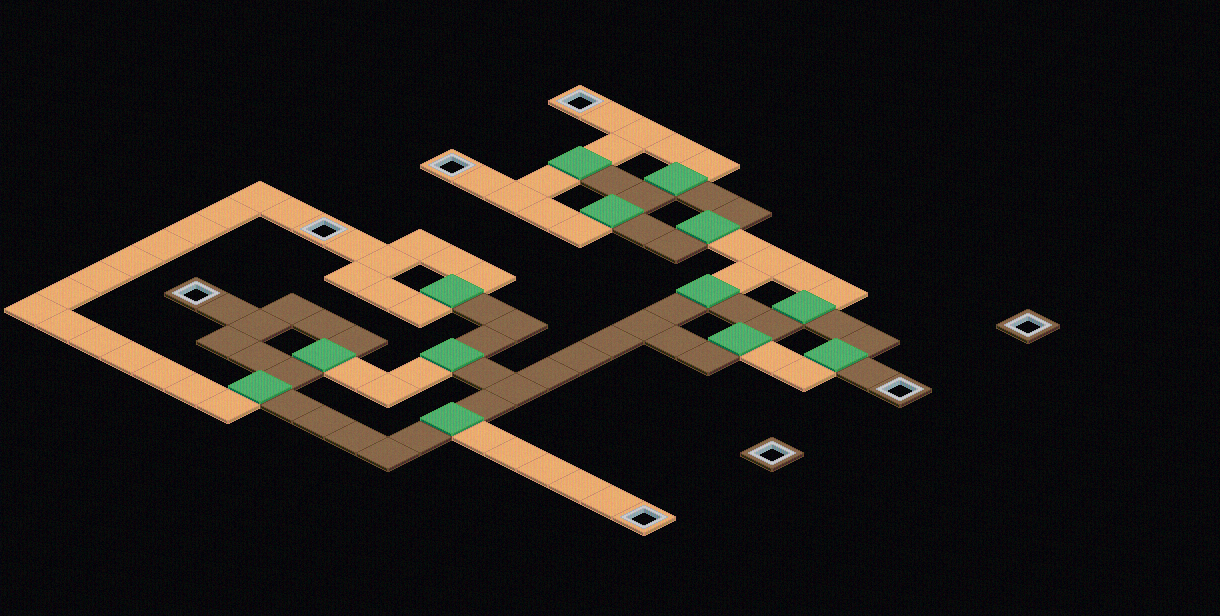
Nachher:
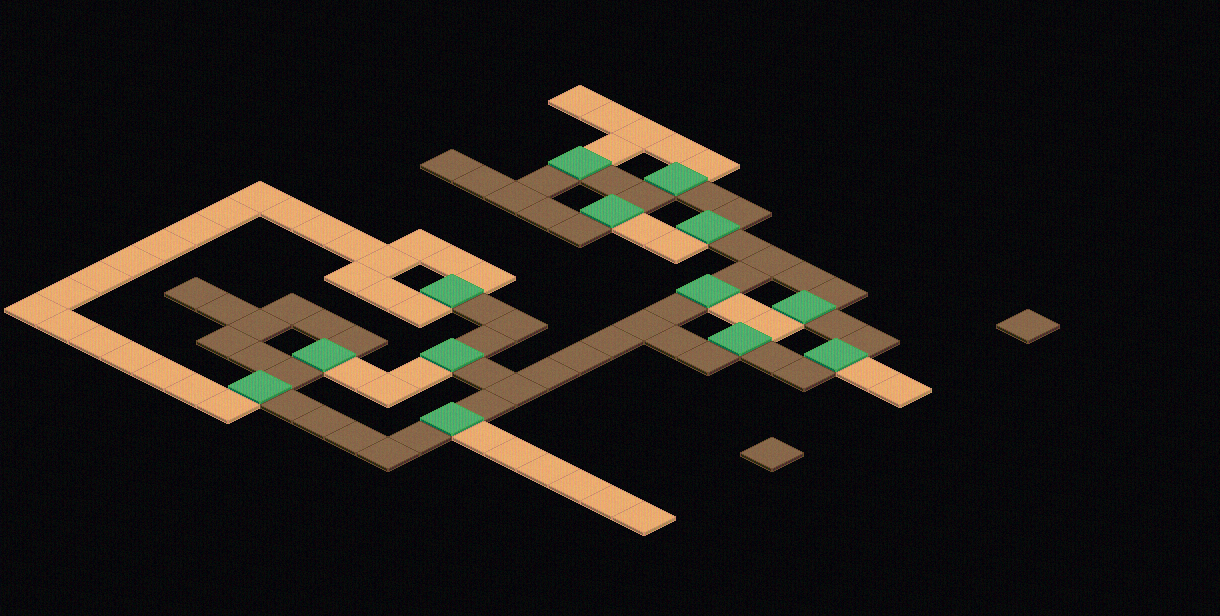
Jetzt wissen wir sicher, dass dies die Textur des Lochs auf dem Brett ist, und können es der Aufzählungsliste hinzufügen, indem wir es in einer separaten Funktion rendern:
Alle Texturen zusammengesetzt:
#include <X11/Xlib.h>
#include <sys/types.h>
#include <sys/stat.h>
#include <fcntl.h>
#include <unistd.h>

/*    */

/*! \brief     */
#define IMAGE_WIDTH (1220)
/*! \brief     */
#define IMAGE_HEIGHT (616)
/*! \brief        */
#define IMAGE_SHIFTX (580)

/*! \brief   */
#define TEXTURE_COUNT (8)
/*! \brief     */
#define TEXTURE_WIDTH (64)
/*! \brief     */
#define TEXTURE_HEIGHT (40)
/*! \brief      */
#define TEXTURE_TOP_WIDTH (64)
/*! \brief      */
#define TEXTURE_TOP_HEIGHT (32)

/*! \brief    */
#define MAP_WIDTH (19)
/*! \brief    */
#define MAP_HEIGHT (19)
/*! \brief    -.      '\n' */
#define MAP_FILEDATA ((MAP_WIDTH + 1) * MAP_HEIGHT)
/*! \brief      NOR- */
#define MAP_ITERATIONS (20)

/*! \brief    - */
enum map_characters {
    MAPCHAR_WIRE  = '.', /**<             (ASCII = 46) */
    MAPCHAR_PLUS  = '+', /**<  ( ) (ASCII = 43) */
    MAPCHAR_MINUS = '-', /**<  ( ) (ASCII = 45) */
    MAPCHAR_NOR   = '>', /**< NOR-       (ASCII = 62) */
    MAPCHAR_EMPTY = ' ', /**<         (ASCII = 32) */
};

/*! \brief    */
enum textures_indexes {
    TEXINDEX_EMPTY = (0), /**<                    */
    TEXINDEX_MINUS = (1), /**<   " " */
    TEXINDEX_WIRE  = (2), /**<       */
    TEXINDEX_PLUS  = (3), /**<   ""   */
    /**/
    TEXINDEX_NOR   = (6), /**<   NOR-           */
    TEXINDEX_HOLE  = (7)  /**<          */
};

/*! \brief   */
enum program_arguments {
    ARG_PROGRAM,  /**<    */
    ARG_BLUEPRINT /**<  -   */
};

/*! \brief    .
 *   int      */
int pixdata[IMAGE_HEIGHT][IMAGE_WIDTH];
/*! \brief  ,    */
int textures[TEXTURE_COUNT][TEXTURE_HEIGHT][TEXTURE_WIDTH] = { 0 };
/*! \brief   .
 *        '\n' */
char mapdata[MAP_HEIGHT][MAP_WIDTH + 1];

/*! \brief   Xlib */
Display * display;
/*! \brief    Xlib */
Window window;
/*! \brief      */
XImage * image;

static void _texture_draw(int t, int x, int y);

/*! \brief      */
static void _image_create(void) {
    display = XOpenDisplay(0);
    window = XCreateSimpleWindow(display,
                                 RootWindow(display, DefaultScreen(display)),
                                 0, 0, IMAGE_WIDTH, IMAGE_HEIGHT, 1, 0, 0);
    image = XCreateImage(display,
                     DefaultVisual(display, DefaultScreen(display)),
                     DefaultDepth(display, DefaultScreen(display)),
                     2, 0, (char *) pixdata, IMAGE_WIDTH, IMAGE_HEIGHT, 32, 0);
}

/* \brief  ,     */
static void _image_reset(void) {
    for (int y = 0; y < IMAGE_HEIGHT; y++)
        for (int x = 0; x < IMAGE_WIDTH; x++)
            pixdata[y][x] = 0;
}

/*! \brief
 * \param[in] elem
 * \return   */
static int _map2texture(char elem) {
    return ((elem >> 4) & 1) << 2 | (elem & 3);
}

/*! \brief        */
static void _image_compile(void) {
    for (int y = 0; y < MAP_HEIGHT; y++)
        for (int x = 0; x < MAP_WIDTH; x++)
            _texture_draw(_map2texture(mapdata[y][x]), x, y);
}

/*! \brief     */
static void _image_draw(void) {
    XPutImage(display, window,
              DefaultGC(display, DefaultScreen(display)),
              image, 0, 0, 0, 0, IMAGE_WIDTH, IMAGE_HEIGHT);
    XMapWindow(display, window);
    XFlush(display);
}

/*! \brief      */
static void _image_drill(void) {
    for (int y = 0; y < MAP_HEIGHT; y++)
            for (int x = 0; x < MAP_WIDTH; x++)
                if ((x % 14 == 2) && (y % 4 == 3))
                    _texture_draw(TEXINDEX_HOLE, x, y);
}

/*! \brief
 * \param[in] t
 * \param[in] x X
 * \param[in] y Y   */
static void _texture_draw(int t, int x, int y) {
    for (int ty = 0; ty < TEXTURE_HEIGHT; ty++)
        for (int tx = 0; tx < TEXTURE_WIDTH; tx++)
            if (textures[t][ty][tx])
                pixdata[ty +
                        y * (TEXTURE_TOP_HEIGHT / 2) +
                        x * (TEXTURE_TOP_HEIGHT / 2)]
                       [tx +
                        IMAGE_SHIFTX +
                        x * (TEXTURE_TOP_WIDTH / 2) -
                        y * TEXTURE_TOP_HEIGHT] = textures[t][ty][tx];
}

/*! \brief   -
 * \param[in] filename  - */
static void _map_read(const char * filename) {
    int f = open(filename, 0);
    read(f, mapdata, MAP_FILEDATA);
    close(f);
}

/*! \brief     -
 *          */
static void _map_wire_inputs(void) {
    for (int y = 0; y < MAP_HEIGHT; y++)
        for (int x = 0; x < MAP_WIDTH; x++)
            if ((x % 14 == 2) && (y % 4 == 3))
                mapdata[y][x] = MAPCHAR_WIRE;
}

/*! \brief
 * \param[in] t ,
 * \param[in] x X-
 * \param[in] y Y-
 * \param[in] c
 * \param[in] l   */
static void _map_fill(int t, int x, int y, int c, int l) {
    if ((x >= MAP_WIDTH || y >= MAP_HEIGHT ||
         x < 0 || y < 0) || (mapdata[y][x] == l)
        || (mapdata[y][x] != c))
        return;
    mapdata[y][x] = l;
    _map_fill(t, x - 1, y, c, l);
    _map_fill(t, x + 1, y, c, l);
    _map_fill(t, x, y - 1, c, l);
    _map_fill(t, x, y + 1, c, l);
}

/*! \brief
 * .
 * \param[in] counter  */
static void _map_wire_counter(int counter) {
    _map_fill(0, 2, 3,  mapdata[3][2],  counter & 1 ? MAPCHAR_PLUS : MAPCHAR_MINUS);
    _map_fill(0, 2, 7,  mapdata[7][2],  counter & 2 ? MAPCHAR_PLUS : MAPCHAR_MINUS);
    _map_fill(0, 2, 11, mapdata[11][2], counter & 4 ? MAPCHAR_PLUS : MAPCHAR_MINUS);
    _map_fill(0, 2, 15, mapdata[15][2], counter & 8 ? MAPCHAR_PLUS : MAPCHAR_MINUS);
}

/*! \brief    ()   NOR- */
static void _map_process_gates(void) {
    for (int i = 0; i < MAP_ITERATIONS; i++)
        for (int y = 0; y < MAP_HEIGHT; y++)
            for (int x = 0; x < MAP_WIDTH; x++)
                if (mapdata[y][x] == MAPCHAR_NOR)
                    _map_fill(0, x + 1, y, mapdata[y][x + 1],
                        !(mapdata[y - 1][x] == MAPCHAR_PLUS ? 1 : 0
                       || mapdata[y + 1][x] == MAPCHAR_PLUS ? 1 : 0) ?
                            MAPCHAR_PLUS : MAPCHAR_MINUS);
}

/*    */

int _x[] = { 15117427, 8413248, 5878632, 13027014, 1 };
int rn = 2166136261;

void *T;

void e(int t, int x, int y, int c, int l) {
    if ((x >= TEXTURE_WIDTH || y >= TEXTURE_HEIGHT ||
         x < 0 || y < 0) ||
         (textures[t][y][x] == l) ||
         (textures[t][y][x] != c))
        return;
    textures[t][y][x] = l;
    e(t, x - 1, y, c, l);
    e(t, x + 1, y, c, l);
    e(t, x, y - 1, c, l);
    e(t, x, y + 1, c, l);
}

void k(int t, int x, int y, int c, int l) {
    while (c--) {
        textures[t][y][x++] = l;
        textures[t][y++][x++] = l;
    }
}

void r(int t, int x, int y, int c, int l) {
    while (c--) {
        textures[t][y][x--] = l;
        textures[t][y++][x--] = l;
    }
}

void u(int t, int x, int y, int c, int l) {
    while (c--)
        textures[t][y++][x] = l;
}

char *z[8] = {
    (char[]) {4},
    (char[]) {6, 1 * 4 + 1, 0 + 0, 32 - 0, 5 - 0, 16, 0, 0,
              21 + 0 * 3 - 0, 16, 1, 63, 21 + 0 * 3 - 0, 16, 2,
              63 * 0, 21 - 0, 4, 2, 31 + 0, 36 - 0, 4, 0 + 1,
              32 - 1, 5 - 0, 16, 0, 0, 21 + 1 * 3 - 0, 16, 1, 63,
              21 + 1 * 3 - 0, 16, 2, 63 * 1, 21 - 0, 4, 2, 31 + 1,
              36 - 0, 4, 6, 1 * 4 + 0, 3, 31, 8 - 0, 6, 1 * 4 + 2,
              3, 33, 38 - 0, 6, 1 * 4 + 3, 3, 30, 38 - 0, 4},
    (char[]) {5, 1},
    (char[]) {6, 0 * 4 + 1, 0 + 0, 32 - 0, 5 - 0, 16,
              0, 0, 21 + 0 * 3 - 0, 16, 1, 63,
              21 + 0 * 3 - 0, 16, 2, 63 * 0, 21 - 0,
              4, 2, 31 + 0, 36 - 0, 4, 0 + 1, 32 - 1,
              5 - 0, 16, 0, 0, 21 + 1 * 3 - 0, 16, 1,
              63, 21 + 1 * 3 - 0, 16, 2, 63 * 1,
              21 - 0, 4, 2, 31 + 1, 36 - 0, 4, 6,
              0 * 4 + 0, 3, 31, 8 - 0, 6, 0 * 4 + 2,
              3, 33, 38 - 0, 6, 0 * 4 + 3, 3, 30,
              38 - 0,
              4},
    (char[]) {4},
    (char[]) {4},
    (char[]) {6, 2 * 4 + 1, 0 + 0, 32 - 0, 5 - 3, 16, 0, 0,
              21 + 0 * 3 - 3, 16, 1, 63, 21 + 0 * 3 - 3, 16, 2, 63 * 0,
              21 - 3, 4, 2, 31 + 0, 36 - 3, 4, 0 + 1, 32 - 1, 5 - 3,
              16, 0, 0, 21 + 1 * 3 - 3, 16, 1, 63, 21 + 1 * 3 - 3, 16,
              2, 63 * 1, 21 - 3, 4, 2, 31 + 1, 36 - 3, 4, 6, 2 * 4 + 0,
              3, 31, 8 - 3, 6, 2 * 4 + 2, 3, 33, 38 - 3, 6, 2 * 4 + 3,
              3, 30, 38 - 3, 4},
    (char[]) {6, 13, 0, 32, 9 + 0, 12 - 0,
              0, 8 + 0 + 0, 21, 12 - 0, 1,
              31, 9 + 0, 12 - 0, 1,
              55 - 0 - 0, 21, 12 - 0, 0,
              32, 9 + 3, 12 - 3, 0,
              8 + 3 + 3, 21, 12 - 3, 1,
              31, 9 + 3, 12 - 3, 1,
              55 - 3 - 3, 21, 12 - 3, 6,
              14 + 0, 2, 31 + 0, 13, 4,
              1 - 0, 31 + 0, 16, 7, 3,
              30 + 3 * 0, 14, 6,
              12 + 0 * 4, 3, 32 - 0,
              11 + 0 * 8, 6, 14 + 1, 2,
              31 + 1, 13, 4, 1 - 1,
              31 + 1, 16, 7, 3,
              30 + 3 * 1, 14, 6,
              12 + 1 * 4, 3, 32 - 1,
              11 + 1 * 8,
              4}
};

int main(int argc, char * args[]) {
    _image_create();

    for (int i = 0; i < 8; i++) {
        char *p = z[i];
        int c = 0;
        while (*p != 4) {
            switch (*p) {
            case 0:
                k(i, p[1], p[2], p[3], c);
                p += 4;
                break;
            case 1:
                r(i, p[1], p[2], p[3], c);
                p += 4;
                break;
            case 2:
                u(i, p[1], p[2], p[3], c);
                p += 4;
                break;
            case 3:
                e(i, p[1]
                  , p[2], 0, c);
                p += 3;
                break;
            case 5:
                p = z[p[1]];
                break;
            case 6:
                c = _x[p[1] / 4] - 1643277 * (p[1] % 4);
                p += 2;
                break;
            }
        }
    }
    unsigned int counter = 1;
    while (counter++) {
        _map_read(args[ARG_BLUEPRINT]);
        _map_wire_inputs();
        _map_wire_counter(counter);
        _map_process_gates();

        _image_reset();
        _image_compile();
        _image_drill();

        for (int y = 0; y < IMAGE_HEIGHT; y++)
            for (int x = 0; x < IMAGE_WIDTH; x++) {
                pixdata[y][x] &= 14737632 | (31 << ((x % 3) << 3));
                pixdata[y][x] += 986895 & (rn *= 16777619);
            }

        _image_draw();

        sleep(1);
    }
    return 0;
}
Shader
Die Katzen aus dem vorherigen Artikel versprachen Shader. Und sie sind hier. Und wo ist der Code, der für die Verarbeitung verantwortlich ist?
        _image_reset();           //
        _image_compile();       //
        _image_drill();            //

        for (int y = 0; y < IMAGE_HEIGHT; y++)
            for (int x = 0; x < IMAGE_WIDTH; x++) {
                pixdata[y][x] &= 14737632 | (31 << ((x % 3) << 3));
                pixdata[y][x] += 986895 & (rn *= 16777619);
            }

        _image_draw();  //
Unter der Eliminierungsmethode verstehen wir, dass das Bildschirmrauschen und die Wirkung des LCD-Monitors diese beiden Linien ergeben. Wie arbeiten Sie?
Beginnen wir mit dem letzten:
pixdata[y][x] += 986895 & (rn *= 16777619);Zu jedem Pixel wird der Wert 986895 hinzugefügt (der in hexadezimalen Versionen wie 0x0f0f0f aussieht), der zuvor mithilfe der Bit-UND-Operation in Kombination mit dem Ergebnis der Multiplikation von rn mit 16777619 durchgeführt wurde. Wenn rn ein Zufallszahlengenerator wäre, würde dies ein körniges "Rauschen" erzeugen. auf dem Bildschirm innerhalb von 16 Abstufungen für jeden Kanal. Und da das Rauschen auftritt, ist rn der Zufallszahlengenerator. Aber wie wird das erreicht?
int rn = 2166136261;Zu Beginn des Programms wird die Variable rn mit der Nummer 2166136261 initialisiert. Bei jeder Iteration wird das Pixel mit 16777619 multipliziert. Dies ist nichts weiter als ein Pseudozufallszahlengenerator. Anstelle eines gut untersuchten Lineargenerators wird jedoch der FNV- Hashing-Algorithmus ohne XOR-Schritt verwendet, da wir das Endergebnis nicht benötigen.
Es bleibt abzuwarten, wie die vorherige Zeile funktioniert:
pixdata[y][x] &= 14737632 | (31 << ((x % 3) << 3));Lassen Sie uns die Zahl 14737632 in ein hexadezimales Format konvertieren, da wir mit Ein-Byte-Lichtkanälen arbeiten: 0xe0e0e0. Und jetzt, wenn x gleich 0 bis 3 ist, führen wir die entsprechenden Berechnungen durch:
0xe0e0e0 | (31 << ((0 % 3) << 3)) = e0e0ff
0xe0e0e0 | (31 << ((1 % 3) << 3)) = e0ffe0
0xe0e0e0 | (31 << ((2 % 3) << 3)) = ffe0e0
Wenn diese Masken nun mit der Operation "&" auf die Farbe des Pixels angewendet werden, erhalten wir jeweils stummgeschaltete R- und G-, R- und B-, G- und B-Kanäle, die wie der Effekt eines LCD-Monitors aussehen:

Lassen Sie uns sie in separate Funktionen unterteilen:
#include <X11/Xlib.h>
#include <sys/types.h>
#include <sys/stat.h>
#include <fcntl.h>
#include <unistd.h>

/*    */

/*! \brief     */
#define IMAGE_WIDTH (1220)
/*! \brief     */
#define IMAGE_HEIGHT (616)
/*! \brief        */
#define IMAGE_SHIFTX (580)

/*! \brief   */
#define TEXTURE_COUNT (8)
/*! \brief     */
#define TEXTURE_WIDTH (64)
/*! \brief     */
#define TEXTURE_HEIGHT (40)
/*! \brief      */
#define TEXTURE_TOP_WIDTH (64)
/*! \brief      */
#define TEXTURE_TOP_HEIGHT (32)

/*! \brief    */
#define MAP_WIDTH (19)
/*! \brief    */
#define MAP_HEIGHT (19)
/*! \brief    -.      '\n' */
#define MAP_FILEDATA ((MAP_WIDTH + 1) * MAP_HEIGHT)
/*! \brief      NOR- */
#define MAP_ITERATIONS (20)

/*! \brief    - */
enum map_characters {
    MAPCHAR_WIRE  = '.', /**<             (ASCII = 46) */
    MAPCHAR_PLUS  = '+', /**<  ( ) (ASCII = 43) */
    MAPCHAR_MINUS = '-', /**<  ( ) (ASCII = 45) */
    MAPCHAR_NOR   = '>', /**< NOR-       (ASCII = 62) */
    MAPCHAR_EMPTY = ' ', /**<         (ASCII = 32) */
};

/*! \brief    */
enum textures_indexes {
    TEXINDEX_EMPTY = (0), /**<                    */
    TEXINDEX_MINUS = (1), /**<   " " */
    TEXINDEX_WIRE  = (2), /**<       */
    TEXINDEX_PLUS  = (3), /**<   ""   */
    /**/
    TEXINDEX_NOR   = (6), /**<   NOR-           */
    TEXINDEX_HOLE  = (7)  /**<          */
};

/*! \brief   */
enum program_arguments {
    ARG_PROGRAM,  /**<    */
    ARG_BLUEPRINT /**<  -   */
};

/*! \brief    .
 *   int      */
int pixdata[IMAGE_HEIGHT][IMAGE_WIDTH];
/*! \brief  ,    */
int textures[TEXTURE_COUNT][TEXTURE_HEIGHT][TEXTURE_WIDTH] = { 0 };
/*! \brief   .
 *        '\n' */
char mapdata[MAP_HEIGHT][MAP_WIDTH + 1];
/*! \brief     */
int random = 2166136261;

/*! \brief   Xlib */
Display * display;
/*! \brief    Xlib */
Window window;
/*! \brief      */
XImage * image;

static void _texture_draw(int t, int x, int y);

/*! \brief      */
static void _image_create(void) {
    display = XOpenDisplay(0);
    window = XCreateSimpleWindow(display,
                                 RootWindow(display, DefaultScreen(display)),
                                 0, 0, IMAGE_WIDTH, IMAGE_HEIGHT, 1, 0, 0);
    image = XCreateImage(display,
                     DefaultVisual(display, DefaultScreen(display)),
                     DefaultDepth(display, DefaultScreen(display)),
                     2, 0, (char *) pixdata, IMAGE_WIDTH, IMAGE_HEIGHT, 32, 0);
}

/* \brief  ,     */
static void _image_reset(void) {
    for (int y = 0; y < IMAGE_HEIGHT; y++)
        for (int x = 0; x < IMAGE_WIDTH; x++)
            pixdata[y][x] = 0;
}

/*! \brief
 * \param[in] elem
 * \return   */
static int _map2texture(char elem) {
    return ((elem >> 4) & 1) << 2 | (elem & 3);
}

/*! \brief        */
static void _image_compile(void) {
    for (int y = 0; y < MAP_HEIGHT; y++)
        for (int x = 0; x < MAP_WIDTH; x++)
            _texture_draw(_map2texture(mapdata[y][x]), x, y);
}

/*! \brief     */
static void _image_draw(void) {
    XPutImage(display, window,
              DefaultGC(display, DefaultScreen(display)),
              image, 0, 0, 0, 0, IMAGE_WIDTH, IMAGE_HEIGHT);
    XMapWindow(display, window);
    XFlush(display);
}

/*! \brief      */
static void _image_drill(void) {
    for (int y = 0; y < MAP_HEIGHT; y++)
            for (int x = 0; x < MAP_WIDTH; x++)
                if ((x % 14 == 2) && (y % 4 == 3))
                    _texture_draw(TEXINDEX_HOLE, x, y);
}

/*! \brief   LCD-
 * \param[in] x X-
 * \param[in] y Y-  */
static void _shader_lcd(int x, int y) {
    pixdata[y][x] &= 0xe0e0e0 | (31 << ((x % 3) << 3));
}

/*! \brief
 * \param[in] x X-
 * \param[in] y Y-  */
static void _shader_noise(int x, int y) {
    pixdata[y][x] += 0x0f0f0f & (random *= 16777619);
}

/*! \brief      */
static void _image_postprocess(void) {
    for (int y = 0; y < IMAGE_HEIGHT; y++)
        for (int x = 0; x < IMAGE_WIDTH; x++) {
            _shader_lcd(x, y);
            _shader_noise(x, y);
        }
}

/*! \brief
 * \param[in] t
 * \param[in] x X
 * \param[in] y Y   */
static void _texture_draw(int t, int x, int y) {
    for (int ty = 0; ty < TEXTURE_HEIGHT; ty++)
        for (int tx = 0; tx < TEXTURE_WIDTH; tx++)
            if (textures[t][ty][tx])
                pixdata[ty +
                        y * (TEXTURE_TOP_HEIGHT / 2) +
                        x * (TEXTURE_TOP_HEIGHT / 2)]
                       [tx +
                        IMAGE_SHIFTX +
                        x * (TEXTURE_TOP_WIDTH / 2) -
                        y * TEXTURE_TOP_HEIGHT] = textures[t][ty][tx];
}

/*! \brief   -
 * \param[in] filename  - */
static void _map_read(const char * filename) {
    int f = open(filename, 0);
    read(f, mapdata, MAP_FILEDATA);
    close(f);
}

/*! \brief     -
 *          */
static void _map_wire_inputs(void) {
    for (int y = 0; y < MAP_HEIGHT; y++)
        for (int x = 0; x < MAP_WIDTH; x++)
            if ((x % 14 == 2) && (y % 4 == 3))
                mapdata[y][x] = MAPCHAR_WIRE;
}

/*! \brief
 * \param[in] t ,
 * \param[in] x X-
 * \param[in] y Y-
 * \param[in] c
 * \param[in] l   */
static void _map_fill(int t, int x, int y, int c, int l) {
    if ((x >= MAP_WIDTH || y >= MAP_HEIGHT ||
         x < 0 || y < 0) || (mapdata[y][x] == l)
        || (mapdata[y][x] != c))
        return;
    mapdata[y][x] = l;
    _map_fill(t, x - 1, y, c, l);
    _map_fill(t, x + 1, y, c, l);
    _map_fill(t, x, y - 1, c, l);
    _map_fill(t, x, y + 1, c, l);
}

/*! \brief
 * .
 * \param[in] counter  */
static void _map_wire_counter(int counter) {
    _map_fill(0, 2, 3,  mapdata[3][2],  counter & 1 ? MAPCHAR_PLUS : MAPCHAR_MINUS);
    _map_fill(0, 2, 7,  mapdata[7][2],  counter & 2 ? MAPCHAR_PLUS : MAPCHAR_MINUS);
    _map_fill(0, 2, 11, mapdata[11][2], counter & 4 ? MAPCHAR_PLUS : MAPCHAR_MINUS);
    _map_fill(0, 2, 15, mapdata[15][2], counter & 8 ? MAPCHAR_PLUS : MAPCHAR_MINUS);
}

/*! \brief    ()   NOR- */
static void _map_process_gates(void) {
    for (int i = 0; i < MAP_ITERATIONS; i++)
        for (int y = 0; y < MAP_HEIGHT; y++)
            for (int x = 0; x < MAP_WIDTH; x++)
                if (mapdata[y][x] == MAPCHAR_NOR)
                    _map_fill(0, x + 1, y, mapdata[y][x + 1],
                        !(mapdata[y - 1][x] == MAPCHAR_PLUS ? 1 : 0
                       || mapdata[y + 1][x] == MAPCHAR_PLUS ? 1 : 0) ?
                            MAPCHAR_PLUS : MAPCHAR_MINUS);
}

/*    */

int _x[] = { 15117427, 8413248, 5878632, 13027014, 1 };

void e(int t, int x, int y, int c, int l) {
    if ((x >= TEXTURE_WIDTH || y >= TEXTURE_HEIGHT ||
         x < 0 || y < 0) ||
         (textures[t][y][x] == l) ||
         (textures[t][y][x] != c))
        return;
    textures[t][y][x] = l;
    e(t, x - 1, y, c, l);
    e(t, x + 1, y, c, l);
    e(t, x, y - 1, c, l);
    e(t, x, y + 1, c, l);
}

void k(int t, int x, int y, int c, int l) {
    while (c--) {
        textures[t][y][x++] = l;
        textures[t][y++][x++] = l;
    }
}

void r(int t, int x, int y, int c, int l) {
    while (c--) {
        textures[t][y][x--] = l;
        textures[t][y++][x--] = l;
    }
}

void u(int t, int x, int y, int c, int l) {
    while (c--)
        textures[t][y++][x] = l;
}

char *z[8] = {
    (char[]) {4},
    (char[]) {6, 1 * 4 + 1, 0 + 0, 32 - 0, 5 - 0, 16, 0, 0,
              21 + 0 * 3 - 0, 16, 1, 63, 21 + 0 * 3 - 0, 16, 2,
              63 * 0, 21 - 0, 4, 2, 31 + 0, 36 - 0, 4, 0 + 1,
              32 - 1, 5 - 0, 16, 0, 0, 21 + 1 * 3 - 0, 16, 1, 63,
              21 + 1 * 3 - 0, 16, 2, 63 * 1, 21 - 0, 4, 2, 31 + 1,
              36 - 0, 4, 6, 1 * 4 + 0, 3, 31, 8 - 0, 6, 1 * 4 + 2,
              3, 33, 38 - 0, 6, 1 * 4 + 3, 3, 30, 38 - 0, 4},
    (char[]) {5, 1},
    (char[]) {6, 0 * 4 + 1, 0 + 0, 32 - 0, 5 - 0, 16,
              0, 0, 21 + 0 * 3 - 0, 16, 1, 63,
              21 + 0 * 3 - 0, 16, 2, 63 * 0, 21 - 0,
              4, 2, 31 + 0, 36 - 0, 4, 0 + 1, 32 - 1,
              5 - 0, 16, 0, 0, 21 + 1 * 3 - 0, 16, 1,
              63, 21 + 1 * 3 - 0, 16, 2, 63 * 1,
              21 - 0, 4, 2, 31 + 1, 36 - 0, 4, 6,
              0 * 4 + 0, 3, 31, 8 - 0, 6, 0 * 4 + 2,
              3, 33, 38 - 0, 6, 0 * 4 + 3, 3, 30,
              38 - 0,
              4},
    (char[]) {4},
    (char[]) {4},
    (char[]) {6, 2 * 4 + 1, 0 + 0, 32 - 0, 5 - 3, 16, 0, 0,
              21 + 0 * 3 - 3, 16, 1, 63, 21 + 0 * 3 - 3, 16, 2, 63 * 0,
              21 - 3, 4, 2, 31 + 0, 36 - 3, 4, 0 + 1, 32 - 1, 5 - 3,
              16, 0, 0, 21 + 1 * 3 - 3, 16, 1, 63, 21 + 1 * 3 - 3, 16,
              2, 63 * 1, 21 - 3, 4, 2, 31 + 1, 36 - 3, 4, 6, 2 * 4 + 0,
              3, 31, 8 - 3, 6, 2 * 4 + 2, 3, 33, 38 - 3, 6, 2 * 4 + 3,
              3, 30, 38 - 3, 4},
    (char[]) {6, 13, 0, 32, 9 + 0, 12 - 0,
              0, 8 + 0 + 0, 21, 12 - 0, 1,
              31, 9 + 0, 12 - 0, 1,
              55 - 0 - 0, 21, 12 - 0, 0,
              32, 9 + 3, 12 - 3, 0,
              8 + 3 + 3, 21, 12 - 3, 1,
              31, 9 + 3, 12 - 3, 1,
              55 - 3 - 3, 21, 12 - 3, 6,
              14 + 0, 2, 31 + 0, 13, 4,
              1 - 0, 31 + 0, 16, 7, 3,
              30 + 3 * 0, 14, 6,
              12 + 0 * 4, 3, 32 - 0,
              11 + 0 * 8, 6, 14 + 1, 2,
              31 + 1, 13, 4, 1 - 1,
              31 + 1, 16, 7, 3,
              30 + 3 * 1, 14, 6,
              12 + 1 * 4, 3, 32 - 1,
              11 + 1 * 8,
              4}
};

int main(int argc, char * args[]) {
    _image_create();

    for (int i = 0; i < 8; i++) {
        char *p = z[i];
        int c = 0;
        while (*p != 4) {
            switch (*p) {
            case 0:
                k(i, p[1], p[2], p[3], c);
                p += 4;
                break;
            case 1:
                r(i, p[1], p[2], p[3], c);
                p += 4;
                break;
            case 2:
                u(i, p[1], p[2], p[3], c);
                p += 4;
                break;
            case 3:
                e(i, p[1]
                  , p[2], 0, c);
                p += 3;
                break;
            case 5:
                p = z[p[1]];
                break;
            case 6:
                c = _x[p[1] / 4] - 1643277 * (p[1] % 4);
                p += 2;
                break;
            }
        }
    }
    unsigned int counter = 1;
    while (counter++) {
        _map_read(args[ARG_BLUEPRINT]);
        _map_wire_inputs();
        _map_wire_counter(counter);
        _map_process_gates();

        _image_reset();
        _image_compile();
        _image_drill();
        _image_postprocess();
        _image_draw();

        sleep(1);
    }
    return 0;
}
"E", "k", "r", "u"
Es gibt noch 4 Funktionen, die wir nicht untersucht oder umbenannt haben - dies sind "e", "k", "r" und "u". Versuchen wir, sie zu inspizieren, ohne nach Orten zu suchen, von denen aus sie angerufen werden:
void e(int t, int x, int y, int c, int l) {
    if ((x >= TEXTURE_WIDTH || y >= TEXTURE_HEIGHT ||
         x < 0 || y < 0) ||
         (textures[t][y][x] == l) ||
         (textures[t][y][x] != c))
        return;
    textures[t][y][x] = l;
    e(t, x - 1, y, c, l);
    e(t, x + 1, y, c, l);
    e(t, x, y - 1, c, l);
    e(t, x, y + 1, c, l);
}
Offensichtlich sieht diese Funktion wie Flut_Füll aus und funktioniert nur für das Texturen-Array. Benennen Sie es in _texture_fill um.
void k(int t, int x, int y, int c, int l) {
    while (c--) {
        textures[t][y][x++] = l;
        textures[t][y++][x++] = l;
    }
}

void r(int t, int x, int y, int c, int l) {
    while (c--) {
        textures[t][y][x--] = l;
        textures[t][y++][x--] = l;
    }
}
Die Funktionen "k" und "r" für jede gegebene Einheit c zeichnen zwei Pixel mit dem Wert l und bewegen sich um zwei Pixel nach rechts oder links und um eins nach unten - dies bedeutet, dass dies Funktionen zum Zeichnen der isometrischen Linien SW und SE sind. Benennen wir sie in _texture_linesw und _texture_linese um.
Zu diesem Zeitpunkt können Sie bereits erraten, dass die letzte Funktion "u" eine Linie vertikal nach unten zeichnet:
void u(int t, int x, int y, int c, int l) {
    while (c--)
        textures[t][y++][x] = l;
}
Benennen wir es in _texture_linedown um.
Alle Einzelfunktionen wurden überarbeitet:
#include <X11/Xlib.h>
#include <sys/types.h>
#include <sys/stat.h>
#include <fcntl.h>
#include <unistd.h>

/*    */

/*! \brief     */
#define IMAGE_WIDTH (1220)
/*! \brief     */
#define IMAGE_HEIGHT (616)
/*! \brief        */
#define IMAGE_SHIFTX (580)

/*! \brief   */
#define TEXTURE_COUNT (8)
/*! \brief     */
#define TEXTURE_WIDTH (64)
/*! \brief     */
#define TEXTURE_HEIGHT (40)
/*! \brief      */
#define TEXTURE_TOP_WIDTH (64)
/*! \brief      */
#define TEXTURE_TOP_HEIGHT (32)

/*! \brief    */
#define MAP_WIDTH (19)
/*! \brief    */
#define MAP_HEIGHT (19)
/*! \brief    -.      '\n' */
#define MAP_FILEDATA ((MAP_WIDTH + 1) * MAP_HEIGHT)
/*! \brief      NOR- */
#define MAP_ITERATIONS (20)

/*! \brief    - */
enum map_characters {
    MAPCHAR_WIRE  = '.', /**<             (ASCII = 46) */
    MAPCHAR_PLUS  = '+', /**<  ( ) (ASCII = 43) */
    MAPCHAR_MINUS = '-', /**<  ( ) (ASCII = 45) */
    MAPCHAR_NOR   = '>', /**< NOR-       (ASCII = 62) */
    MAPCHAR_EMPTY = ' ', /**<         (ASCII = 32) */
};

/*! \brief    */
enum textures_indexes {
    TEXINDEX_EMPTY = (0), /**<                    */
    TEXINDEX_MINUS = (1), /**<   " " */
    TEXINDEX_WIRE  = (2), /**<       */
    TEXINDEX_PLUS  = (3), /**<   ""   */
    /**/
    TEXINDEX_NOR   = (6), /**<   NOR-           */
    TEXINDEX_HOLE  = (7)  /**<          */
};

/*! \brief   */
enum program_arguments {
    ARG_PROGRAM,  /**<    */
    ARG_BLUEPRINT /**<  -   */
};

/*! \brief    .
 *   int      */
int pixdata[IMAGE_HEIGHT][IMAGE_WIDTH];
/*! \brief  ,    */
int textures[TEXTURE_COUNT][TEXTURE_HEIGHT][TEXTURE_WIDTH] = { 0 };
/*! \brief   .
 *        '\n' */
char mapdata[MAP_HEIGHT][MAP_WIDTH + 1];
/*! \brief     */
int random = 2166136261;

/*! \brief   Xlib */
Display * display;
/*! \brief    Xlib */
Window window;
/*! \brief      */
XImage * image;

static void _texture_draw(int t, int x, int y);

/*! \brief      */
static void _image_create(void) {
    display = XOpenDisplay(0);
    window = XCreateSimpleWindow(display,
                                 RootWindow(display, DefaultScreen(display)),
                                 0, 0, IMAGE_WIDTH, IMAGE_HEIGHT, 1, 0, 0);
    image = XCreateImage(display,
                     DefaultVisual(display, DefaultScreen(display)),
                     DefaultDepth(display, DefaultScreen(display)),
                     2, 0, (char *) pixdata, IMAGE_WIDTH, IMAGE_HEIGHT, 32, 0);
}

/* \brief  ,     */
static void _image_reset(void) {
    for (int y = 0; y < IMAGE_HEIGHT; y++)
        for (int x = 0; x < IMAGE_WIDTH; x++)
            pixdata[y][x] = 0;
}

/*! \brief
 * \param[in] elem
 * \return   */
static int _map2texture(char elem) {
    return ((elem >> 4) & 1) << 2 | (elem & 3);
}

/*! \brief        */
static void _image_compile(void) {
    for (int y = 0; y < MAP_HEIGHT; y++)
        for (int x = 0; x < MAP_WIDTH; x++)
            _texture_draw(_map2texture(mapdata[y][x]), x, y);
}

/*! \brief     */
static void _image_draw(void) {
    XPutImage(display, window,
              DefaultGC(display, DefaultScreen(display)),
              image, 0, 0, 0, 0, IMAGE_WIDTH, IMAGE_HEIGHT);
    XMapWindow(display, window);
    XFlush(display);
}

/*! \brief      */
static void _image_drill(void) {
    for (int y = 0; y < MAP_HEIGHT; y++)
            for (int x = 0; x < MAP_WIDTH; x++)
                if ((x % 14 == 2) && (y % 4 == 3))
                    _texture_draw(TEXINDEX_HOLE, x, y);
}

/*! \brief   LCD-
 * \param[in] x X-
 * \param[in] y Y-  */
static void _shader_lcd(int x, int y) {
    pixdata[y][x] &= 0xe0e0e0 | (31 << ((x % 3) << 3));
}

/*! \brief
 * \param[in] x X-
 * \param[in] y Y-  */
static void _shader_noise(int x, int y) {
    pixdata[y][x] += 0x0f0f0f & (random *= 16777619);
}

/*! \brief      */
static void _image_postprocess(void) {
    for (int y = 0; y < IMAGE_HEIGHT; y++)
        for (int x = 0; x < IMAGE_WIDTH; x++) {
            _shader_lcd(x, y);
            _shader_noise(x, y);
        }
}

/*! \brief
 * \param[in] t
 * \param[in] x X
 * \param[in] y Y   */
static void _texture_draw(int t, int x, int y) {
    for (int ty = 0; ty < TEXTURE_HEIGHT; ty++)
        for (int tx = 0; tx < TEXTURE_WIDTH; tx++)
            if (textures[t][ty][tx])
                pixdata[ty +
                        y * (TEXTURE_TOP_HEIGHT / 2) +
                        x * (TEXTURE_TOP_HEIGHT / 2)]
                       [tx +
                        IMAGE_SHIFTX +
                        x * (TEXTURE_TOP_WIDTH / 2) -
                        y * TEXTURE_TOP_HEIGHT] = textures[t][ty][tx];
}

/*! \brief
 * \param[in] t
 * \param[in] x X-
 * \param[in] y Y-
 * \param[in] source
 * \param[in] target   */
static void _texture_fill(int t, int x, int y, int source, int target) {
    if ((x >= TEXTURE_WIDTH || y >= TEXTURE_HEIGHT ||
         x < 0 || y < 0) ||
         (textures[t][y][x] == target) ||
         (textures[t][y][x] != source))
        return;
    textures[t][y][x] = target;
    _texture_fill(t, x - 1, y, source, target);
    _texture_fill(t, x + 1, y, source, target);
    _texture_fill(t, x, y - 1, source, target);
    _texture_fill(t, x, y + 1, source, target);
}

/*! \brief      SE
 * \param[in] t
 * \param[in] x X-
 * \param[in] y Y-
 * \param[in] c
 * \param[in] color   */
static void _texture_linese(int t, int x, int y, int c, int color) {
    while (c--) {
        textures[t][y][x++] = color;
        textures[t][y++][x++] = color;
    }
}

/*! \brief      SW
 * \param[in] t
 * \param[in] x X-
 * \param[in] y Y-
 * \param[in] c
 * \param[in] color   */
static void _texture_linesw(int t, int x, int y, int c, int color) {
    while (c--) {
        textures[t][y][x--] = color;
        textures[t][y++][x--] = color;
    }
}

/*! \brief
 * \param[in] t
 * \param[in] x X-
 * \param[in] y Y-
 * \param[in] c
 * \param[in] color   */
static void _texture_linedown(int t, int x, int y, int c, int color) {
    while (c--)
        textures[t][y++][x] = color;
}

/*! \brief   -
 * \param[in] filename  - */
static void _map_read(const char * filename) {
    int f = open(filename, 0);
    read(f, mapdata, MAP_FILEDATA);
    close(f);
}

/*! \brief     -
 *          */
static void _map_wire_inputs(void) {
    for (int y = 0; y < MAP_HEIGHT; y++)
        for (int x = 0; x < MAP_WIDTH; x++)
            if ((x % 14 == 2) && (y % 4 == 3))
                mapdata[y][x] = MAPCHAR_WIRE;
}

/*! \brief
 * \param[in] t ,
 * \param[in] x X-
 * \param[in] y Y-
 * \param[in] c
 * \param[in] l   */
static void _map_fill(int t, int x, int y, int c, int l) {
    if ((x >= MAP_WIDTH || y >= MAP_HEIGHT ||
         x < 0 || y < 0) || (mapdata[y][x] == l)
        || (mapdata[y][x] != c))
        return;
    mapdata[y][x] = l;
    _map_fill(t, x - 1, y, c, l);
    _map_fill(t, x + 1, y, c, l);
    _map_fill(t, x, y - 1, c, l);
    _map_fill(t, x, y + 1, c, l);
}

/*! \brief
 * .
 * \param[in] counter  */
static void _map_wire_counter(int counter) {
    _map_fill(0, 2, 3,  mapdata[3][2],  counter & 1 ? MAPCHAR_PLUS : MAPCHAR_MINUS);
    _map_fill(0, 2, 7,  mapdata[7][2],  counter & 2 ? MAPCHAR_PLUS : MAPCHAR_MINUS);
    _map_fill(0, 2, 11, mapdata[11][2], counter & 4 ? MAPCHAR_PLUS : MAPCHAR_MINUS);
    _map_fill(0, 2, 15, mapdata[15][2], counter & 8 ? MAPCHAR_PLUS : MAPCHAR_MINUS);
}

/*! \brief    ()   NOR- */
static void _map_process_gates(void) {
    for (int i = 0; i < MAP_ITERATIONS; i++)
        for (int y = 0; y < MAP_HEIGHT; y++)
            for (int x = 0; x < MAP_WIDTH; x++)
                if (mapdata[y][x] == MAPCHAR_NOR)
                    _map_fill(0, x + 1, y, mapdata[y][x + 1],
                        !(mapdata[y - 1][x] == MAPCHAR_PLUS ? 1 : 0
                       || mapdata[y + 1][x] == MAPCHAR_PLUS ? 1 : 0) ?
                            MAPCHAR_PLUS : MAPCHAR_MINUS);
}

/*    */

int _x[] = { 15117427, 8413248, 5878632, 13027014, 1 };

char *z[8] = {
    (char[]) {4},
    (char[]) {6, 1 * 4 + 1, 0 + 0, 32 - 0, 5 - 0, 16, 0, 0,
              21 + 0 * 3 - 0, 16, 1, 63, 21 + 0 * 3 - 0, 16, 2,
              63 * 0, 21 - 0, 4, 2, 31 + 0, 36 - 0, 4, 0 + 1,
              32 - 1, 5 - 0, 16, 0, 0, 21 + 1 * 3 - 0, 16, 1, 63,
              21 + 1 * 3 - 0, 16, 2, 63 * 1, 21 - 0, 4, 2, 31 + 1,
              36 - 0, 4, 6, 1 * 4 + 0, 3, 31, 8 - 0, 6, 1 * 4 + 2,
              3, 33, 38 - 0, 6, 1 * 4 + 3, 3, 30, 38 - 0, 4},
    (char[]) {5, 1},
    (char[]) {6, 0 * 4 + 1, 0 + 0, 32 - 0, 5 - 0, 16,
              0, 0, 21 + 0 * 3 - 0, 16, 1, 63,
              21 + 0 * 3 - 0, 16, 2, 63 * 0, 21 - 0,
              4, 2, 31 + 0, 36 - 0, 4, 0 + 1, 32 - 1,
              5 - 0, 16, 0, 0, 21 + 1 * 3 - 0, 16, 1,
              63, 21 + 1 * 3 - 0, 16, 2, 63 * 1,
              21 - 0, 4, 2, 31 + 1, 36 - 0, 4, 6,
              0 * 4 + 0, 3, 31, 8 - 0, 6, 0 * 4 + 2,
              3, 33, 38 - 0, 6, 0 * 4 + 3, 3, 30,
              38 - 0,
              4},
    (char[]) {4},
    (char[]) {4},
    (char[]) {6, 2 * 4 + 1, 0 + 0, 32 - 0, 5 - 3, 16, 0, 0,
              21 + 0 * 3 - 3, 16, 1, 63, 21 + 0 * 3 - 3, 16, 2, 63 * 0,
              21 - 3, 4, 2, 31 + 0, 36 - 3, 4, 0 + 1, 32 - 1, 5 - 3,
              16, 0, 0, 21 + 1 * 3 - 3, 16, 1, 63, 21 + 1 * 3 - 3, 16,
              2, 63 * 1, 21 - 3, 4, 2, 31 + 1, 36 - 3, 4, 6, 2 * 4 + 0,
              3, 31, 8 - 3, 6, 2 * 4 + 2, 3, 33, 38 - 3, 6, 2 * 4 + 3,
              3, 30, 38 - 3, 4},
    (char[]) {6, 13, 0, 32, 9 + 0, 12 - 0,
              0, 8 + 0 + 0, 21, 12 - 0, 1,
              31, 9 + 0, 12 - 0, 1,
              55 - 0 - 0, 21, 12 - 0, 0,
              32, 9 + 3, 12 - 3, 0,
              8 + 3 + 3, 21, 12 - 3, 1,
              31, 9 + 3, 12 - 3, 1,
              55 - 3 - 3, 21, 12 - 3, 6,
              14 + 0, 2, 31 + 0, 13, 4,
              1 - 0, 31 + 0, 16, 7, 3,
              30 + 3 * 0, 14, 6,
              12 + 0 * 4, 3, 32 - 0,
              11 + 0 * 8, 6, 14 + 1, 2,
              31 + 1, 13, 4, 1 - 1,
              31 + 1, 16, 7, 3,
              30 + 3 * 1, 14, 6,
              12 + 1 * 4, 3, 32 - 1,
              11 + 1 * 8,
              4}
};

int main(int argc, char * args[]) {
    _image_create();

    for (int i = 0; i < 8; i++) {
        char *p = z[i];
        int c = 0;
        while (*p != 4) {
            switch (*p) {
            case 0:
                _texture_linese(i, p[1], p[2], p[3], c);
                p += 4;
                break;
            case 1:
                _texture_linesw(i, p[1], p[2], p[3], c);
                p += 4;
                break;
            case 2:
                _texture_linedown(i, p[1], p[2], p[3], c);
                p += 4;
                break;
            case 3:
                _texture_fill(i, p[1], p[2], 0, c);
                p += 3;
                break;
            case 5:
                p = z[p[1]];
                break;
            case 6:
                c = _x[p[1] / 4] - 1643277 * (p[1] % 4);
                p += 2;
                break;
            }
        }
    }
    unsigned int counter = 1;
    while (counter++) {
        _map_read(args[ARG_BLUEPRINT]);
        _map_wire_inputs();
        _map_wire_counter(counter);
        _map_process_gates();

        _image_reset();
        _image_compile();
        _image_drill();
        _image_postprocess();
        _image_draw();

        sleep(1);
    }
    return 0;
}
Vektorgrafiken
Es ist nur noch ein letzter Schritt übrig - um herauszufinden, was im letzten Schaltkoffer passiert, der für später übrig bleibt:
    for (int i = 0; i < 8; i++) {
        char *p = z[i];
        int c = 0;
        while (*p != 4) {
            switch (*p) {
            case 0:
                _texture_linese(i, p[1], p[2], p[3], c);
                p += 4;
                break;
            case 1:
                _texture_linesw(i, p[1], p[2], p[3], c);
                p += 4;
                break;
            case 2:
                _texture_linedown(i, p[1], p[2], p[3], c);
                p += 4;
                break;
            case 3:
                _texture_fill(i, p[1], p[2], 0, c);
                p += 3;
                break;
            case 5:
                p = z[p[1]];
                break;
            case 6:
                c = _x[p[1] / 4] - 1643277 * (p[1] % 4);
                p += 2;
                break;
            }
        }
    }
Jetzt, da die Funktionen neue, verständliche Namen haben, können wir sagen, dass dieser Codeblock Daten aus dem Array "z" interpretiert und gemäß den darin enthaltenen Anweisungen (zum Beispiel 0, 5, 5, 8, 2 - "die Linie nach Süden zieht). Ost, von [5,5] 8 Pixel lang auf der kurzen Seite mit der Farbnummer 2 ") zeichnet den gesamten Satz von Texturen.
Alles scheint klar zu sein, aber es wurde kein einziger Hinweis auf die Farbe im Programm bemerkt.
c = _x[p[1] / 4] - 1643277 * (p[1] % 4);Ja, das _x-Array ist also eine Palette, aber in einem sehr seltsamen, "komprimierten" Format.
int _x[] = { 15117427, 8413248, 5878632, 13027014, 1 };Da wir noch nicht wissen, wie viele Farben in der Palette verwendet werden (beim Festlegen der Farbe ist der Index mindestens durch 4 teilbar), formatieren wir die Datentabelle zum Zeichnen neu und gruppieren die Zahlen nach Kategorien, wobei die Befehlssignaturen durch Konstanten ersetzt werden:
Refactoring der Vektoranweisungstabelle
#include <X11/Xlib.h>
#include <sys/types.h>
#include <sys/stat.h>
#include <fcntl.h>
#include <unistd.h>

/*    */

/*! \brief     */
#define IMAGE_WIDTH (1220)
/*! \brief     */
#define IMAGE_HEIGHT (616)
/*! \brief        */
#define IMAGE_SHIFTX (580)

/*! \brief   */
#define TEXTURE_COUNT (8)
/*! \brief     */
#define TEXTURE_WIDTH (64)
/*! \brief     */
#define TEXTURE_HEIGHT (40)
/*! \brief      */
#define TEXTURE_TOP_WIDTH (64)
/*! \brief      */
#define TEXTURE_TOP_HEIGHT (32)

/*! \brief    */
#define MAP_WIDTH (19)
/*! \brief    */
#define MAP_HEIGHT (19)
/*! \brief    -.      '\n' */
#define MAP_FILEDATA ((MAP_WIDTH + 1) * MAP_HEIGHT)
/*! \brief      NOR- */
#define MAP_ITERATIONS (20)

/*! \brief    - */
enum map_characters {
    MAPCHAR_WIRE  = '.', /**<             (ASCII = 46) */
    MAPCHAR_PLUS  = '+', /**<  ( ) (ASCII = 43) */
    MAPCHAR_MINUS = '-', /**<  ( ) (ASCII = 45) */
    MAPCHAR_NOR   = '>', /**< NOR-       (ASCII = 62) */
    MAPCHAR_EMPTY = ' ', /**<         (ASCII = 32) */
};

/*! \brief    */
enum textures_indexes {
    TEXINDEX_EMPTY = (0), /**<                    */
    TEXINDEX_MINUS = (1), /**<   " " */
    TEXINDEX_WIRE  = (2), /**<       */
    TEXINDEX_PLUS  = (3), /**<   ""   */
    /**/
    TEXINDEX_NOR   = (6), /**<   NOR-           */
    TEXINDEX_HOLE  = (7)  /**<          */
};

/*! \brief     */
enum textures_instructions {
    TEXVEC_LINESE = (0), /**<  SE                          */
    TEXVEC_LINESW = (1), /**<  SW                          */
    TEXVEC_LINEDW = (2), /**<                          */
    TEXVEC_FILL   = (3), /**<                            */
    TEXVEC_EXIT   = (4), /**<              */
    TEXVEC_REPEAT = (5), /**<     */
    TEXVEC_COLOR  = (6)  /**<                         */
};

/*! \brief   */
enum program_arguments {
    ARG_PROGRAM,  /**<    */
    ARG_BLUEPRINT /**<  -   */
};

/*! \brief    .
 *   int      */
int pixdata[IMAGE_HEIGHT][IMAGE_WIDTH];
/*! \brief  ,    */
int textures[TEXTURE_COUNT][TEXTURE_HEIGHT][TEXTURE_WIDTH] = { 0 };
/*! \brief   .
 *        '\n' */
char mapdata[MAP_HEIGHT][MAP_WIDTH + 1];
/*! \brief     */
int random = 2166136261;

/*! \brief   Xlib */
Display * display;
/*! \brief    Xlib */
Window window;
/*! \brief      */
XImage * image;

/*! \brief      */
static const char * vecdata[TEXTURE_COUNT] = {
    /* TEXINDEX_EMPTY */
    (char[]) { TEXVEC_EXIT },
    /* TEXINDEX_MINUS */
    (char[]) { TEXVEC_COLOR,   5,            TEXVEC_LINESE, 32,  5, 16,
               TEXVEC_LINESE,  0, 21, 16,    TEXVEC_LINESW, 63, 21, 16,
               TEXVEC_LINEDW,  0, 21,  4,    TEXVEC_LINEDW, 31, 36,  4,
               TEXVEC_LINESW, 31,  5, 16,    TEXVEC_LINESE,  0, 24, 16,
               TEXVEC_LINESW, 63, 24, 16,    TEXVEC_LINEDW, 63, 21,  4,
               TEXVEC_LINEDW, 32, 36,  4,    TEXVEC_COLOR,   4,
               TEXVEC_FILL,   31, 8,         TEXVEC_COLOR,   6,
               TEXVEC_FILL,   33, 38,        TEXVEC_COLOR,   7,
               TEXVEC_FILL,   30, 38,        TEXVEC_EXIT },
    /* TEXINDEX_WIRE */
    (char[]) { TEXVEC_REPEAT,  1 },
    /* TEXINDEX_PLUS */
    (char[]) { TEXVEC_COLOR,   1,            TEXVEC_LINESE, 32,  5, 16,
               TEXVEC_LINESE,  0, 21, 16,    TEXVEC_LINESW, 63, 21, 16,
               TEXVEC_LINEDW, 63, 21,  4,    TEXVEC_LINEDW, 31, 36,  4,
               TEXVEC_LINESW, 31,  5, 16,    TEXVEC_LINESE,  0, 24, 16,
               TEXVEC_LINESW, 63, 24, 16,    TEXVEC_LINEDW, 63, 21,  4,
               TEXVEC_LINEDW, 32, 36,  4,    TEXVEC_COLOR,   0,
               TEXVEC_FILL,   31,  8,        TEXVEC_COLOR,   2,
               TEXVEC_FILL,   33, 38,        TEXVEC_COLOR,   3,
               TEXVEC_FILL,   30, 38,        TEXVEC_EXIT },
    /*   */
    (char[]) { TEXVEC_EXIT },
    /*   */
    (char[]) { TEXVEC_EXIT },
    /* TEXINDEX_NOR */
    (char[]) { TEXVEC_COLOR,   9,            TEXVEC_LINESE, 32,  2, 16,
               TEXVEC_LINESE,  0, 18, 16,    TEXVEC_LINESW, 63, 18, 16,
               TEXVEC_LINEDW,  0, 18,  4,    TEXVEC_LINEDW, 31, 33,  4,
               TEXVEC_LINESW, 31,  2, 16,    TEXVEC_LINESE,  0, 21, 16,
               TEXVEC_LINESW, 63, 21, 16,    TEXVEC_LINEDW, 63, 18,  4,
               TEXVEC_LINEDW, 32, 33,  4,    TEXVEC_COLOR,   8,
               TEXVEC_FILL,   31,  5,        TEXVEC_COLOR,  10,
               TEXVEC_FILL,   33, 35,        TEXVEC_COLOR,  11,
               TEXVEC_FILL,   30, 35,        TEXVEC_EXIT },
    /* TEXINDEX_HOLE */
    (char[]) { TEXVEC_COLOR,  13,            TEXVEC_LINESE, 32, 9, 12,
               TEXVEC_LINESE,  8, 21, 12,    TEXVEC_LINESW, 31, 9, 12,
               TEXVEC_LINESW, 55, 21, 12,    TEXVEC_LINESE, 32, 12, 9,
               TEXVEC_LINESE, 14, 21,  9,    TEXVEC_LINESW, 31, 12, 9,
               TEXVEC_LINESW, 49, 21,  9,    TEXVEC_COLOR,  14,
               TEXVEC_LINEDW, 31, 13,  4,    TEXVEC_LINESW, 31, 16, 7,
               TEXVEC_FILL,   30, 14,        TEXVEC_COLOR,  12,
               TEXVEC_FILL,   32, 11,        TEXVEC_COLOR,  15,
               TEXVEC_LINEDW, 32, 13,  4,    TEXVEC_LINESE, 32, 16, 7,
               TEXVEC_FILL,   33, 14,        TEXVEC_COLOR,  16,
               TEXVEC_FILL,   31, 19,        TEXVEC_EXIT }
};

static void _texture_draw(int t, int x, int y);

/*! \brief      */
static void _image_create(void) {
    display = XOpenDisplay(0);
    window = XCreateSimpleWindow(display,
                                 RootWindow(display, DefaultScreen(display)),
                                 0, 0, IMAGE_WIDTH, IMAGE_HEIGHT, 1, 0, 0);
    image = XCreateImage(display,
                     DefaultVisual(display, DefaultScreen(display)),
                     DefaultDepth(display, DefaultScreen(display)),
                     2, 0, (char *) pixdata, IMAGE_WIDTH, IMAGE_HEIGHT, 32, 0);
}

/* \brief  ,     */
static void _image_reset(void) {
    for (int y = 0; y < IMAGE_HEIGHT; y++)
        for (int x = 0; x < IMAGE_WIDTH; x++)
            pixdata[y][x] = 0;
}

/*! \brief
 * \param[in] elem
 * \return   */
static int _map2texture(char elem) {
    return ((elem >> 4) & 1) << 2 | (elem & 3);
}

/*! \brief        */
static void _image_compile(void) {
    for (int y = 0; y < MAP_HEIGHT; y++)
        for (int x = 0; x < MAP_WIDTH; x++)
            _texture_draw(_map2texture(mapdata[y][x]), x, y);
}

/*! \brief     */
static void _image_draw(void) {
    XPutImage(display, window,
              DefaultGC(display, DefaultScreen(display)),
              image, 0, 0, 0, 0, IMAGE_WIDTH, IMAGE_HEIGHT);
    XMapWindow(display, window);
    XFlush(display);
}

/*! \brief      */
static void _image_drill(void) {
    for (int y = 0; y < MAP_HEIGHT; y++)
            for (int x = 0; x < MAP_WIDTH; x++)
                if ((x % 14 == 2) && (y % 4 == 3))
                    _texture_draw(TEXINDEX_HOLE, x, y);
}

/*! \brief   LCD-
 * \param[in] x X-
 * \param[in] y Y-  */
static void _shader_lcd(int x, int y) {
    pixdata[y][x] &= 0xe0e0e0 | (31 << ((x % 3) << 3));
}

/*! \brief
 * \param[in] x X-
 * \param[in] y Y-  */
static void _shader_noise(int x, int y) {
    pixdata[y][x] += 0x0f0f0f & (random *= 16777619);
}

/*! \brief      */
static void _image_postprocess(void) {
    for (int y = 0; y < IMAGE_HEIGHT; y++)
        for (int x = 0; x < IMAGE_WIDTH; x++) {
            _shader_lcd(x, y);
            _shader_noise(x, y);
        }
}

/*! \brief
 * \param[in] t
 * \param[in] x X
 * \param[in] y Y   */
static void _texture_draw(int t, int x, int y) {
    for (int ty = 0; ty < TEXTURE_HEIGHT; ty++)
        for (int tx = 0; tx < TEXTURE_WIDTH; tx++)
            if (textures[t][ty][tx])
                pixdata[ty +
                        y * (TEXTURE_TOP_HEIGHT / 2) +
                        x * (TEXTURE_TOP_HEIGHT / 2)]
                       [tx +
                        IMAGE_SHIFTX +
                        x * (TEXTURE_TOP_WIDTH / 2) -
                        y * TEXTURE_TOP_HEIGHT] = textures[t][ty][tx];
}

/*! \brief
 * \param[in] t
 * \param[in] x X-
 * \param[in] y Y-
 * \param[in] source
 * \param[in] target   */
static void _texture_fill(int t, int x, int y, int source, int target) {
    if ((x >= TEXTURE_WIDTH || y >= TEXTURE_HEIGHT ||
         x < 0 || y < 0) ||
         (textures[t][y][x] == target) ||
         (textures[t][y][x] != source))
        return;
    textures[t][y][x] = target;
    _texture_fill(t, x - 1, y, source, target);
    _texture_fill(t, x + 1, y, source, target);
    _texture_fill(t, x, y - 1, source, target);
    _texture_fill(t, x, y + 1, source, target);
}

/*! \brief      SE
 * \param[in] t
 * \param[in] x X-
 * \param[in] y Y-
 * \param[in] c
 * \param[in] color   */
static void _texture_linese(int t, int x, int y, int c, int color) {
    while (c--) {
        textures[t][y][x++] = color;
        textures[t][y++][x++] = color;
    }
}

/*! \brief      SW
 * \param[in] t
 * \param[in] x X-
 * \param[in] y Y-
 * \param[in] c
 * \param[in] color   */
static void _texture_linesw(int t, int x, int y, int c, int color) {
    while (c--) {
        textures[t][y][x--] = color;
        textures[t][y++][x--] = color;
    }
}

/*! \brief
 * \param[in] t
 * \param[in] x X-
 * \param[in] y Y-
 * \param[in] c
 * \param[in] color   */
static void _texture_linedown(int t, int x, int y, int c, int color) {
    while (c--)
        textures[t][y++][x] = color;
}

/*! \brief   -
 * \param[in] filename  - */
static void _map_read(const char * filename) {
    int f = open(filename, 0);
    read(f, mapdata, MAP_FILEDATA);
    close(f);
}

/*! \brief     -
 *          */
static void _map_wire_inputs(void) {
    for (int y = 0; y < MAP_HEIGHT; y++)
        for (int x = 0; x < MAP_WIDTH; x++)
            if ((x % 14 == 2) && (y % 4 == 3))
                mapdata[y][x] = MAPCHAR_WIRE;
}

/*! \brief
 * \param[in] t ,
 * \param[in] x X-
 * \param[in] y Y-
 * \param[in] c
 * \param[in] l   */
static void _map_fill(int t, int x, int y, int c, int l) {
    if ((x >= MAP_WIDTH || y >= MAP_HEIGHT ||
         x < 0 || y < 0) || (mapdata[y][x] == l)
        || (mapdata[y][x] != c))
        return;
    mapdata[y][x] = l;
    _map_fill(t, x - 1, y, c, l);
    _map_fill(t, x + 1, y, c, l);
    _map_fill(t, x, y - 1, c, l);
    _map_fill(t, x, y + 1, c, l);
}

/*! \brief
 * .
 * \param[in] counter  */
static void _map_wire_counter(int counter) {
    _map_fill(0, 2, 3,  mapdata[3][2],  counter & 1 ? MAPCHAR_PLUS : MAPCHAR_MINUS);
    _map_fill(0, 2, 7,  mapdata[7][2],  counter & 2 ? MAPCHAR_PLUS : MAPCHAR_MINUS);
    _map_fill(0, 2, 11, mapdata[11][2], counter & 4 ? MAPCHAR_PLUS : MAPCHAR_MINUS);
    _map_fill(0, 2, 15, mapdata[15][2], counter & 8 ? MAPCHAR_PLUS : MAPCHAR_MINUS);
}

/*! \brief    ()   NOR- */
static void _map_process_gates(void) {
    for (int i = 0; i < MAP_ITERATIONS; i++)
        for (int y = 0; y < MAP_HEIGHT; y++)
            for (int x = 0; x < MAP_WIDTH; x++)
                if (mapdata[y][x] == MAPCHAR_NOR)
                    _map_fill(0, x + 1, y, mapdata[y][x + 1],
                        !(mapdata[y - 1][x] == MAPCHAR_PLUS ? 1 : 0
                       || mapdata[y + 1][x] == MAPCHAR_PLUS ? 1 : 0) ?
                            MAPCHAR_PLUS : MAPCHAR_MINUS);
}

/*    */

int _x[] = { 15117427, 8413248, 5878632, 13027014, 1 };

int main(int argc, char * args[]) {
    _image_create();

    for (int tex = 0; tex < TEXTURE_COUNT; tex++) {
        char * ptr = vecdata[tex];
        int c = 0;
        while (*ptr != TEXVEC_EXIT) {
            switch (*ptr) {
            case TEXVEC_LINESE:
                _texture_linese(tex, ptr[1], ptr[2], ptr[3], c);
                ptr += 4;
                break;
            case TEXVEC_LINESW:
                _texture_linesw(tex, ptr[1], ptr[2], ptr[3], c);
                ptr += 4;
                break;
            case TEXVEC_LINEDW:
                _texture_linedown(tex, ptr[1], ptr[2], ptr[3], c);
                ptr += 4;
                break;
            case TEXVEC_FILL:
                _texture_fill(tex, ptr[1], ptr[2], 0, c);
                ptr += 3;
                break;
            case TEXVEC_REPEAT:
                ptr = vecdata[ptr[1]];
                break;
            case TEXVEC_COLOR:
                c = _x[ptr[1] / 4] - 1643277 * (ptr[1] % 4);
                ptr += 2;
                break;
            }
        }
    }
    unsigned int counter = 1;
    while (counter++) {
        _map_read(args[ARG_BLUEPRINT]);
        _map_wire_inputs();
        _map_wire_counter(counter);
        _map_process_gates();

        _image_reset();
        _image_compile();
        _image_drill();
        _image_postprocess();
        _image_draw();

        sleep(1);
    }
    return 0;
}
Die maximale Anzahl, die nach der Anweisung "TEXVEC_COLOR" steht, ist 16. Schreiben wir den einfachsten Code, um die gesamte Tabelle abzurufen :
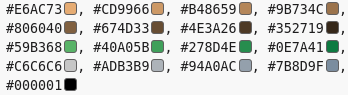
Nachdem wir nun die entschlüsselte Palette in unseren Händen haben, können wir die Funktion ihrer Verwendung ersetzen und gleichzeitig Entschlüsselungen für die Farben in die konstante Tabelle schreiben Markieren Sie die Funktion zum Erstellen von Texturen:
Vollständiger Code nach dem Refactoring:
#include <X11/Xlib.h>
#include <sys/types.h>
#include <sys/stat.h>
#include <fcntl.h>
#include <unistd.h>

/*    */

/*! \brief     */
#define IMAGE_WIDTH (1220)
/*! \brief     */
#define IMAGE_HEIGHT (616)
/*! \brief        */
#define IMAGE_SHIFTX (580)

/*! \brief   */
#define TEXTURE_COUNT (8)
/*! \brief     */
#define TEXTURE_WIDTH (64)
/*! \brief     */
#define TEXTURE_HEIGHT (40)
/*! \brief      */
#define TEXTURE_TOP_WIDTH (64)
/*! \brief      */
#define TEXTURE_TOP_HEIGHT (32)

/*! \brief    */
#define MAP_WIDTH (19)
/*! \brief    */
#define MAP_HEIGHT (19)
/*! \brief    -.      '\n' */
#define MAP_FILEDATA ((MAP_WIDTH + 1) * MAP_HEIGHT)
/*! \brief      NOR- */
#define MAP_ITERATIONS (20)

/*! \brief    - */
enum map_characters {
    MAPCHAR_WIRE  = '.', /**<             (ASCII = 46) */
    MAPCHAR_PLUS  = '+', /**<  ( ) (ASCII = 43) */
    MAPCHAR_MINUS = '-', /**<  ( ) (ASCII = 45) */
    MAPCHAR_NOR   = '>', /**< NOR-       (ASCII = 62) */
    MAPCHAR_EMPTY = ' ', /**<         (ASCII = 32) */
};

/*! \brief    */
enum textures_indexes {
    TEXINDEX_EMPTY = (0), /**<                    */
    TEXINDEX_MINUS = (1), /**<   " " */
    TEXINDEX_WIRE  = (2), /**<       */
    TEXINDEX_PLUS  = (3), /**<   ""   */
    /**/
    TEXINDEX_NOR   = (6), /**<   NOR-           */
    TEXINDEX_HOLE  = (7)  /**<          */
};

/*! \brief     */
enum textures_instructions {
    TEXVEC_LINESE = (0), /**<  SE                          */
    TEXVEC_LINESW = (1), /**<  SW                          */
    TEXVEC_LINEDW = (2), /**<                          */
    TEXVEC_FILL   = (3), /**<                            */
    TEXVEC_EXIT   = (4), /**<              */
    TEXVEC_REPEAT = (5), /**<     */
    TEXVEC_COLOR  = (6)  /**<                         */
};

/*! \brief   */
enum program_arguments {
    ARG_PROGRAM,  /**<    */
    ARG_BLUEPRINT /**<  -   */
};

/*! \brief    .
 *   int      */
int pixdata[IMAGE_HEIGHT][IMAGE_WIDTH];
/*! \brief  ,    */
int textures[TEXTURE_COUNT][TEXTURE_HEIGHT][TEXTURE_WIDTH] = { 0 };
/*! \brief   .
 *        '\n' */
char mapdata[MAP_HEIGHT][MAP_WIDTH + 1];
/*! \brief     */
int random = 2166136261;

/*! \brief   Xlib */
Display * display;
/*! \brief    Xlib */
Window window;
/*! \brief      */
XImage * image;

/*! \brief
 * \note    {001}    ""  {000} */
static const int texturepalette[] = {
                         /*     ▁▁▂▂▃▃▄▄▅▅▆▆▇▇██    */
    /* - */ 0xe6ac73, 0xcd9966, 0xb48659, 0x9b734c,
    /* -  */ 0x806040, 0x674d33, 0x4e3a26, 0x352719,
    /*            */ 0x59b368, 0x40a05b, 0x278d4e, 0x0e7a41,
    /*              */ 0xc6c6c6, 0xadb3b9, 0x94a0ac, 0x7b8d9f,
    /*             */ 0x000001
};

/*! \brief      */
static const char * vecdata[TEXTURE_COUNT] = {
    /* TEXINDEX_EMPTY */
    (char[]) { TEXVEC_EXIT },
    /* TEXINDEX_MINUS */
    (char[]) { TEXVEC_COLOR,   5,            TEXVEC_LINESE, 32,  5, 16,
               TEXVEC_LINESE,  0, 21, 16,    TEXVEC_LINESW, 63, 21, 16,
               TEXVEC_LINEDW,  0, 21,  4,    TEXVEC_LINEDW, 31, 36,  4,
               TEXVEC_LINESW, 31,  5, 16,    TEXVEC_LINESE,  0, 24, 16,
               TEXVEC_LINESW, 63, 24, 16,    TEXVEC_LINEDW, 63, 21,  4,
               TEXVEC_LINEDW, 32, 36,  4,    TEXVEC_COLOR,   4,
               TEXVEC_FILL,   31, 8,         TEXVEC_COLOR,   6,
               TEXVEC_FILL,   33, 38,        TEXVEC_COLOR,   7,
               TEXVEC_FILL,   30, 38,        TEXVEC_EXIT },
    /* TEXINDEX_WIRE */
    (char[]) { TEXVEC_REPEAT,  1 },
    /* TEXINDEX_PLUS */
    (char[]) { TEXVEC_COLOR,   1,            TEXVEC_LINESE, 32,  5, 16,
               TEXVEC_LINESE,  0, 21, 16,    TEXVEC_LINESW, 63, 21, 16,
               TEXVEC_LINEDW, 63, 21,  4,    TEXVEC_LINEDW, 31, 36,  4,
               TEXVEC_LINESW, 31,  5, 16,    TEXVEC_LINESE,  0, 24, 16,
               TEXVEC_LINESW, 63, 24, 16,    TEXVEC_LINEDW, 63, 21,  4,
               TEXVEC_LINEDW, 32, 36,  4,    TEXVEC_COLOR,   0,
               TEXVEC_FILL,   31,  8,        TEXVEC_COLOR,   2,
               TEXVEC_FILL,   33, 38,        TEXVEC_COLOR,   3,
               TEXVEC_FILL,   30, 38,        TEXVEC_EXIT },
    /*   */
    (char[]) { TEXVEC_EXIT },
    /*   */
    (char[]) { TEXVEC_EXIT },
    /* TEXINDEX_NOR */
    (char[]) { TEXVEC_COLOR,   9,            TEXVEC_LINESE, 32,  2, 16,
               TEXVEC_LINESE,  0, 18, 16,    TEXVEC_LINESW, 63, 18, 16,
               TEXVEC_LINEDW,  0, 18,  4,    TEXVEC_LINEDW, 31, 33,  4,
               TEXVEC_LINESW, 31,  2, 16,    TEXVEC_LINESE,  0, 21, 16,
               TEXVEC_LINESW, 63, 21, 16,    TEXVEC_LINEDW, 63, 18,  4,
               TEXVEC_LINEDW, 32, 33,  4,    TEXVEC_COLOR,   8,
               TEXVEC_FILL,   31,  5,        TEXVEC_COLOR,  10,
               TEXVEC_FILL,   33, 35,        TEXVEC_COLOR,  11,
               TEXVEC_FILL,   30, 35,        TEXVEC_EXIT },
    /* TEXINDEX_HOLE */
    (char[]) { TEXVEC_COLOR,  13,            TEXVEC_LINESE, 32, 9, 12,
               TEXVEC_LINESE,  8, 21, 12,    TEXVEC_LINESW, 31, 9, 12,
               TEXVEC_LINESW, 55, 21, 12,    TEXVEC_LINESE, 32, 12, 9,
               TEXVEC_LINESE, 14, 21,  9,    TEXVEC_LINESW, 31, 12, 9,
               TEXVEC_LINESW, 49, 21,  9,    TEXVEC_COLOR,  14,
               TEXVEC_LINEDW, 31, 13,  4,    TEXVEC_LINESW, 31, 16, 7,
               TEXVEC_FILL,   30, 14,        TEXVEC_COLOR,  12,
               TEXVEC_FILL,   32, 11,        TEXVEC_COLOR,  15,
               TEXVEC_LINEDW, 32, 13,  4,    TEXVEC_LINESE, 32, 16, 7,
               TEXVEC_FILL,   33, 14,        TEXVEC_COLOR,  16,
               TEXVEC_FILL,   31, 19,        TEXVEC_EXIT }
};

static void _texture_draw(int t, int x, int y);

/*! \brief      */
static void _image_create(void) {
    display = XOpenDisplay(0);
    window = XCreateSimpleWindow(display,
                                 RootWindow(display, DefaultScreen(display)),
                                 0, 0, IMAGE_WIDTH, IMAGE_HEIGHT, 1, 0, 0);
    image = XCreateImage(display,
                     DefaultVisual(display, DefaultScreen(display)),
                     DefaultDepth(display, DefaultScreen(display)),
                     2, 0, (char *) pixdata, IMAGE_WIDTH, IMAGE_HEIGHT, 32, 0);
}

/* \brief  ,     */
static void _image_reset(void) {
    for (int y = 0; y < IMAGE_HEIGHT; y++)
        for (int x = 0; x < IMAGE_WIDTH; x++)
            pixdata[y][x] = 0;
}

/*! \brief
 * \param[in] elem
 * \return   */
static int _map2texture(char elem) {
    return ((elem >> 4) & 1) << 2 | (elem & 3);
}

/*! \brief        */
static void _image_compile(void) {
    for (int y = 0; y < MAP_HEIGHT; y++)
        for (int x = 0; x < MAP_WIDTH; x++)
            _texture_draw(_map2texture(mapdata[y][x]), x, y);
}

/*! \brief     */
static void _image_draw(void) {
    XPutImage(display, window,
              DefaultGC(display, DefaultScreen(display)),
              image, 0, 0, 0, 0, IMAGE_WIDTH, IMAGE_HEIGHT);
    XMapWindow(display, window);
    XFlush(display);
}

/*! \brief      */
static void _image_drill(void) {
    for (int y = 0; y < MAP_HEIGHT; y++)
            for (int x = 0; x < MAP_WIDTH; x++)
                if ((x % 14 == 2) && (y % 4 == 3))
                    _texture_draw(TEXINDEX_HOLE, x, y);
}

/*! \brief   LCD-
 * \param[in] x X-
 * \param[in] y Y-  */
static void _shader_lcd(int x, int y) {
    pixdata[y][x] &= 0xe0e0e0 | (31 << ((x % 3) << 3));
}

/*! \brief
 * \param[in] x X-
 * \param[in] y Y-  */
static void _shader_noise(int x, int y) {
    pixdata[y][x] += 0x0f0f0f & (random *= 16777619);
}

/*! \brief      */
static void _image_postprocess(void) {
    for (int y = 0; y < IMAGE_HEIGHT; y++)
        for (int x = 0; x < IMAGE_WIDTH; x++) {
            _shader_lcd(x, y);
            _shader_noise(x, y);
        }
}

/*! \brief
 * \param[in] t
 * \param[in] x X
 * \param[in] y Y   */
static void _texture_draw(int t, int x, int y) {
    for (int ty = 0; ty < TEXTURE_HEIGHT; ty++)
        for (int tx = 0; tx < TEXTURE_WIDTH; tx++)
            if (textures[t][ty][tx])
                pixdata[ty +
                        y * (TEXTURE_TOP_HEIGHT / 2) +
                        x * (TEXTURE_TOP_HEIGHT / 2)]
                       [tx +
                        IMAGE_SHIFTX +
                        x * (TEXTURE_TOP_WIDTH / 2) -
                        y * TEXTURE_TOP_HEIGHT] = textures[t][ty][tx];
}

/*! \brief
 * \param[in] t
 * \param[in] x X-
 * \param[in] y Y-
 * \param[in] source
 * \param[in] target   */
static void _texture_fill(int t, int x, int y, int source, int target) {
    if ((x >= TEXTURE_WIDTH || y >= TEXTURE_HEIGHT ||
         x < 0 || y < 0) ||
         (textures[t][y][x] == target) ||
         (textures[t][y][x] != source))
        return;
    textures[t][y][x] = target;
    _texture_fill(t, x - 1, y, source, target);
    _texture_fill(t, x + 1, y, source, target);
    _texture_fill(t, x, y - 1, source, target);
    _texture_fill(t, x, y + 1, source, target);
}

/*! \brief      SE
 * \param[in] t
 * \param[in] x X-
 * \param[in] y Y-
 * \param[in] c
 * \param[in] color   */
static void _texture_linese(int t, int x, int y, int c, int color) {
    while (c--) {
        textures[t][y][x++] = color;
        textures[t][y++][x++] = color;
    }
}

/*! \brief      SW
 * \param[in] t
 * \param[in] x X-
 * \param[in] y Y-
 * \param[in] c
 * \param[in] color   */
static void _texture_linesw(int t, int x, int y, int c, int color) {
    while (c--) {
        textures[t][y][x--] = color;
        textures[t][y++][x--] = color;
    }
}

/*! \brief
 * \param[in] t
 * \param[in] x X-
 * \param[in] y Y-
 * \param[in] c
 * \param[in] color   */
static void _texture_linedown(int t, int x, int y, int c, int color) {
    while (c--)
        textures[t][y++][x] = color;
}

/*! \brief   ,    */
static void _textures_create(void) {
    for (int tex = 0; tex < TEXTURE_COUNT; tex++) {
        const char * ptr = vecdata[tex];
        int c = 0;
        while (*ptr != TEXVEC_EXIT) {
            switch (*ptr) {
            case TEXVEC_LINESE:
                _texture_linese(tex, ptr[1], ptr[2], ptr[3], c);
                ptr += 4;
                break;

            case TEXVEC_LINESW:
                _texture_linesw(tex, ptr[1], ptr[2], ptr[3], c);
                ptr += 4;
                break;

            case TEXVEC_LINEDW:
                _texture_linedown(tex, ptr[1], ptr[2], ptr[3], c);
                ptr += 4;
                break;

            case TEXVEC_FILL:
                _texture_fill(tex, ptr[1], ptr[2], 0, c);
                ptr += 3;
                break;

            case TEXVEC_REPEAT:
                ptr = vecdata[ptr[1]];
                break;

            case TEXVEC_COLOR:
                c = texturepalette[ptr[1]];
                ptr += 2;
                break;
            }
        }
    }
}

/*! \brief   -
 * \param[in] filename  - */
static void _map_read(const char * filename) {
    int f = open(filename, 0);
    read(f, mapdata, MAP_FILEDATA);
    close(f);
}

/*! \brief     -
 *          */
static void _map_wire_inputs(void) {
    for (int y = 0; y < MAP_HEIGHT; y++)
        for (int x = 0; x < MAP_WIDTH; x++)
            if ((x % 14 == 2) && (y % 4 == 3))
                mapdata[y][x] = MAPCHAR_WIRE;
}

/*! \brief
 * \param[in] t ,
 * \param[in] x X-
 * \param[in] y Y-
 * \param[in] c
 * \param[in] l   */
static void _map_fill(int t, int x, int y, int c, int l) {
    if ((x >= MAP_WIDTH || y >= MAP_HEIGHT ||
         x < 0 || y < 0) || (mapdata[y][x] == l)
        || (mapdata[y][x] != c))
        return;
    mapdata[y][x] = l;
    _map_fill(t, x - 1, y, c, l);
    _map_fill(t, x + 1, y, c, l);
    _map_fill(t, x, y - 1, c, l);
    _map_fill(t, x, y + 1, c, l);
}

/*! \brief
 * .
 * \param[in] counter  */
static void _map_wire_counter(int counter) {
    _map_fill(0, 2, 3,  mapdata[3][2],  counter & 1 ? MAPCHAR_PLUS : MAPCHAR_MINUS);
    _map_fill(0, 2, 7,  mapdata[7][2],  counter & 2 ? MAPCHAR_PLUS : MAPCHAR_MINUS);
    _map_fill(0, 2, 11, mapdata[11][2], counter & 4 ? MAPCHAR_PLUS : MAPCHAR_MINUS);
    _map_fill(0, 2, 15, mapdata[15][2], counter & 8 ? MAPCHAR_PLUS : MAPCHAR_MINUS);
}

/*! \brief    ()   NOR- */
static void _map_process_gates(void) {
    for (int i = 0; i < MAP_ITERATIONS; i++)
        for (int y = 0; y < MAP_HEIGHT; y++)
            for (int x = 0; x < MAP_WIDTH; x++)
                if (mapdata[y][x] == MAPCHAR_NOR)
                    _map_fill(0, x + 1, y, mapdata[y][x + 1],
                        !(mapdata[y - 1][x] == MAPCHAR_PLUS ? 1 : 0
                       || mapdata[y + 1][x] == MAPCHAR_PLUS ? 1 : 0) ?
                            MAPCHAR_PLUS : MAPCHAR_MINUS);
}

int main(int argc, char * args[]) {
    _image_create();
    _textures_create();

    unsigned int counter = 1;
    while (counter++) {
        _map_read(args[ARG_BLUEPRINT]);
        _map_wire_inputs();
        _map_wire_counter(counter);
        _map_process_gates();

        _image_reset();
        _image_compile();
        _image_drill();
        _image_postprocess();
        _image_draw();

        sleep(1);
    }
    return 0;
}
Epilog
Das ist alles.Trotz der Tatsache, dass ich keine Preise gewonnen habe, war es eine ziemlich merkwürdige Erfahrung (die Festplatte, die zwei Tage vor Beginn der Annahme der Arbeit starb, trug dazu bei). Es war etwas falsch daran, Code zu schreiben, der so unlesbar wie möglich und gleichzeitig aus sprachlicher Sicht absolut gültig war. Es kann jedoch nicht gesagt werden, dass es nicht interessant war. Wenn ein Dienstprogramm, das Token zählt, angibt, dass der Code gegen die Regeln verstößt, indem er das Limit um mehr als 2000 Token überschreitet, und Sie nicht wissen, wie Sie es verkürzen sollen, ist dies eine Herausforderung. Wenn die Dateigröße die Grenzwerte überschreitet und Sie einen Grafikeffekt hinzufügen möchten, ist dies eine Herausforderung. Es war schwierig, so viele Funktionen unterzubringen, und je süßer es war, die Ausgabe des Dienstprogramms zu lesen, das nach mehreren hundert Korrekturen schließlich besagte, dass der Code entladen werden konnte. Ich würde den Lesern empfehlen, am Wettbewerb teilzunehmen, wenn auch nur zusich anzuschließen und deine Stärke zu testen.
Ja, es gibt keine Auszeichnungen oder Preise, aber Sie werden wissen, dass Sie sich auf der IOCCC-Website unter dem Spitznamen zhestokyshveller verstecken.